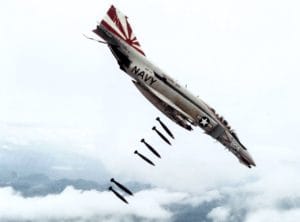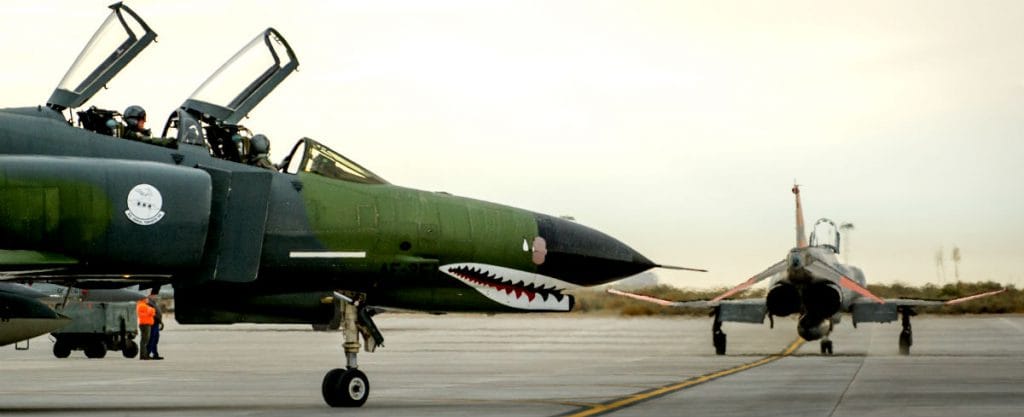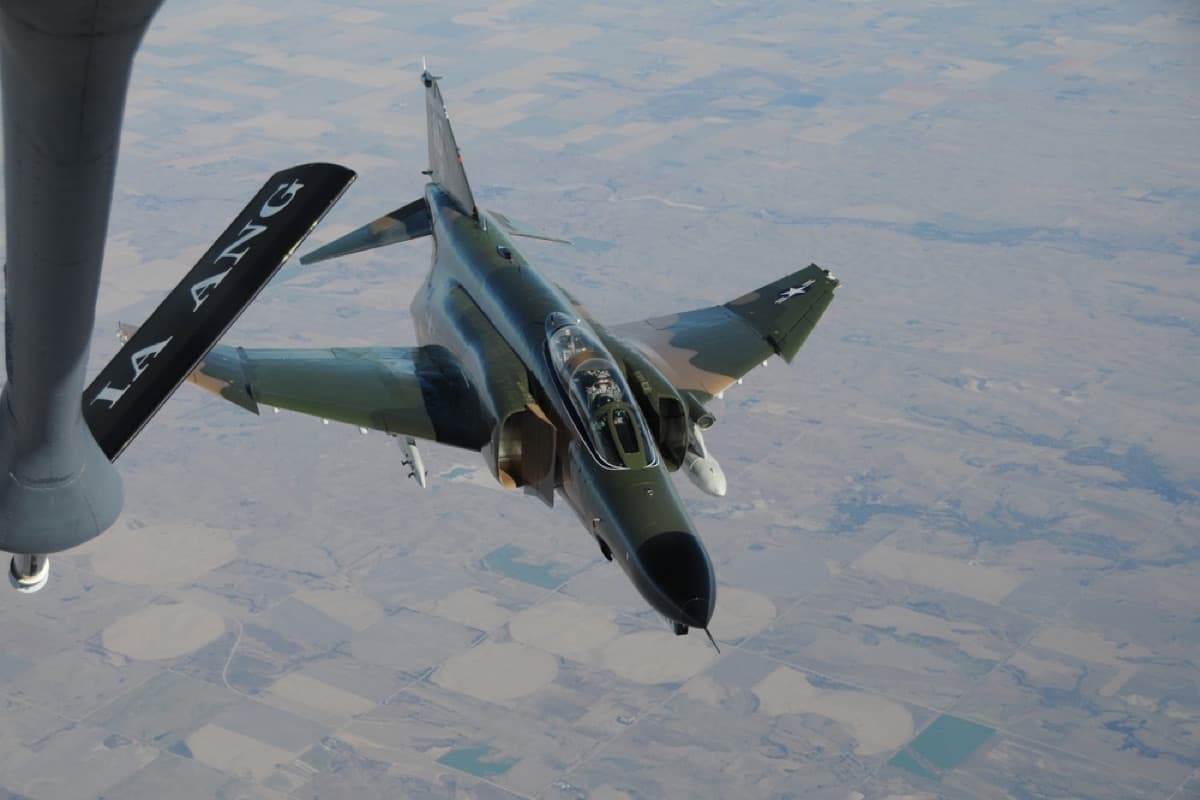

The F-4 Phantom II is a multirole attack fighter-bomber developed for use for the U.S. Navy and Marine Corps. It is the product of nearly a decade of development from initial phase testing, deployment, and radical redesign. In the 1950s, military planners wanted to depart from the days of dog-fighting and advance wholeheartedly into an age they believed would be dominated purely by air-to-air missile technology. With the Navy’s requirement for a new jet fighter to patrol the airways around the fleet, McDonnell Douglas produced the F-4H1 Phantom. Capable of holding up to six air-to-air missiles and flying at speeds above Mach 2, the Phantom promised to be a glimpse into the future of military aeronautics.
The F-4 Phantom was first proposed in 1953 when the United States Navy requested an aircraft that could patrol the skies in three hour increments in a radius of 250 nautical miles. Fulfilling those requests, McDonnell Douglas produced the F-4H1 for initial testing in 1956. It was released for its first initial assignment to an aircraft carrier as the F-4B Phantom in 1961.
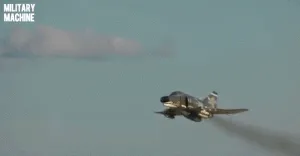
Flexible Design:
This two-seat, twin-engine aircraft was primarily designed for naval interdiction missions, fleet air defense (FAD), and limited bombing runs. Before it made a huge impact on the Navy’s fleet, it had to be refined several times to achieve the right wing dynamics for stable at speeds above Mach 2. In fact, the Phantom had to undergo so many changes to both its design and capabilities, that the Navy became reluctant to keep adopting additional forms of the aircraft. However, once in its final form in 1967, the F-4E proved to be a very versatile and reliable jet fighter and bomber.