Alex Carter writes about modern warfare, emerging military technology, and how doctrine adapts to new tools. His work focuses on what changes in practice -- command, control, targeting, and risk -- when systems like drones and autonomous platforms become routine.
A laser weapon costs about $1 per shot. A Patriot missile costs $3 million. They both kill the same drone. The math is changing everything about how militaries think about air defense.
For decades, directed-energy weapons occupied the same conceptual space as jetpacks and flying cars: perpetually five years away. The physics were sound. The engineering was not. Lasers powerful enough to destroy targets required building-sized chemical systems, consumed staggering amounts of power, and broke down constantly. The Pentagon spent billions on programs like the Airborne Laser Laboratory and the Tactical High Energy Laser, only to cancel them when they couldn't meet operational requirements.
Then, quietly, everything changed. Solid-state laser technology matured. Power generation systems shrank. Beam quality improved. And the threat environment shifted dramatically as cheap drones proliferated, making traditional missile-based air defense economically unsustainable. Between 2014 and 2025, directed-energy weapons went from experimental curiosities to operational systems deployed on warships and combat vehicles.
The Breakthrough: USS Ponce and the LaWS (2014)
The first combat-deployed laser weapon system was the AN/SEQ-3 Laser Weapon System (LaWS), installed aboard the amphibious transport dock USS Ponce in the Persian Gulf in August 2014. The 30-kilowatt solid-state laser was designed to engage small boats, drones, and improvised threats at relatively short ranges.
The LaWS wasn't particularly powerful by modern standards, but it proved something critical: a laser weapon could operate reliably in a harsh maritime environment, including salt air, vibration, humidity, and heat, and engage real-world targets. The Navy released video of the system disabling a ScanEagle drone, detonating a rocket-propelled grenade in flight, and burning out the engine of a rigid-hull inflatable boat.
U.S. Central Command authorized the Ponce's commanding officer to use the LaWS as a defensive weapon, making it the first laser weapon cleared for operational use in military history. The cost per shot: approximately $1. The cost of the Stinger missile it replaced for drone defense: $38,000.
HELIOS: The 60-Kilowatt Ship Killer
Building on the LaWS experience, the Navy moved to the High Energy Laser with Integrated Optical-dazzler and Surveillance (HELIOS) system, developed by Lockheed Martin. At 60 kilowatts, double the LaWS power, HELIOS represents a generational leap in naval directed-energy capability.
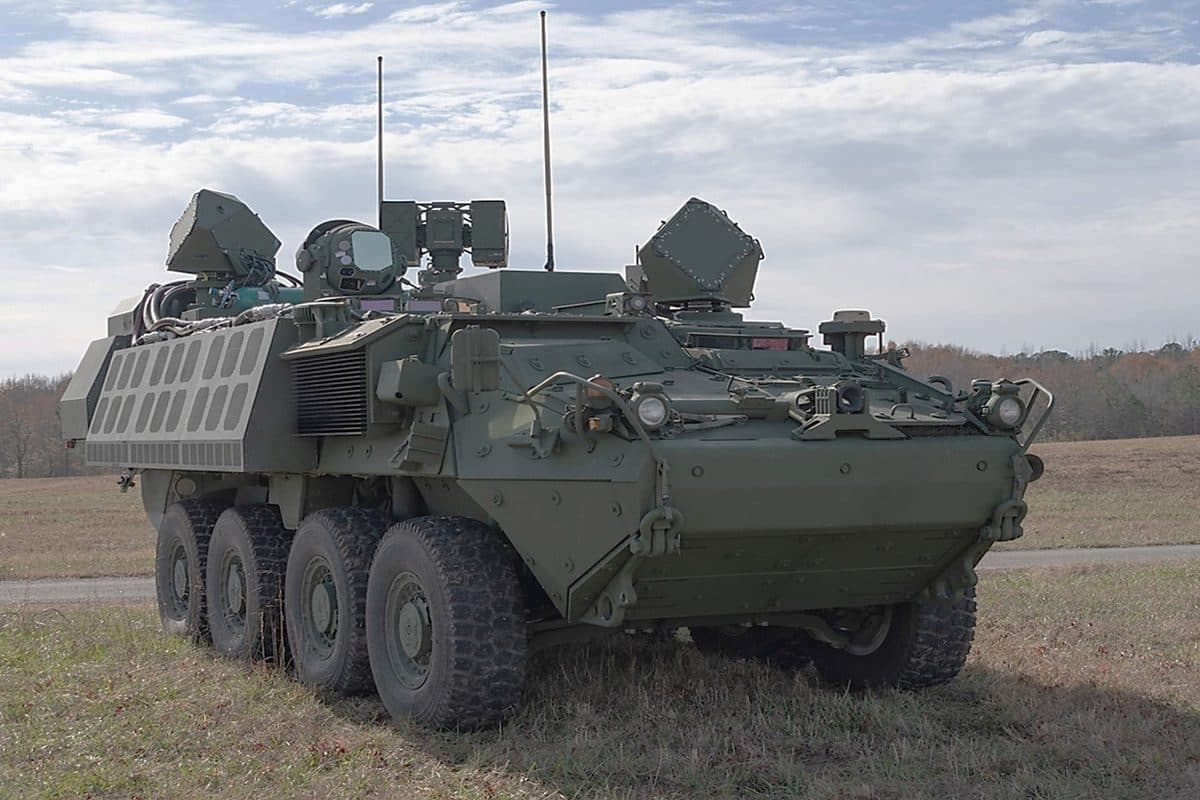
A close-up view of the Directed Energy Maneuver-Short Range Air Defense system, showing the laser turret assembly designed to track and destroy incoming aerial threats (U.S. Army photo)
HELIOS was installed aboard the Arleigh Burke-class destroyer USS Preble (DDG 88), making it the first destroyer equipped with a high-energy laser weapon. In testing during 2024, the Preble successfully destroyed four drones using the HELIOS system. When the Preble deployed to the Middle East amid Houthi drone and missile attacks, the laser system was available as part of the ship's layered defense.
HELIOS isn't just a weapon. It also provides ISR (intelligence, surveillance, and reconnaissance) capability through its optical system and can dazzle enemy sensors and optics. A single system replaces multiple capabilities that previously required separate equipment.
DE-SHORAD: Lasers on the Ground
While the Navy put lasers on ships, the Army pursued ground-based directed energy for a different problem: protecting maneuvering troops from drone swarms.
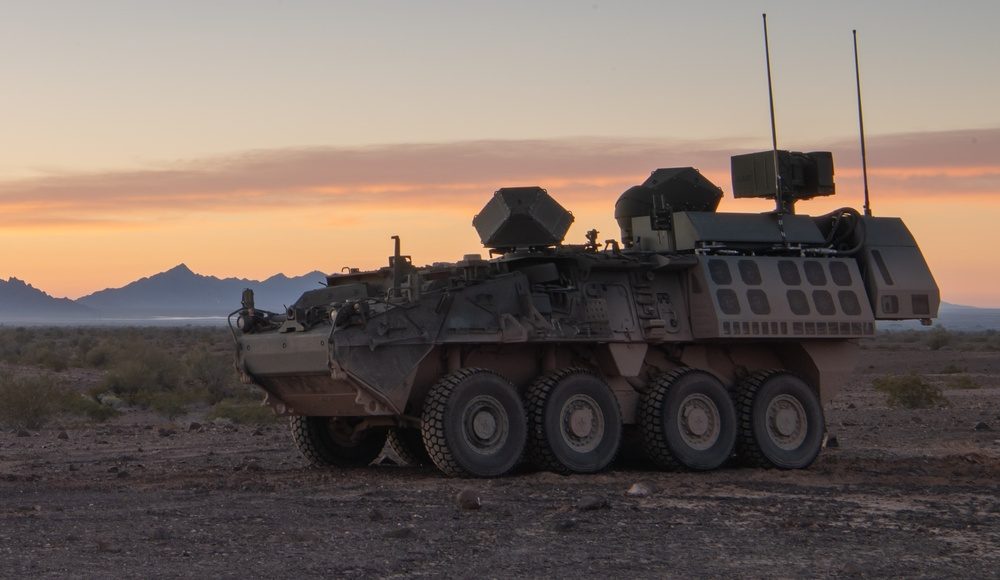
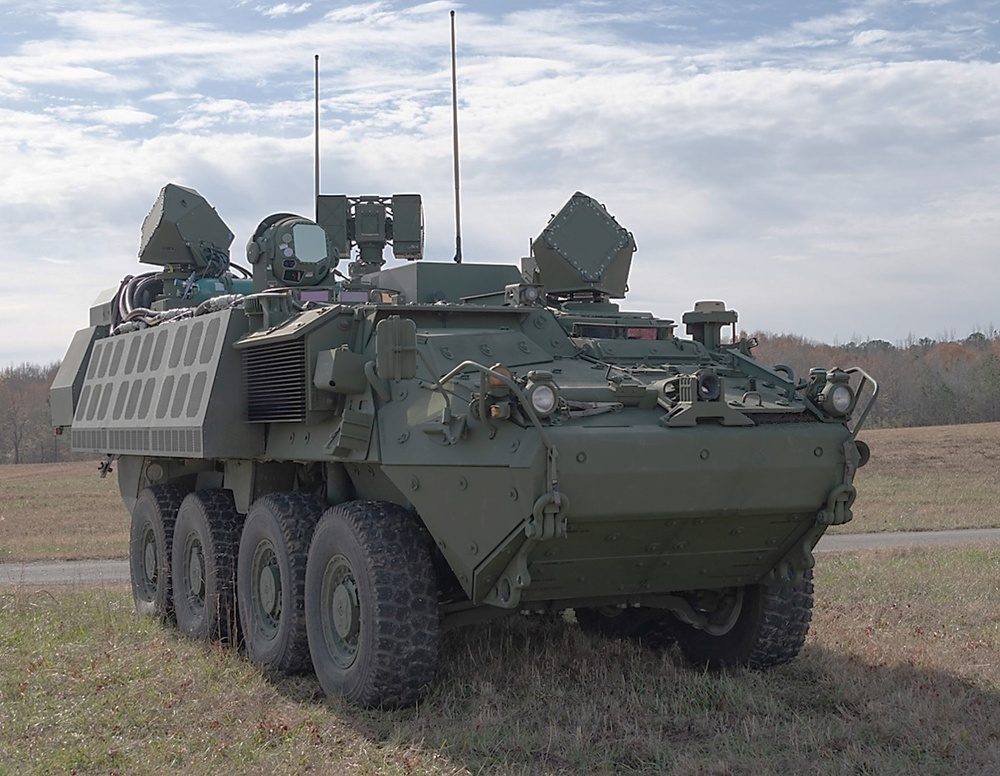
The Directed Energy Maneuver-Short Range Air Defense (DE M-SHORAD) system mounts a 50-kilowatt-class high-energy laser on a Stryker A1 armored vehicle. Built by Raytheon (now RTX), the system is designed to intercept drones, rockets, artillery, and mortars, the same threats that have dominated the battlefield in Ukraine.
The DE M-SHORAD prototype integrates a 50-kilowatt laser with the mobility of the Stryker A1 platform, providing brigade combat teams with a reloadable, low-cost counter-drone capability (U.S. Army photo)
The Army activated the first DE M-SHORAD unit, the 6th Battalion, 56th Air Defense Artillery Regiment, in 2024. The unit is equipped with four prototype Stryker-mounted laser systems, making it the first ground combat unit in history to field directed-energy weapons as its primary armament.
The DE M-SHORAD addresses a problem that Ukraine has made impossible to ignore. Small commercial drones modified to carry grenades or conduct reconnaissance cost a few hundred dollars. Shooting them down with a Stinger missile ($38,000) or a Patriot interceptor ($3 million) is like using a gold bar to swat a fly. A laser that costs a dollar per shot and has an effectively unlimited magazine fundamentally changes the equation.
Iron Beam: Israel's Laser Shield
Israel's Iron Beam system may be the most strategically significant directed-energy program in the world. Developed by Rafael Advanced Defense Systems, Iron Beam is designed to complement the Iron Dome system, using a laser to intercept short-range rockets, mortars, and drones that Iron Dome currently handles with $50,000 Tamir interceptor missiles.
Iron Beam underwent its first successful tests against rockets, mortars, and drones in 2022. Israel has accelerated deployment following the October 2023 Hamas attack, which saw thousands of rockets launched at Israeli territory in a single day. The Iron Dome performed well but consumed interceptors at an unsustainable rate. Iron Beam promises to handle the lower-tier threats, freeing Tamir missiles for the more dangerous targets that lasers can't yet engage.
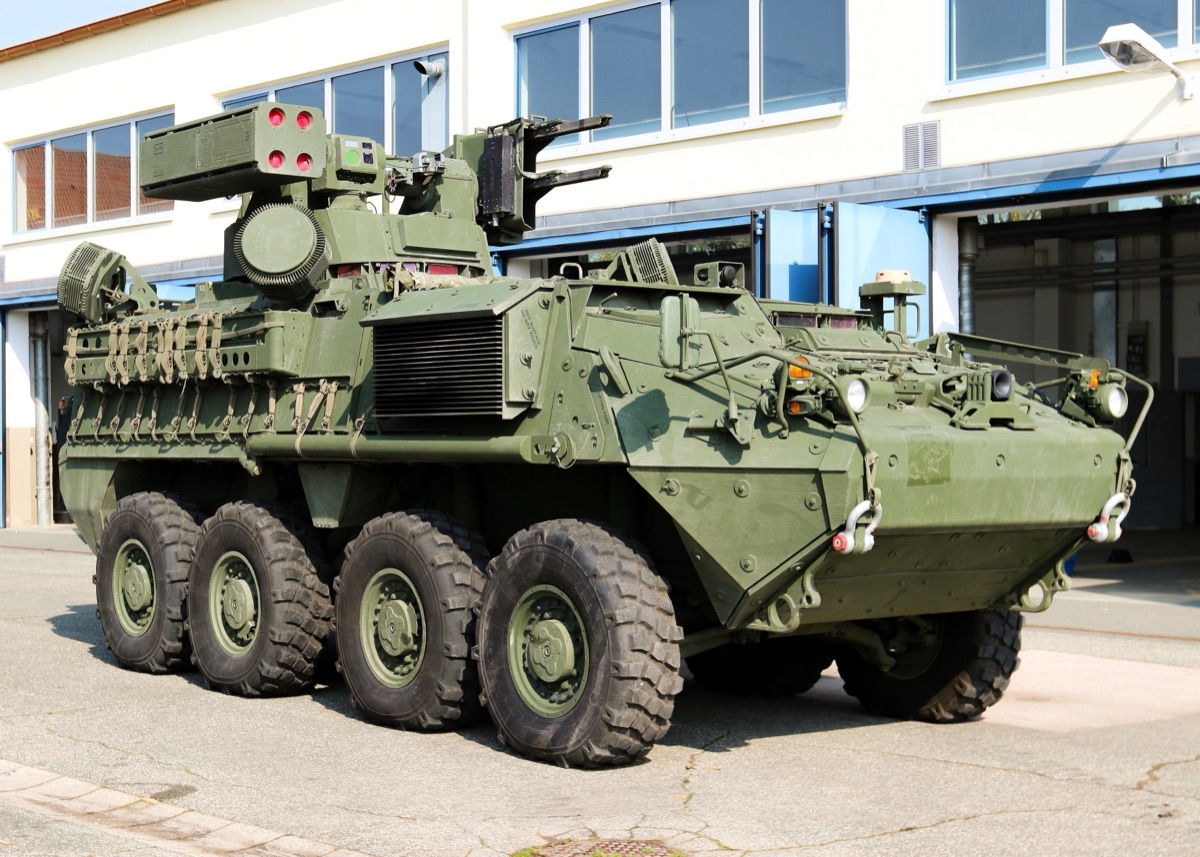
A kinetic-energy M-SHORAD Stryker variant, armed with Stinger missiles and a 30mm cannon, represents the conventional air defense systems that directed-energy weapons will increasingly complement (U.S. Army photo)
The combination of Iron Dome (missiles for larger threats), Iron Beam (laser for smaller threats), David's Sling (medium-range), and Arrow (ballistic missile defense) creates the most comprehensive layered air defense system in the world. Iron Beam fills the gap that made Iron Dome vulnerable: cost-per-intercept.
The Physics That Finally Cooperated
Why did directed-energy weapons suddenly become practical after decades of failure? Three technological breakthroughs converged.
First, solid-state lasers replaced chemical lasers. The earlier generation of military lasers used toxic chemical reactions (deuterium fluoride, chemical oxygen-iodine) to generate their beams. These systems were huge, dangerous, and required specialized fuel that had to be resupplied. Modern solid-state lasers use electricity, making them compatible with existing vehicle and ship power systems.
Second, beam quality improved dramatically. Early high-energy lasers produced beams that spread too quickly, losing destructive power at range. Advances in adaptive optics, technology originally developed for astronomical telescopes, allowed military lasers to maintain tight, focused beams over meaningful distances.
Third, power generation became more compact. Modern warships and combat vehicles generate enough electrical power to feed a 50-100 kilowatt laser while still operating their other systems. The Navy's DDG(X) next-generation destroyer is being designed with integrated power systems specifically sized to support directed-energy weapons above 150 kilowatts.
The Limits: What Lasers Can't Do (Yet)
Directed-energy weapons are not silver bullets. Several physical limitations constrain their utility.
Weather degrades performance. Rain, fog, dust, and smoke scatter the laser beam, reducing its effective range and destructive power. In the Persian Gulf's humid atmosphere, the LaWS had to fire at shorter ranges than in clear desert air. A system optimized for the Arabian Sea may struggle in the North Atlantic.
Fast targets remain a problem. Current laser systems need to hold their beam on a target for several seconds to heat the surface enough to cause structural failure. Against a slow-moving drone, that's straightforward. Against a hypersonic missile traveling at Mach 5+, the dwell time is insufficient. Increasing laser power to the 300-500 kilowatt range could solve this, but those systems are still in development.
Power requirements scale exponentially. A 50-kilowatt laser is manageable on a Stryker. A 300-kilowatt laser requires a dedicated power generation system. A megawatt-class laser, the theoretical threshold for shooting down cruise missiles at meaningful range, would require more power than most combat vehicles can currently produce.
The Real Revolution: Unlimited Magazine
The most important advantage of directed-energy weapons isn't the cost per shot, though that matters enormously. It's the magazine depth. A guided-missile destroyer carries a finite number of interceptor missiles, typically 90 to 96 in its vertical launch system. Once those are expended, the ship must return to port to reload, a process that can take days.
A laser weapon, by contrast, fires as long as it has electrical power. A nuclear-powered warship effectively has an unlimited magazine. Even a conventionally powered destroyer can fire thousands of shots before its fuel runs low. In a conflict where the enemy employs drone swarms or saturation attacks, launching hundreds of cheap threats to exhaust expensive interceptors, a laser weapon changes the calculus entirely.
The future of air defense isn't lasers or missiles. It's lasers and missiles, integrated into layered systems where the cheapest effective weapon is used first. Lasers handle the drones and small rockets. Missiles handle the cruise missiles and manned aircraft. The laser frees the missile magazine for the threats that only a missile can stop.
What was science fiction in 2015 is now operational doctrine. The directed-energy revolution didn't arrive with a dramatic demonstration. It crept in quietly, one deployed system at a time, until the math of modern air defense made lasers not just desirable, but necessary.