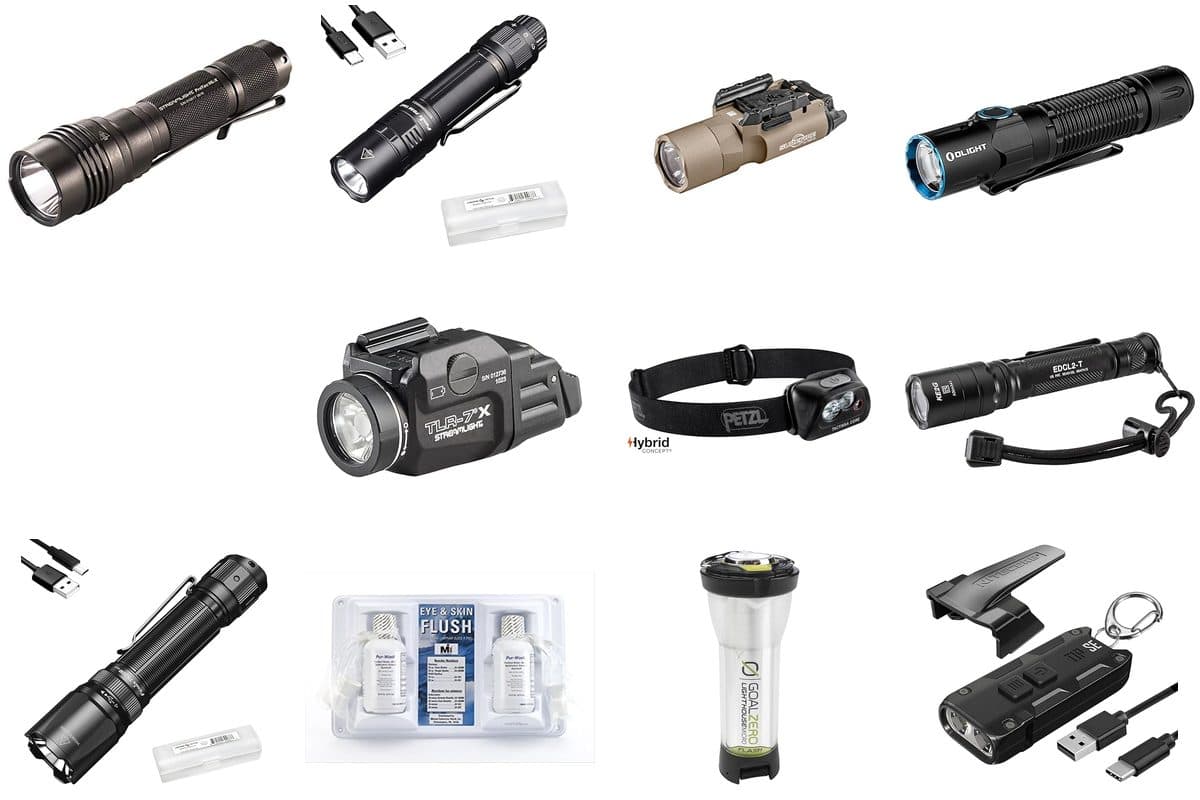

Tactical flashlights have come a long way from the heavy, dim Maglites that soldiers and law enforcement officers carried in the 1990s. Modern LED technology packs thousands of lumens into housings that weigh a few ounces and survive drops onto concrete. The challenge is no longer finding a bright flashlight. It is sorting through hundreds of options that all claim to be "tactical" and "military-grade" to find the ones that actually deliver on those promises.
We tested and researched 23 lights across seven categories, from $20 keychain backups to $300 weapon-mounted units built for professional use. Every pick below includes honest trade-offs, because the right flashlight depends on how you plan to use it. A 5,000-lumen searchlight is overkill for checking a circuit breaker, and a 150-lumen keychain light is not going to cut it for security work. This guide helps you match the light to the mission.
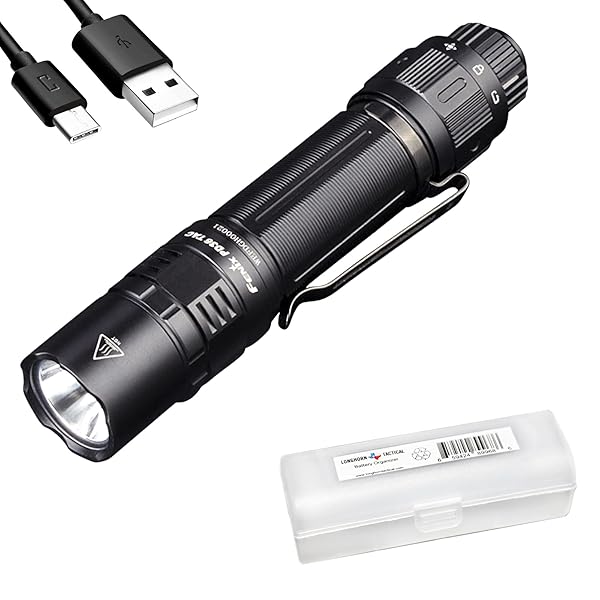
Fenix PD36 TAC
~$85


Goal Zero Lighthouse Micro Flash
$40 on Amazon
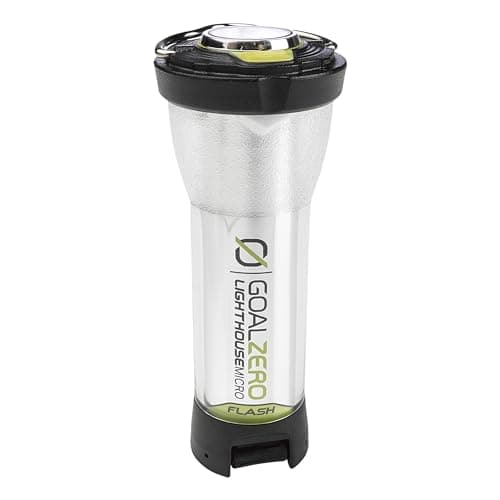
Goal Zero's Lighthouse Micro Flash is a dual-purpose device: a 150-lumen lantern that collapses to pocket size and an integrated flashlight mode that provides a directed beam. USB rechargeable with up to 170 hours of runtime on low, and a built-in carabiner clip for hanging in tents or from MOLLE webbing.
Budget EDC Flashlights ($20-$35)
You do not need to spend $100 to get a reliable flashlight for daily tasks. These budget picks deliver solid performance in compact packages that disappear into a pocket or clip onto a keyring. Both are rechargeable, which means you will not be burning through disposable batteries every few weeks.
1. Olight i1R 2 EOS
~$20 on Amazon
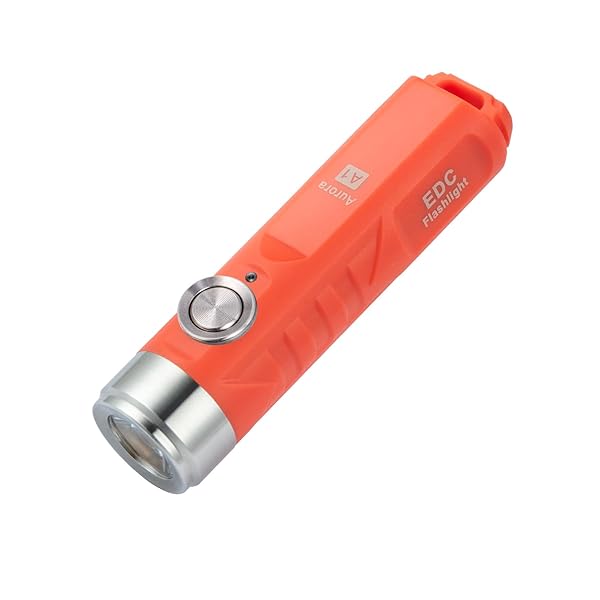
At just 2.1 inches long and half an ounce, the i1R 2 EOS practically vanishes on a keychain. Twist the head for 5 lumens on low or 150 lumens on high, with a USB-C magnetic charging cable that snaps onto the tail. For a backup light that is always with you, this is hard to beat at $20.
Best for: Keychain backup, checking menus in dark restaurants, finding keyholes, and anyone who wants a light they will never notice carrying
Olight designed the i1R 2 EOS to be the light you forget you are carrying until you need it. The twist-to-activate head is intuitive even in the dark, with a half-turn for low mode and a full turn for high. The magnetic USB charging cable means you never need to remove the battery or fiddle with a charging port, though that proprietary cable is also the light's biggest weakness. Lose the cable and you cannot charge it without ordering a replacement from Olight directly. Standard micro-USB or USB-C would have been a better choice. The 150-lumen high mode also drains the tiny battery in about 12 minutes at full output, so this is a backup light, not a primary. For those brief moments when you need to see something in the dark and your phone flashlight is not cutting it, the i1R 2 EOS earns its spot on your keys.
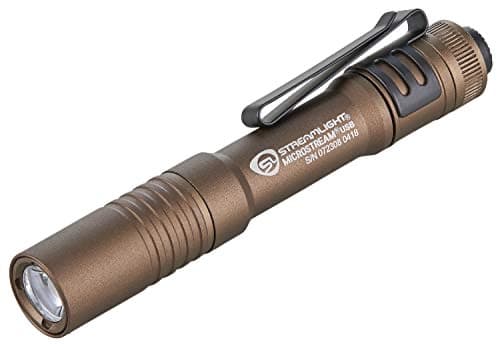
2. Streamlight MicroStream USB
~$35 on Amazon
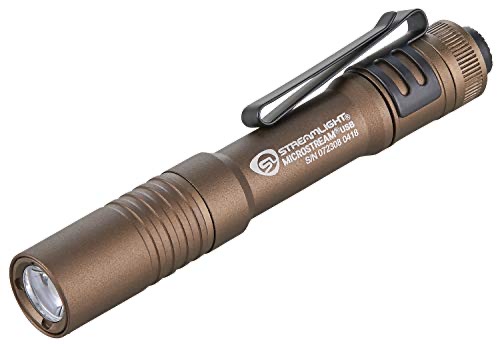
Streamlight's MicroStream USB packs 250 lumens into a pen-sized body that clips securely into a shirt or pants pocket. Built-in USB charging eliminates disposable batteries, and the aluminum body withstands the daily bumps and drops that come with pocket carry.
Best for: Daily pocket carry, mechanics, electricians, and anyone who wants a reliable light without spending more than $35
Streamlight has been supplying flashlights to law enforcement and fire departments for decades, and the MicroStream USB distills that professional-grade reliability into a $35 package. The tail-cap push button provides momentary-on with a half press and constant-on with a full click, which is the same interface used on much more expensive tactical lights. Output is a flat 250 lumens for about an hour before stepping down, with a low mode around 50 lumens that extends runtime significantly. The pocket clip is deep-carry and reversible, keeping the light low in your pocket with minimal visibility. Where the MicroStream falls short is beam distance. The small reflector produces a wide, floody beam that works well within 30 feet but struggles past that range. If you need to light up objects at 100+ feet, step up to the ProTac 2L-X or MacroStream below. For close-range daily tasks, though, the MicroStream USB has been the default recommendation in this price range for good reason.
Mid-Range Tactical Flashlights ($55-$90)
Mid-range lights represent the sweet spot for most users. These models offer genuine tactical features like programmable modes, dual-fuel capability, and enough output to handle security work and search tasks. Build quality takes a clear step up from budget lights, with better anodizing, deeper knurling, and switches rated for hundreds of thousands of cycles.
3. Streamlight MacroStream USB
~$57 on Amazon
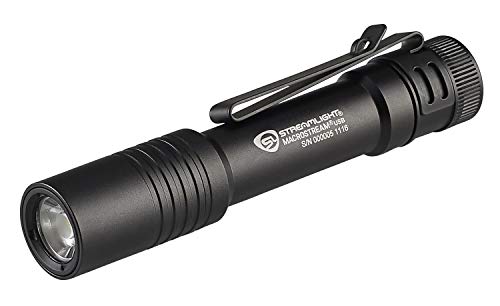
Think of the MacroStream as the MicroStream's bigger sibling. Same pocket-friendly form factor, but 500 lumens and a deeper reflector that pushes the beam past 200 meters. USB-C charging keeps things simple, and the body is only marginally larger than the MicroStream.
Best for: Security patrols, dog walks, vehicle inspections, and users who want more throw without carrying a full-size light
Streamlight positioned the MacroStream as the natural upgrade path from the MicroStream, and the execution delivers. Doubling the output to 500 lumens while keeping the body slim enough for pocket carry gives you a light that handles both daily tasks and situations where you actually need to push light out to distance. The deeper reflector creates a tighter hotspot than the MicroStream, trading some close-range flood for better throw. USB-C charging is a welcome upgrade over the MicroStream's micro-USB port. The main shortcoming is the lack of multiple output modes. You get high and low, but no medium setting, which leaves a gap between 50 lumens and 500 lumens. For a $57 light, a three-mode setup would be expected. The tail switch also sits slightly recessed, making momentary activation harder with gloves. If you can live with two modes and you want Streamlight reliability in a compact package, the MacroStream is a solid step up from the budget tier.
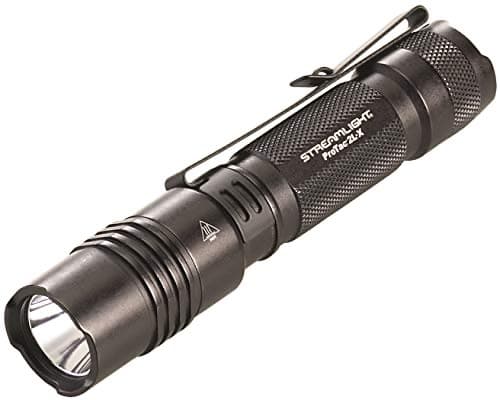
4. Streamlight ProTac 2L-X
~$60 on Amazon
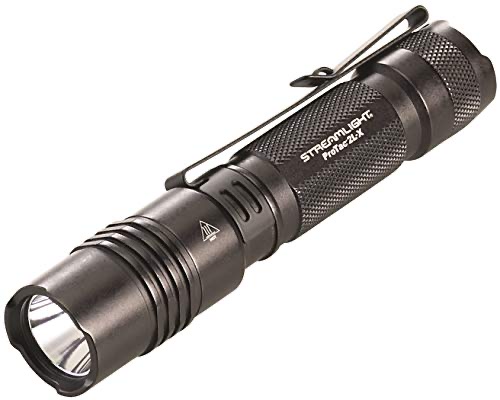
The ProTac 2L-X runs on either a rechargeable 18650 battery or two CR123A disposables, giving you a reliable backup power source when charging is not an option. Ten-Tap programmable switching lets you configure the light for high-only, low-high, or high-strobe-low sequences depending on your use case.
Best for: Field use where charging access is limited, emergency preparedness kits, and anyone who wants fuel flexibility
Dual-fuel capability is the ProTac 2L-X's defining feature, and it solves a real problem. Rechargeable 18650 cells are cost-effective for daily use, but if you are three days into a power outage or working in a remote location, the ability to swap in CR123A lithium primaries and keep working is worth its weight. Streamlight's Ten-Tap programming system lets you configure the mode sequence by tapping the switch ten times rapidly, then selecting your preferred pattern. It sounds finicky, but once set, you do not touch it again. Output peaks at 500 lumens with solid throw past 200 meters. The weakness here is build quality at this price point. The anodizing is thinner than what you get on premium Streamlight models, and some users report the pocket clip loosening over time. The included rechargeable battery also has lower capacity than a quality third-party 18650 cell. Replacing it with a Keeppower or Samsung 35E cell improves runtime noticeably. Despite those quibbles, the ProTac 2L-X remains the best dual-fuel option under $75.
5. Fenix PD36 TAC
~$85 on Amazon
Fenix packed 3,000 lumens and a dedicated tactical tail switch into the PD36 TAC, making it one of the brightest mid-range lights available. A separate side switch handles everyday modes while the tail switch provides instant access to turbo and strobe for tactical situations.
Best for: Law enforcement, security professionals, and enthusiasts who want high output without paying SureFire prices
Fenix's dual-switch design on the PD36 TAC solves a problem that plagues most tactical flashlights: the conflict between tactical simplicity and everyday usability. The tail switch provides instant-on at maximum output, which is exactly what you want in a high-stress situation. The side switch cycles through five modes (Eco, Low, Med, High, Turbo) for everyday tasks where you do not need 3,000 lumens blasting. This separation means you never accidentally activate strobe when you just want to check under a couch cushion. Output at 3,000 lumens generates serious heat, and the light steps down after about three minutes of sustained turbo output to protect the LED. That thermal throttling is the primary trade-off. You get 3,000 lumens in bursts, not sustained. Continuous use settles closer to 1,200 lumens, which is still plenty bright but worth understanding. The included 21700 battery provides excellent runtime at lower modes. For the price, no other tactical light matches this combination of output, features, and build quality.
6. SureFire G2X Pro
~$89 on Amazon
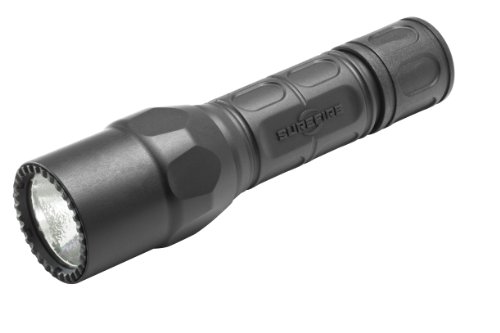
SureFire's most affordable light brings the brand's reliability to a lower price point. The G2X Pro uses a Nitrolon polymer body instead of aluminum to cut costs while maintaining a proper SureFire LED module and the tight beam profile the brand is known for. Two output levels, 600 lumens and 15 lumens, cover tactical and everyday needs.
Best for: SureFire fans on a budget, nightstand duty lights, and anyone who prioritizes beam quality over raw lumen count
SureFire commands premium prices because their lights work when it matters most, and the G2X Pro is the cheapest way into that ecosystem. The beam profile is noticeably tighter and cleaner than comparably priced competitors, throwing a well-defined hotspot with smooth spill that makes target identification easier at distance. SureFire's LED regulation delivers consistent output until the batteries are nearly depleted, rather than gradually dimming. The obvious trade-off is that the G2X Pro only runs on CR123A batteries, which cost between $1 and $3 per cell. No rechargeable option and no 18650 compatibility. Over a year of regular use, battery costs add up significantly compared to USB-rechargeable alternatives. The Nitrolon polymer body also lacks the knurling and heft that some users expect from a tactical light, though it does reduce weight and improve cold-weather grip. If you value beam quality and reliability over features, the G2X Pro delivers SureFire performance at a price point that does not require a budget committee.
Premium Tactical Flashlights ($98-$175)
Premium tactical flashlights justify their higher prices with better regulation, superior materials, longer warranties, and features like intelligent thermal management and programmable interfaces. These are the lights that professionals carry on duty and that enthusiasts collect, test, and debate endlessly on forums. Build quality at this tier is visibly and tactilely different from mid-range options.
7. Streamlight ProTac HL-X
~$98 on Amazon
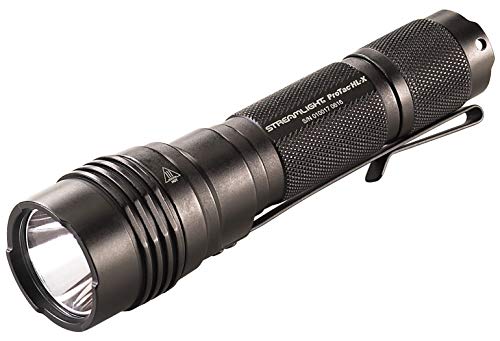
Selected by the FBI as their standard-issue flashlight, the ProTac HL-X delivers 1,000 lumens with a beam that reaches over 330 meters. Dual-fuel compatibility, Ten-Tap programming, and a durable aluminum body make this the benchmark by which other tactical lights are measured in its price class.
Best for: Law enforcement, security professionals, search and rescue, and anyone who needs a do-everything tactical light under $100
The FBI's selection of the ProTac HL-X as their standard-issue light carries weight, because federal procurement evaluates flashlights on reliability under stress, not marketing specs. What earned that contract is the combination of consistent 1,000-lumen output, a deeply textured reflector that throws a well-defined beam past 300 meters, and a dual-fuel design that accepts 18650 rechargeable cells or two CR123A lithium primaries. Streamlight's Ten-Tap programming lets you set the light to high-only mode for tactical use, eliminating the risk of cycling through low or strobe when you need full output immediately. The main limitation is size. At 5.43 inches, the ProTac HL-X is too long for comfortable pocket carry. This is a belt-holster or bag light, not an EDC pocket light. The included rechargeable battery is also mediocre, and swapping in a quality third-party 18650 improves both runtime and consistent output regulation. Those are minor complaints for a $98 light that has proven itself across thousands of hours of professional field use.
8. Olight Warrior 3S
~$113 on Amazon
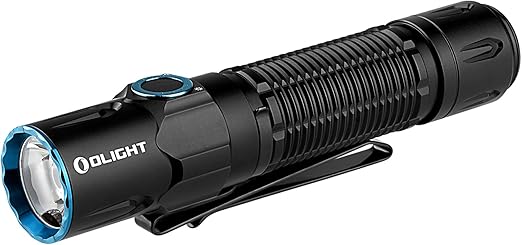
Olight's Warrior 3S pairs 2,300 lumens with a proximity sensor that automatically steps down output when the bezel is close to a surface, preventing accidental overheating or blinding reflections. Magnetic charging snaps into the tail cap, and the dual-switch design separates tactical and everyday modes.
Best for: Tech-forward users who want smart features, automotive work where proximity dimming helps, and outdoor recreation
Olight builds some of the most feature-rich tactical lights on the market, and the Warrior 3S showcases that engineering approach. The proximity sensor is practically useful, not a gimmick. Point the light at a wall from two feet away at turbo output without it, and you get blinding reflection and heat buildup. The sensor automatically reduces output when it detects a close surface, then ramps back up when you pull away. Magnetic tail-cap charging is quick and convenient, though the proprietary system means you are dependent on Olight's charging cables. That proprietary ecosystem is the Warrior 3S's most significant weakness. You cannot use a standard USB cable to charge it, and the magnetic puck can detach from a metal surface if bumped. The cool white tint on the LED also leans blue compared to the warmer, more natural tints used by Fenix and Streamlight, which some users find less pleasant for extended use. If you can live with the proprietary charging, the Warrior 3S offers more lumens per dollar than any other light in this price range.
9. Olight Warrior X 4
~$117 on Amazon
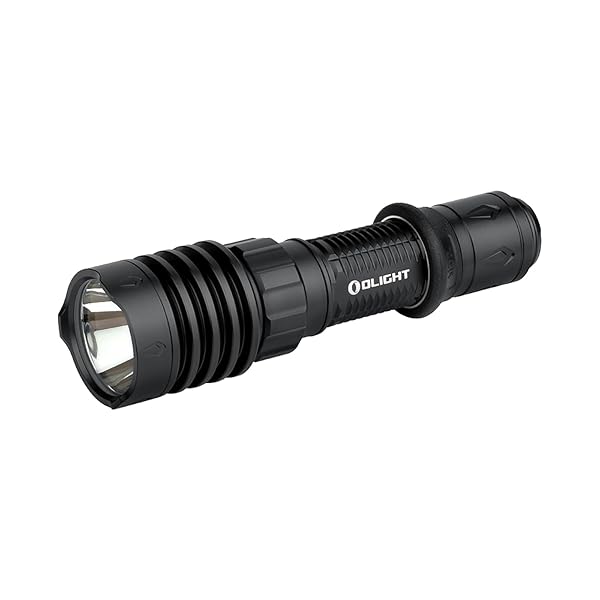
Built specifically for throw distance, the Warrior X 4 pushes its beam past 630 meters using a large, deep reflector. This is the light you reach for when you need to identify something at the far end of a parking lot, across a field, or down a long corridor. Simplified two-mode operation keeps things fast under pressure.
Best for: Search and rescue, perimeter security, rural property owners, and anyone who needs maximum beam distance
Where most tactical flashlights try to balance flood and throw, the Warrior X 4 commits entirely to distance. The large reflector creates a tight, pencil-like beam that reaches over 600 meters in real-world conditions, making it one of the most effective handheld throwers under $150. Olight simplified the interface to just two modes plus strobe, accessed through a tail switch, which eliminates mode-cycling confusion during high-stress situations. The trade-off for all that throw is the near-field experience. Close-range tasks within 10 feet are uncomfortable because the tight hotspot concentrates all the light into a small circle with minimal spill. Working under a vehicle hood or searching a room with this light is like trying to read a book with a laser pointer. The body is also noticeably larger and heavier than the Warrior 3S, making pocket carry impractical. If long-range identification is your primary need, the Warrior X 4 excels. For general-purpose use, choose the Warrior 3S instead.
10. Fenix PD36R Pro
~$120 on Amazon
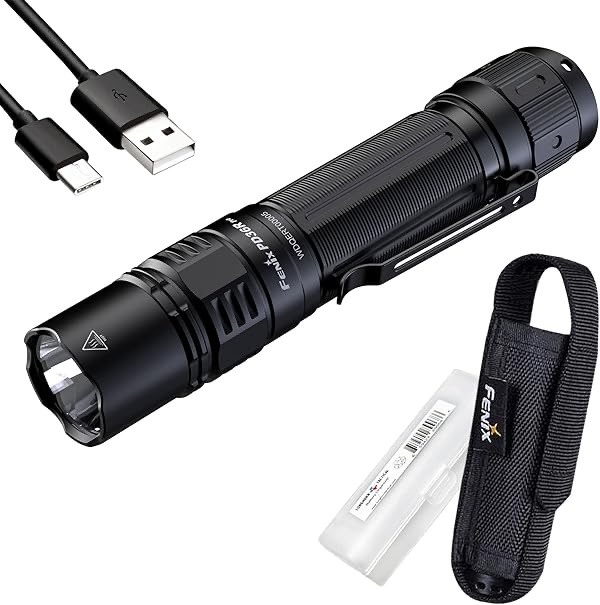
Fenix's PD36R Pro bumps the output ceiling to 2,800 lumens while adding USB-C fast charging that brings the 21700 battery from empty to full in under two hours. The all-metal construction, Type III hard anodizing, and IP68 rating make this one of the toughest mid-size lights available.
Best for: Outdoor professionals, serious campers, and anyone who wants a balance of high output, fast charging, and durability
The PD36R Pro represents Fenix's refined approach to the everyday tactical light. USB-C fast charging at 2A is a practical improvement over the slower micro-USB charging found on older models, and the 5,000mAh 21700 cell provides extended runtime at moderate output levels. You can run this light at 350 lumens for over 10 hours, which covers an entire overnight shift without needing a charge. Fenix's Type III hard-coat anodizing is among the best in the industry, resisting scratches and wear that would strip lesser finishes within months. The light also accepts standard flat-top 21700 cells, so you are not locked into proprietary batteries. Where the PD36R Pro loses points is its side-switch-only interface. There is no tail switch, which means tactical instant-on requires reaching up the body to find the side button. In the dark, under stress, that extra fraction of a second matters. The PD36 TAC solves this with its dedicated tail switch, so if tactical response time is your priority, choose the TAC model. For everything else, the PD36R Pro is a superbly built light.
11. Fenix TK20R V2.0
~$130 on Amazon
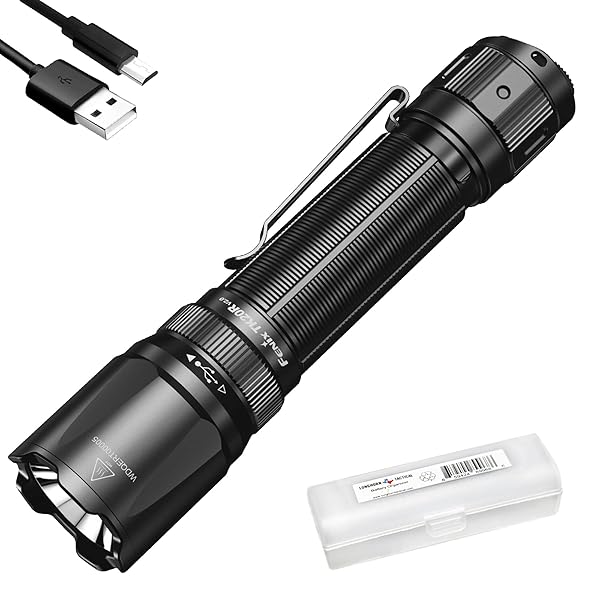
Fenix designed the TK20R V2.0 around a dual tail switch that provides instant access to turbo and strobe without cycling through lower modes. At 3,000 lumens with a beam distance over 475 meters, this light bridges the gap between compact tactical lights and dedicated throwers.
Best for: Patrol officers, property security, and users who need both high output and long throw in one package
The TK20R V2.0 earns its place in this guide through its dual tail switch design, which is among the best mechanical interfaces in the flashlight world. One switch activates the light in your selected everyday mode, while the other provides instant turbo or strobe. No cycling, no hunting for the right mode, no accidental activations. This matters when a split second of fumbling with a switch can have real consequences. The 475-meter beam distance comes from a larger head diameter than most pocket-sized lights, which houses a deeper reflector. That larger head is also the primary drawback. The TK20R V2.0 does not pocket-carry well. It is a belt holster light, and users with smaller hands may find the wider head uncomfortable during extended use. Thermal regulation is aggressive, stepping turbo down to around 1,500 lumens after two minutes to protect the LED. Still, the combination of throw distance, instant tactical access, and Fenix's typical build quality makes this one of the best all-around duty lights at this price.
12. Nitecore P20iX
~$130 on Amazon
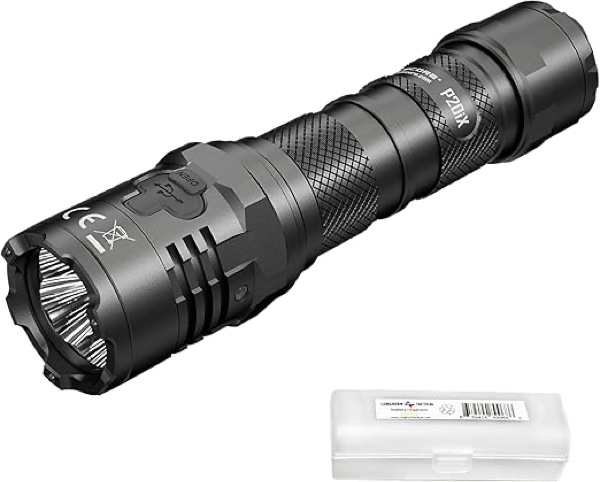
Nitecore's P20iX uses four CREE XP-L2 LEDs to deliver 4,000 lumens from a body not much larger than a standard single-LED tactical light. The quad-LED design creates a wide, even beam pattern that floods an area with light rather than concentrating it into a narrow hotspot.
Best for: Room clearing, search operations, vehicle inspections, and anyone who needs maximum flood coverage
Most flashlights try to balance flood and throw with a single LED and reflector. Nitecore's approach with the P20iX abandons that compromise entirely by using four LEDs and four shallow reflectors to create a wall-of-light effect. The result is 4,000 lumens distributed across a wide beam that illuminates entire rooms, vehicle interiors, or large outdoor areas without the tunnel-vision effect of a single-LED thrower. For close-to-mid-range work, this beam pattern is noticeably more useful than a focused hotspot. The sacrifice is beam distance. Four shallow reflectors cannot push light as far as one deep reflector, so the P20iX tops out around 250 meters. Compared to the Fenix TK20R V2.0 at 475 meters or the Olight Warrior X 4 at 630 meters, that is a significant reduction in range. Heat management is also aggressive, with the light stepping down from turbo quickly. Nitecore's proprietary 21700 battery with a built-in USB-C port is convenient but means you cannot easily substitute third-party cells. If your primary use case is flooding areas with light rather than reaching distant targets, the P20iX does it better than anything else at this price.
13. SureFire EDCL2-T
~$171 on Amazon
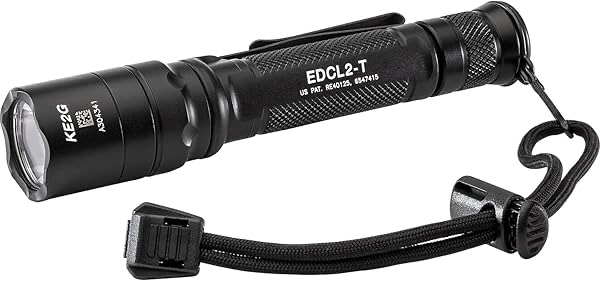
SureFire's EDCL2-T pairs a precision Total Internal Reflection (TIR) lens with dual-output switching for a beam that is cleaner and more uniform than anything using a traditional reflector. Soft-press for 5 lumens, full-press for 1,200, with the kind of output regulation SureFire is known for.
Best for: Users who prioritize beam quality above all else, professionals who need clean target identification, and SureFire enthusiasts
SureFire's TIR lens technology sets the EDCL2-T apart from every reflector-based light on this list. Instead of bouncing light off a curved reflector, a TIR lens refracts and focuses the LED output through a precisely shaped optical element. The result is a beam with virtually no artifacts, rings, or dark spots. For target identification at distance, this clean beam is a measurable advantage. Output regulation is also best-in-class, maintaining nearly flat 1,200 lumens until the batteries drop below operating voltage, then cutting off rather than dimming gradually. You get full power until you do not, with no guessing about remaining runtime. The EDCL2-T's weakness is the same one that affects the G2X Pro: CR123A batteries only, no rechargeable option. At $171, that is a harder pill to swallow. Two CR123A cells cost $2 to $5 depending on brand, and the light runs through them in about 1.5 hours at high output. Users who run their lights frequently will spend more on batteries per year than they spent on cheaper rechargeable competitors. If beam quality and regulation matter more to you than operating cost, no light under $200 matches the EDCL2-T.
Weapon-Mounted Lights ($120-$300)
Weapon-mounted lights occupy a specialized niche in the flashlight world. These units are engineered to withstand recoil forces, vibration, and the specific mounting requirements of Picatinny and accessory rails. Build quality, activation ergonomics, and beam pattern matter more here than raw lumen counts. All three picks below have been adopted by military and law enforcement agencies worldwide, which says more about their reliability than any spec sheet.
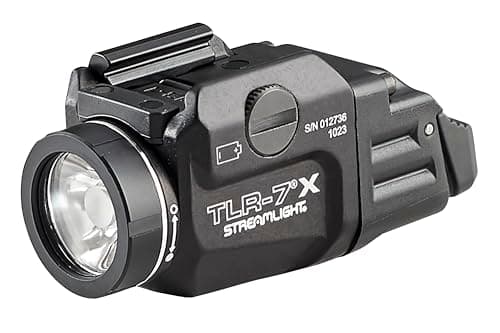
14. Streamlight TLR-7A
~$120 on Amazon
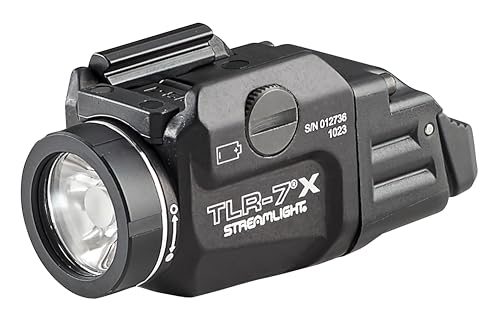
The TLR-7A is Streamlight's compact weapon light with a flex switch system that ships with both high and low activation paddles. At 500 lumens, it provides enough output for positive identification at room distances while keeping the housing compact enough to sit flush with most standard-length barrels.
Best for: Compact platforms, users who prefer a low-profile light that does not extend past the muzzle
Streamlight's flex switch system is the TLR-7A's strongest engineering feature. The kit includes both high and low switch paddles that snap into place without tools, letting you customize the activation to your hand size and grip preference. High switches sit proud for easy thumb activation, while low switches tuck closer for a slimmer profile. This level of switch customization is unusual at this price point. The 500-lumen output uses a smooth reflector that produces a broad, even beam pattern well suited to indoor distances. Beam reach tops out around 140 meters, which is more than adequate for its intended use case. The limitation is that 500 lumens. In bright ambient conditions or at distances beyond 25 yards, the TLR-7A struggles compared to the 1,000-lumen TLR-1 HL below. The single CR123A battery also provides only 1.5 hours of runtime, and there is no rechargeable option. For compact mounting where the light must sit flush with the barrel, the TLR-7A is the standard choice. If you need more reach or runtime, step up to the TLR-1 HL.
15. Streamlight TLR-1 HL
~$165 on Amazon
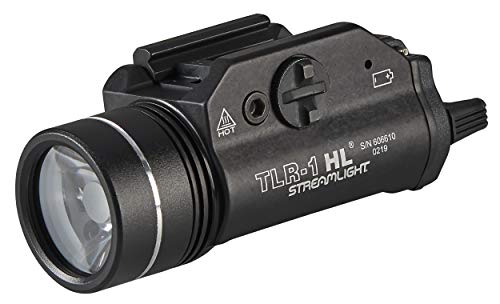
Streamlight's TLR-1 HL is the full-size weapon light that has been standard-issue for dozens of law enforcement agencies across the country. Powered by two CR123A batteries, it delivers 1,000 lumens with a balanced beam that combines a tight center hotspot with wide peripheral spill for situational awareness.
Best for: Full-size duty platforms, professionals who need maximum output and beam quality from a proven design
Years of real-world deployment have made the TLR-1 HL the weapon light that other manufacturers benchmark against. The ambidextrous paddle switch is intuitive for both left and right-handed operators, with momentary and constant-on modes accessible through the same control. Beam pattern hits the sweet spot between flood and throw, providing a defined center hotspot for identification at 50+ yards and enough spill to maintain peripheral awareness. The quick-release rail clamp works with both Picatinny and Glock-style rails without tools, and the mounting is rock-solid after thousands of rounds. Size is the primary limitation. The TLR-1 HL extends noticeably past the muzzle on compact frames, and its width can cause fit issues with certain holsters. You will want to verify holster compatibility before purchasing. Battery life at 1.5 hours on two CR123A cells is also average for this class. For full-size platforms where holster clearance is not an issue, the TLR-1 HL remains the most proven choice in its price range.
16. SureFire X300U-A
~$300 on Amazon
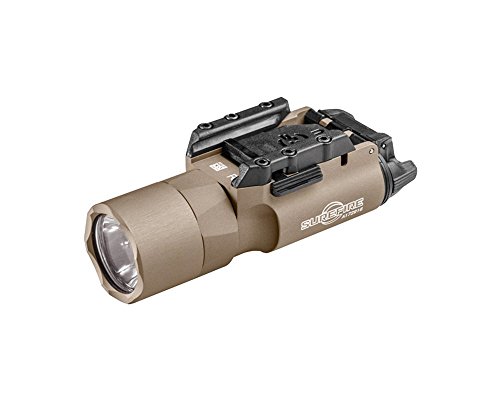
SureFire's X300U-A is the weapon light that special operations units and elite law enforcement teams have carried for over a decade. The TIR lens produces the cleanest, most artifact-free beam in the weapon light category, and the machined aluminum housing survives abuse that would destroy lesser lights.
Best for: Professional duty use, users who demand the highest build quality and beam performance available
The X300U-A commands a $300 price tag because SureFire builds it to a standard that most manufacturers cannot match. The TIR lens produces a beam with zero artifacts, zero rings, and a perfectly smooth transition from hotspot to spill. For positive identification at distance, this beam quality provides a measurable advantage over reflector-based weapon lights. The machined 6061-T6 aluminum housing with mil-spec Type III hard anodizing survives drops, impacts, and sustained recoil that would crack polymer housings. SureFire's output regulation delivers flat 1,000 lumens until the CR123A batteries are depleted, with no gradual dimming. The weaknesses are price and battery format. At $300, the X300U-A costs nearly twice the TLR-1 HL, and it runs exclusively on CR123A batteries. No rechargeable option exists in the X300 platform. The 1,000-lumen output also matches, but does not exceed, the Streamlight TLR-1 HL at nearly half the price. What you pay for is the beam quality, the build tolerances, and the track record. For professionals who depend on their equipment in the worst conditions, the X300U-A has earned its reputation.
Tactical Headlamps ($55-$100)
Headlamps free up both hands, which makes them essential for tasks where you need to work, climb, read maps, or move through terrain while maintaining illumination. Tactical headlamps add features like red and green LEDs for preserving night vision, low-profile designs that fit under helmets, and outputs high enough for navigation and search work. All three picks below have been used by military personnel in the field.
17. Petzl Tactikka+ RGB
~$55 on Amazon
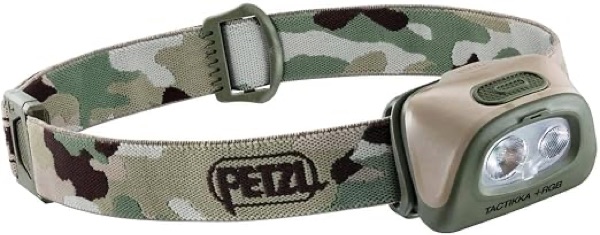
Petzl's Tactikka+ RGB includes red, green, and blue secondary LEDs alongside the main 350-lumen white LED. Red preserves night vision, green is readable on topographic maps without washing out contour lines, and blue helps track blood trails and fluid leaks. Three AAA batteries keep things simple and replaceable anywhere.
Best for: Navigation, map reading, field work requiring night-vision preservation, and users who want colored LED versatility
Petzl has been the go-to headlamp brand for military and mountaineering use for decades, and the Tactikka+ RGB represents their purpose-built tactical offering. The RGB secondary LEDs are not a gimmick. Red light at 2 lumens lets you read, navigate, and work without destroying your dark-adapted vision, which takes 20 to 30 minutes to rebuild after exposure to white light. Green light reads cleanly on topographic maps where red tends to make contour lines disappear. Blue is more specialized but useful for tracking fluids and certain field tasks. The main white LED at 350 lumens handles trail navigation and general illumination. Beam distance maxes out at about 90 meters, which is the main trade-off. For serious search work or long-range trail scanning, 350 lumens is limiting. The AAA battery format is both a strength and a weakness: AAAs are available everywhere, but they provide shorter runtime than rechargeable lithium cells. If you need the colored LED versatility, no headlamp at this price matches the Tactikka+ RGB.
18. Petzl Tactikka Core
~$65 on Amazon
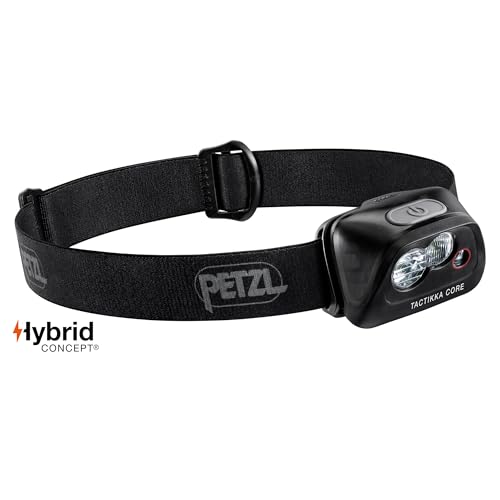
The Tactikka Core includes Petzl's Core rechargeable battery pack alongside standard AAA compatibility, giving you the same dual-fuel flexibility that makes certain handheld lights so practical. Red LED mode preserves night vision, and the 450-lumen output is a step up from the RGB model for users who prioritize brightness over colored LEDs.
Best for: Extended field operations, camping, and users who want rechargeable convenience with AAA backup capability
Petzl's Core battery system is a rechargeable lithium-ion pack that fits into the same compartment as three AAA batteries, letting you switch between rechargeable and disposable power depending on the situation. On the Core pack, you get about 2 hours at max output and up to 200 hours on the lowest setting. When the Core pack dies in the field, swap in three AAAs from any gas station and keep going. That fuel flexibility alone justifies the $10 premium over the Tactikka+ RGB for many users. Output bumps to 450 lumens, and the beam distance improves accordingly. The red LED is limited to a single brightness level, and there are no green or blue options. If colored LED variety matters to you, the RGB model is the better pick. The IPX4 water resistance rating also means the Tactikka Core handles rain and splashes but should not be submerged. For overnight hikes, camping trips, and multi-day field work where charging access is intermittent, the dual-fuel design gives you a reliability advantage that single-format headlamps cannot match.
19. Streamlight Sidewinder Compact II
~$100 on Amazon
Purpose-built for military operations, the Sidewinder Compact II meets MIL-STD-810F and carries NSN (National Stock Number) certification. Four LED colors (white, red, blue, and IR), a helmet mount, and a 185-degree articulating head make this the most versatile tactical headlamp available.
Best for: Active duty military, night operations requiring IR illumination, helmet-mounted use, and anyone who needs a truly mil-spec headlamp
The Sidewinder Compact II is the only light on this list that was designed from the ground up for military combat operations. The IR LED works with night-vision devices, the four color options serve specific tactical purposes, and the helmet mount integrates with MICH, ACH, and similar helmet systems. The 185-degree articulating head lets you angle the beam precisely, which matters when you are working on equipment or navigating terrain at an angle. Battery versatility is excellent: the Sidewinder runs on a single CR123A, AA lithium, or AA alkaline battery. That one-battery simplicity means you can always find a compatible cell. The obvious limitation is output. At 55 lumens on the white LED, this is a fraction of what the Petzl headlamps produce. Streamlight engineered it this way intentionally, because high-lumen headlamps are a liability in tactical environments where light discipline matters. For civilian hiking or camping where you want to light up the trail, the Petzl models are better choices. For genuine military-style operations where controlled, multi-color, IR-capable illumination matters, the Sidewinder Compact II has no real competition at any price.
Tactical Lanterns ($40-$45)
Sometimes you need area lighting rather than a directed beam. Tactical lanterns fill a tent, vehicle interior, or work area with even light, and the best ones double as power banks to charge your phone in the field. Both picks below from Goal Zero combine reliable LED illumination with USB charging capability in packages small enough to fit in a jacket pocket.
20. Goal Zero Lighthouse Micro Flash
~$40 on Amazon
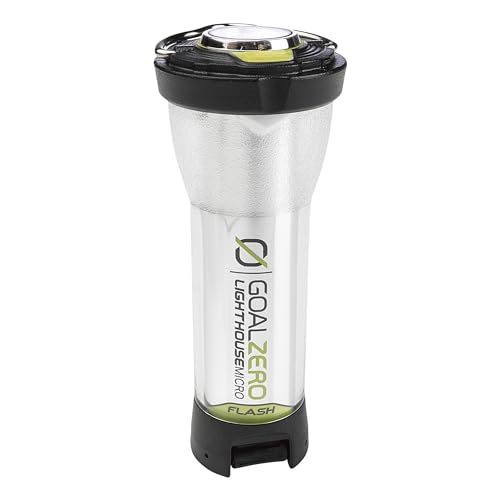
Goal Zero's Lighthouse Micro Flash is a dual-purpose device: a 150-lumen lantern that collapses to pocket size and an integrated flashlight mode that provides a directed beam. USB rechargeable with up to 170 hours of runtime on low, and a built-in carabiner clip for hanging in tents or from MOLLE webbing.
Best for: Camping, tent illumination, power outage preparedness, and lightweight backup area lighting
Goal Zero built its reputation on portable solar power systems, and the Lighthouse Micro Flash benefits from that battery expertise. The collapsible design telescopes from a compact puck into a full lantern, with adjustable brightness and a 360-degree light pattern that fills a two-person tent evenly. The integrated flashlight mode is a nice addition for tasks where you need a directed beam instead of ambient light. At 4.4 ounces, it adds virtually nothing to your pack weight. Runtime at the lowest lantern setting stretches to 170 hours, which is enough for a two-week camping trip on a single charge. The trade-off is output. At 150 lumens maximum, the Micro Flash does not produce enough light for large-area illumination. It lights a tent or a small room adequately, but a garage, large campsite, or outdoor work area will need something brighter. The Micro Flash also lacks the USB output port found on the Micro Charge below, so it cannot serve as an emergency phone charger. If you just need light, this is the lighter and cheaper option. If you want the power bank functionality, spend the extra $5 on the Charge model.
21. Goal Zero Lighthouse Micro Charge
~$45 on Amazon
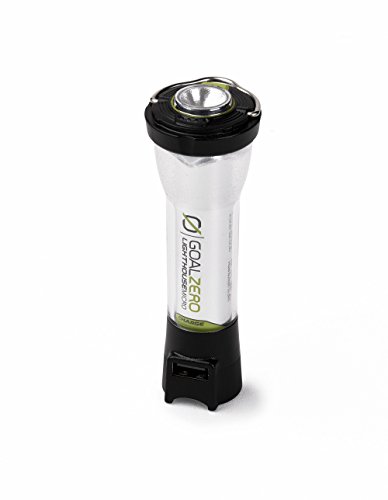
Identical to the Micro Flash in design but adds a USB output port that lets it double as a small power bank. Charge your phone, GPS, or other USB devices from the lantern's internal battery. For $5 more than the Flash model, you get a backup power source alongside your area light.
Best for: Bug-out bags, emergency kits, camping where phone charging matters, and anyone who wants dual-purpose gear
The Micro Charge takes everything the Flash does well and adds USB output capability for five extra dollars. The internal battery can push roughly one partial phone charge to a device through the USB-A port, which is enough to get a dead phone back to functional in an emergency. It will not fully charge a modern smartphone from zero, but getting from 0% to 30-40% can be the difference between having a working communication device and not. All the lantern specifications match the Flash model: 150 lumens, collapsible design, adjustable brightness, and the same 170-hour runtime on low. The limitation is the same as the Flash: 150 lumens is modest for anything beyond tent or small-room illumination. The power bank capacity is also small compared to a dedicated portable battery, so treat it as an emergency backup rather than a primary charging solution. For the extra $5, the USB output makes the Charge the default recommendation over the Flash for emergency kits and bug-out bags where every piece of gear should serve multiple purposes.
Keychain Lights ($35-$42)
Keychain lights sit at the intersection of portability and capability. The best ones deliver enough output for real tasks, not just finding a keyhole, while staying small enough that you forget they are attached to your keys until you need them. Both picks below run on built-in rechargeable batteries and produce output that would have required a full-size flashlight a decade ago.
22. Nitecore Tip SE
~$35 on Amazon
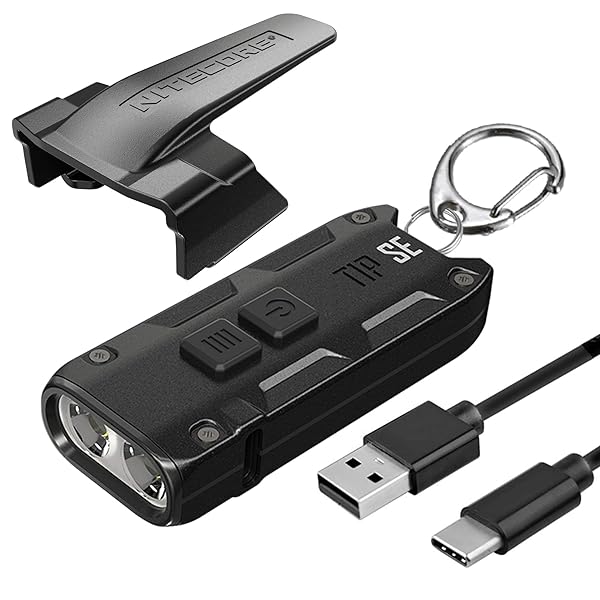
Nitecore's Tip SE pushes 700 lumens from a housing smaller than a USB flash drive. Dual buttons provide instant access to any of four brightness modes, and the metal body with IP54 rating survives the daily abuse of keychain carry. USB-C charging keeps the internal battery topped off without removing it from your keys.
Best for: Keychain EDC, backup light, quick tasks around the house, and anyone who wants serious output in the smallest possible package
Cramming 700 lumens into a keychain light creates engineering challenges, and Nitecore handles most of them well. The dual-button interface is intuitive: one button cycles modes, the other activates the light, and pressing both simultaneously locks the buttons to prevent accidental activation in your pocket. The USB-C port hides under a rubber flap that keeps out moisture and debris. At its maximum output, the Tip SE gets noticeably warm within 30 seconds and steps down to prevent overheating. That thermal throttle is the primary trade-off. Sustained output at turbo is closer to 300 lumens after the step-down, so the 700-lumen rating is a burst figure. Battery runtime at maximum is also just 30 minutes, though the 1-lumen low mode stretches to 46 hours. The IP54 rating is lower than most flashlights on this list, meaning the Tip SE handles splashes but should not be submerged or used in heavy rain. For the size, these are reasonable compromises. The Tip SE puts more usable light on a keychain than anything else at this price.
23. RovyVon Aurora A3 Gen 4
~$42 on Amazon
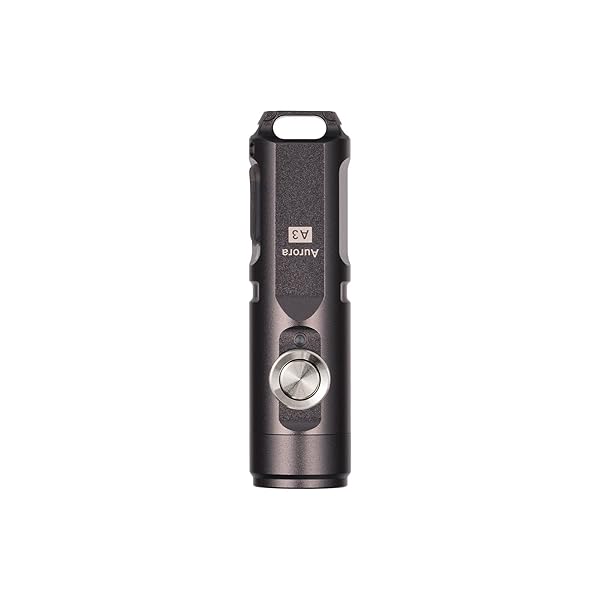
RovyVon's Aurora A3 Gen 4 is a polycarbonate keychain light that packs 650 lumens, a red side LED for night-vision preservation, and a UV LED for checking documents and detecting stains. The translucent body doubles as a diffuser when you need soft area light instead of a directed beam.
Best for: Multi-function keychain carry, users who want red and UV secondary LEDs, and anyone who appreciates the translucent diffuser design
RovyVon carved out a niche in the keychain flashlight market by packing more features into a tiny package than the competition. The Aurora A3 Gen 4 includes a main white LED, a red side LED for preserving night vision, and a UV side LED for checking currency, IDs, and detecting pet stains on carpet. The polycarbonate body is translucent, which means the entire light glows when activated, turning it into a mini lantern for close-range area lighting. USB-C charging is a welcome upgrade from previous generations. The feature density comes with compromises. Polycarbonate is less durable than the aluminum used on the Nitecore Tip SE, and it scratches visibly after months of keychain carry. The 650-lumen turbo mode drains the small battery in about 20 minutes, and thermal step-down kicks in quickly. The multi-button interface for switching between white, red, and UV modes also has a learning curve that frustrates some users. If you value the secondary LEDs and diffuser design, the Aurora A3 offers functionality no other keychain light matches. If you just want a bright, simple keychain light, the Nitecore Tip SE is the cleaner choice.
How to Choose a Tactical Flashlight
Marketing specifications can be misleading if you do not understand what the numbers actually mean. This section breaks down the three most important performance metrics and the battery decision that affects your daily experience more than any other single factor.
Lumens vs. Candela vs. Beam Distance
Lumens measure total light output, which is the raw amount of light leaving the flashlight in all directions. Candela measures peak beam intensity at the center of the hotspot, which determines how bright the light appears at a specific point. Beam distance is calculated from the candela rating and tells you how far the light projects a useful level of illumination (defined as 0.25 lux, roughly equivalent to a full moon).
Here is why this matters practically: a 4,000-lumen flashlight with a shallow reflector (like the Nitecore P20iX) spreads its light wide but does not throw it far. A 1,000-lumen flashlight with a deep reflector (like the Streamlight ProTac HL-X) concentrates its light into a tighter beam that reaches much further. The 4,000-lumen light is better for flooding a room. The 1,000-lumen light is better for identifying an object at 300 meters. Lumens alone do not tell you which light is "better" because the answer depends entirely on your use case.
For indoor use, close-range tasks, and area illumination, prioritize lumens. For long-range identification, search work, and security use, prioritize candela and beam distance. The best all-around tactical lights (like the Fenix PD36 TAC and Streamlight ProTac HL-X) balance both with reflectors designed to provide a useful hotspot surrounded by enough spill to maintain peripheral vision.
Rechargeable vs. CR123A: The Battery Decision
This choice affects your daily experience more than any specification on the box. Here is an honest comparison.
Rechargeable (18650 / 21700): Lower cost per charge cycle (pennies vs. dollars), higher capacity for longer runtime, USB charging convenience, and better sustained output thanks to higher voltage. The downside is that you need to remember to charge them, and if the battery dies in the field with no power source, you are out of luck. Rechargeable cells also degrade over 300-500 charge cycles, though that represents years of regular use for most people.
CR123A Lithium Primary: Shelf life of 10+ years in storage, instant replacement with no charging wait, and reliable output across extreme temperatures. The downside is cost ($1-$3 per cell), environmental waste, and the ongoing need to keep spares on hand. A light that burns through two CR123As in 1.5 hours costs $100 or more per year in batteries with daily use.
Dual-fuel lights like the Streamlight ProTac 2L-X and ProTac HL-X accept both formats, giving you rechargeable convenience for daily use and the ability to swap in disposable CR123As when charging is unavailable. If you can only own one tactical flashlight, dual-fuel is the most practical choice.
Comparison Table: All 23 Flashlights
| Light | Price | Lumens | Battery | Category |
|---|---|---|---|---|
| Olight i1R 2 EOS | $20 | 150 | Built-in Li-ion | Budget EDC |
| Streamlight MicroStream USB | $35 | 250 | Built-in Li-ion | Budget EDC |
| Streamlight MacroStream USB | $57 | 500 | Built-in Li-ion | Mid-Range |
| Streamlight ProTac 2L-X | $60 | 500 | 18650 / CR123A | Mid-Range |
| Fenix PD36 TAC | $85 | 3,000 | 21700 | Mid-Range |
| SureFire G2X Pro | $89 | 600 | CR123A | Mid-Range |
| Streamlight ProTac HL-X | $98 | 1,000 | 18650 / CR123A | Premium |
| Olight Warrior 3S | $113 | 2,300 | 21700 | Premium |
| Olight Warrior X 4 | $117 | 2,600 | 21700 | Premium |
| Fenix PD36R Pro | $120 | 2,800 | 21700 | Premium |
| Fenix TK20R V2.0 | $130 | 3,000 | 21700 | Premium |
| Nitecore P20iX | $130 | 4,000 | 21700 | Premium |
| SureFire EDCL2-T | $171 | 1,200 | CR123A | Premium |
| Streamlight TLR-7A | $120 | 500 | CR123A | Weapon Light |
| Streamlight TLR-1 HL | $165 | 1,000 | CR123A | Weapon Light |
| SureFire X300U-A | $300 | 1,000 | CR123A | Weapon Light |
| Petzl Tactikka+ RGB | $55 | 350 | 3x AAA | Headlamp |
| Petzl Tactikka Core | $65 | 450 | Core / AAA | Headlamp |
| Streamlight Sidewinder Compact II | $100 | 55 | CR123A / AA | Headlamp |
| Goal Zero Lighthouse Micro Flash | $40 | 150 | Built-in Li-ion | Lantern |
| Goal Zero Lighthouse Micro Charge | $45 | 150 | Built-in Li-ion | Lantern |
| Nitecore Tip SE | $35 | 700 | Built-in Li-ion | Keychain |
| RovyVon Aurora A3 Gen 4 | $42 | 650 | Built-in Li-ion | Keychain |
Frequently Asked Questions
How many lumens do I actually need in a tactical flashlight?
For general everyday carry and home use, 200 to 500 lumens handles virtually all tasks. Security and law enforcement work typically requires 500 to 1,000 lumens for positive identification at distance. Search and rescue benefits from 1,000+ lumens. Anything above 3,000 lumens is specialized territory with diminishing practical returns for most users. A reliable low mode in the 5 to 50 lumen range is equally important for close-range tasks, map reading, and preserving night-adapted vision.
What is the difference between 18650 and 21700 batteries?
Both are rechargeable lithium-ion cells. The 18650 is 18mm wide and 65mm long, with typical capacity around 3,000 to 3,500mAh. The 21700 is 21mm wide and 70mm long, with capacity ranging from 4,000 to 5,000mAh. The 21700 provides roughly 40% more runtime but requires a slightly larger flashlight body. Newer premium lights are shifting to 21700 as the standard, while 18650 remains common in compact models. Both formats are widely available from battery suppliers.
Are tactical flashlights legal to carry?
Flashlights are legal to carry in all 50 US states and in most countries worldwide. There are no lumen limits or restrictions on flashlight possession for civilians. Some municipalities have ordinances against shining lights at aircraft or into occupied vehicles, but owning and carrying the flashlight itself is unrestricted. Weapon-mounted lights may be subject to local regulations regarding the platforms they are attached to, but the lights themselves carry no separate legal restrictions.
Is SureFire worth the premium price?
SureFire's premium buys you three things: beam quality from TIR lenses that produce cleaner beams than reflector-based competitors, output regulation that maintains flat brightness until batteries are depleted, and a track record of reliability proven across decades of military and law enforcement use. Whether that justifies paying two to three times the price of a Streamlight or Fenix depends on your priorities. For professionals who depend on their light in critical situations, SureFire's reliability premium is easy to justify. For recreational and general EDC use, Streamlight and Fenix offer 90% of the performance at 40-60% of the price.
What does IPX7 and IPX8 waterproof rating mean?
IPX7 means the flashlight can be submerged in one meter of water for up to 30 minutes. IPX8 means it can be submerged beyond one meter (the manufacturer specifies the exact depth, typically two meters) for extended periods. Both ratings far exceed what you would encounter in rain, snow, or accidental drops into water. IPX4, found on some budget lights, only protects against splashing from any direction. For field use where the light might end up in a puddle, stream, or heavy downpour, IPX7 or IPX8 is the minimum recommended rating.
Should I buy a weapon-mounted light or a handheld tactical light?
They serve different purposes and most serious users own both. A weapon-mounted light provides illumination aligned with your point of aim, keeping both hands on the platform. A handheld light lets you illuminate areas independently, search without pointing a weapon, and perform everyday tasks. Weapon lights are specialized tools for a specific use case. A handheld tactical light is a general-purpose tool you will use daily. If you are only buying one light, start with a quality handheld like the Streamlight ProTac HL-X or Fenix PD36 TAC.
How often should I replace rechargeable flashlight batteries?
Quality lithium-ion cells (18650 or 21700) maintain over 80% of their original capacity through 300 to 500 charge cycles, which translates to roughly two to four years of daily use for most people. Signs that a battery needs replacement include noticeably shorter runtime, reduced brightness on high mode, and the light cutting out before the battery indicator shows empty. Always replace rechargeable cells with the same chemistry and size specified by the manufacturer, and buy from reputable sellers to avoid counterfeits.
What flashlight does the US military actually issue?
Standard issue varies by branch and unit, but common military-issue flashlights include the Streamlight Sidewinder Compact II (widely issued for its IR capability and multi-color LEDs), SureFire weapon lights across special operations units, and various Streamlight and Pelican models for general use. The FBI selected the Streamlight ProTac HL-X as their standard flashlight. Special operations units often have latitude to purchase SureFire, Modlite, and Cloud Defensive lights. Issued equipment tends to prioritize durability, battery commonality, and specific tactical features like IR LEDs over raw lumen output.
Looking for more tactical gear? Check out our best tactical backpacks and EDC gear guide for packs, multi-tools, and accessories that pair well with these lights. Our survival and emergency gear kits guide covers preparedness setups where a reliable flashlight is essential. And if you are shopping for a military enthusiast, the Father's Day military gift guide includes several lights from this list alongside other gear recommendations.