Michael Trent covers military aircraft, weapons systems, and defense technology with an emphasis on cost, maintenance, and real-world performance. He focuses less on specifications and more on how systems hold up once they are deployed, maintained, and operated at scale.
Updated April 2026
2026 Update: The Numbers Have Shifted, and So Has the Strategic Balance
Since this article was first published, significant developments have reshaped the F-22 versus J-20 comparison. The most consequential change is not a new weapon or sensor, it is production numbers. China's J-20 fleet has grown substantially, while the F-22 fleet continues its slow, irreversible decline. The strategic implications of that divergence are becoming harder to ignore.
Open-source tracking by analysts monitoring satellite imagery of Chinese airfields and production facilities suggests the PLAAF now operates between 270 and 300 J-20s, with production rates estimated at 40-50 airframes per year. If those estimates are accurate, China is adding roughly one J-20 per week to its inventory. By contrast, the U.S. Air Force's F-22 fleet stands at approximately 183 airframes, of which roughly 130 are combat-coded at any given time. That number will only decrease as aircraft age out, are damaged, or reach structural life limits. No new F-22s will ever be built.
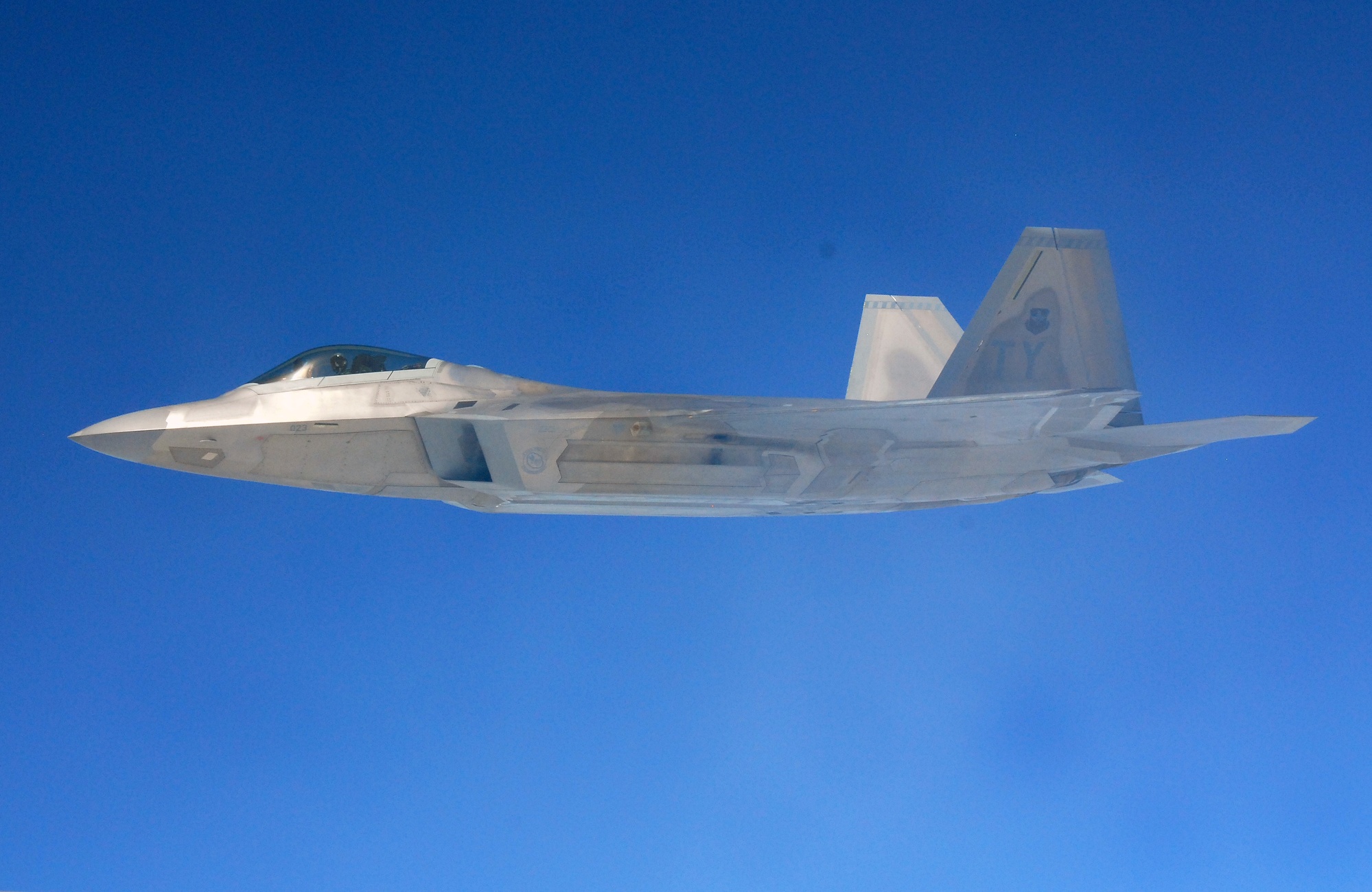
F-22 Raptors during a training exercise. With production ended in 2011, every F-22 lost to attrition or structural aging is irreplaceable, a strategic reality that shapes how the Air Force employs its most capable fighter (U.S. Air Force photo).
The WS-15 engine question, which dominated previous assessments of the J-20's capability gap, appears to be moving toward resolution. Chinese state media, including CCTV reports in late 2025, showed J-20 variants with modified engine nozzles consistent with a new powerplant. Multiple open-source analysts have assessed these as WS-15-equipped aircraft, though independent confirmation remains limited. If the WS-15 has indeed entered serial production, the J-20 gains supercruise capability and a significant thrust increase, closing what was previously the most concrete performance gap between the two fighters.
Reports and imagery also suggest China is fielding a twin-seat J-20 variant, the J-20S or J-20AS, designed for roles that benefit from a dedicated weapons systems officer, including drone wingman command and control, electronic warfare coordination, and long-range strike management. This variant, if operational, would represent a doctrinal evolution: the J-20 not just as a fighter but as a node in China's broader autonomous combat network, directing loyal wingman drones like the GJ-11 Sharp Sword from a stealth platform deep in contested airspace.
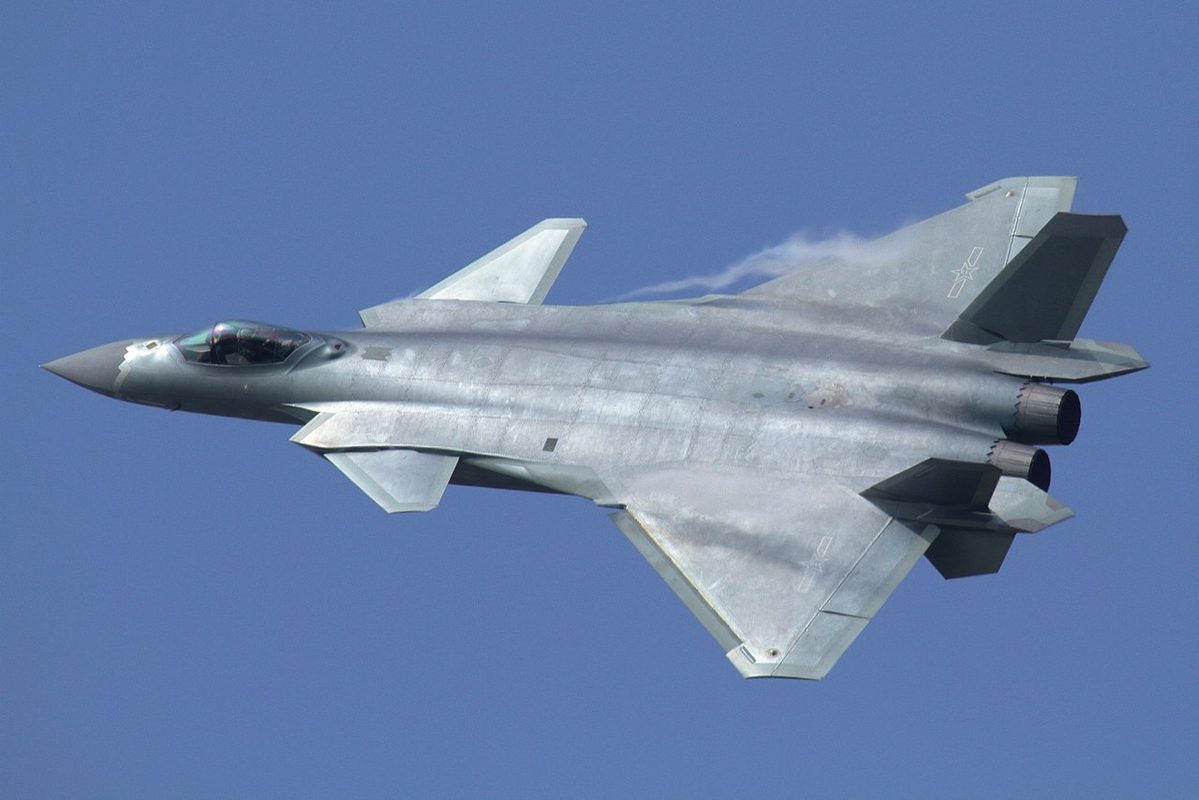
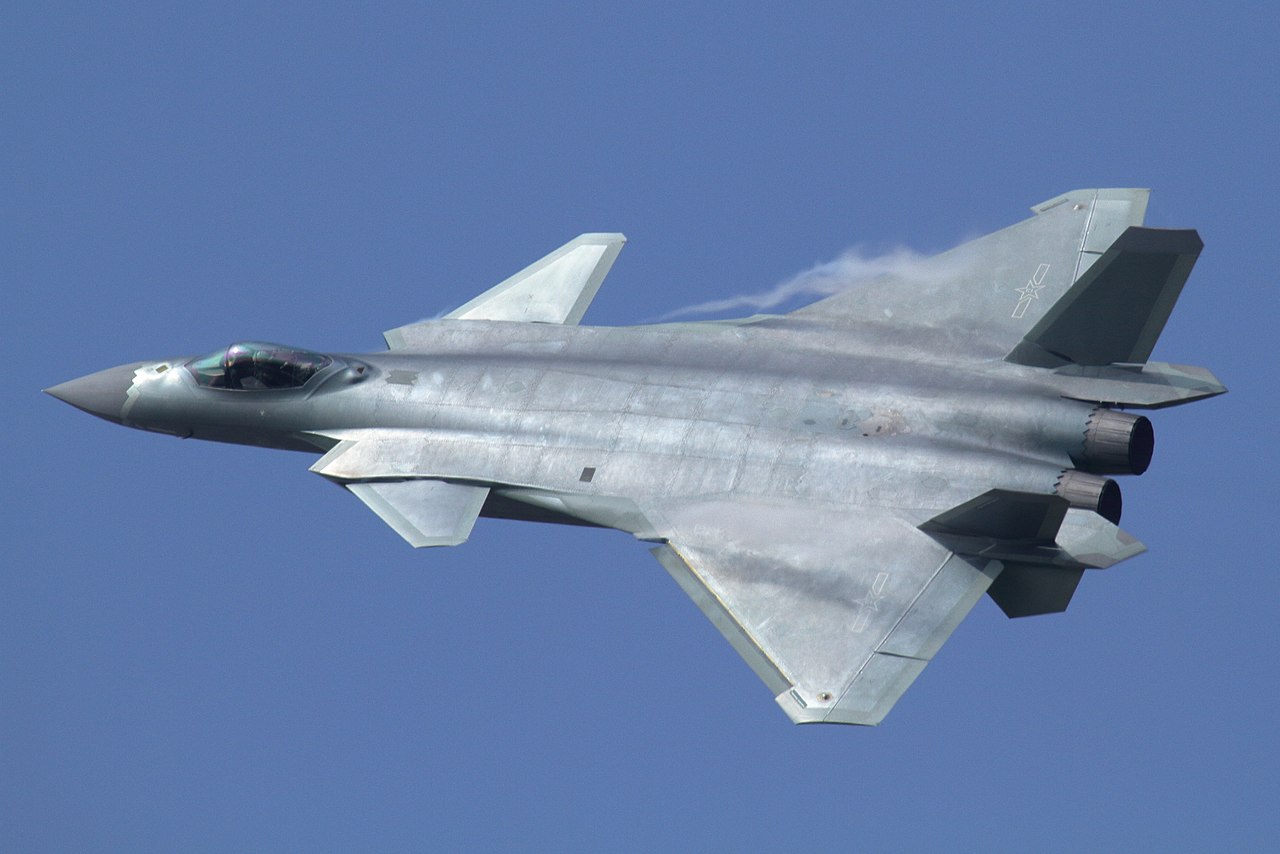
A J-20 at Airshow China. The J-20 fleet has grown to an estimated 270-300 aircraft, with production continuing at a rate of 40-50 per year, a pace that will soon make it the world's most numerous fifth-generation fighter (Photo via Wikimedia Commons).
Meanwhile, the U.S. Air Force has moved forward with the F-47, the Next Generation Air Dominance (NGAD) fighter that will eventually complement and ultimately replace the F-22. Northrop Grumman was selected as the F-47 prime contractor in 2025, with first flight anticipated in the late 2020s. But the F-47 is years from operational service, and the F-22 must hold the line until it arrives. The Air Force has invested in F-22 upgrades, including improved data links, software updates, and potential integration with Collaborative Combat Aircraft (CCA) drones, to extend the Raptor's relevance. But these upgrades are sustaining measures, not transformative ones.
The bottom line has shifted since this article was first written. In 2024, the F-22 likely held a qualitative edge on a per-aircraft basis: better stealth, mature sensor fusion, proven supercruise, and two decades of operational refinement. By 2026, that qualitative gap is narrowing as the J-20 receives its intended engines and sensors, while the quantitative gap is widening decisively in China's favor. The question is no longer whether a single F-22 can beat a single J-20. It is whether 130 combat-ready Raptors can maintain air superiority against 300+ J-20s that are getting better every year.
The Lockheed Martin F-22 Raptor and the Chengdu J-20 Mighty Dragon are the frontline stealth fighters of the world's two most powerful militaries. One has been operational for two decades. The other entered service less than ten years ago and remains partially shrouded in secrecy. Comparing them requires separating what we actually know from what we're guessing at, and being honest about the size of that gap.
The F-22 first flew in 1997 and entered operational service with the U.S. Air Force in December 2005. According to the Air Force's official F-22 fact sheet, it was the world's first fifth-generation fighter, purpose-built for air superiority with an uncompromising focus on stealth, supercruise, and sensor fusion. Lockheed Martin delivered 187 production aircraft (195 total including test airframes) before the line shut down in 2011.
The J-20 made its maiden flight in January 2011 and was declared operational with the People's Liberation Army Air Force (PLAAF) around 2017-2018. Built by Chengdu Aerospace Corporation, it's a larger aircraft than the Raptor, with a canard-delta configuration that suggests a different set of design priorities. Most Western analysts believe those priorities emphasize long-range strike and interception alongside air-to-air combat.
This comparison sticks to publicly verifiable information. Much about the J-20 remains classified by the Chinese government, and even some F-22 capabilities are still under wraps. Where facts end and informed speculation begins, we'll say so.
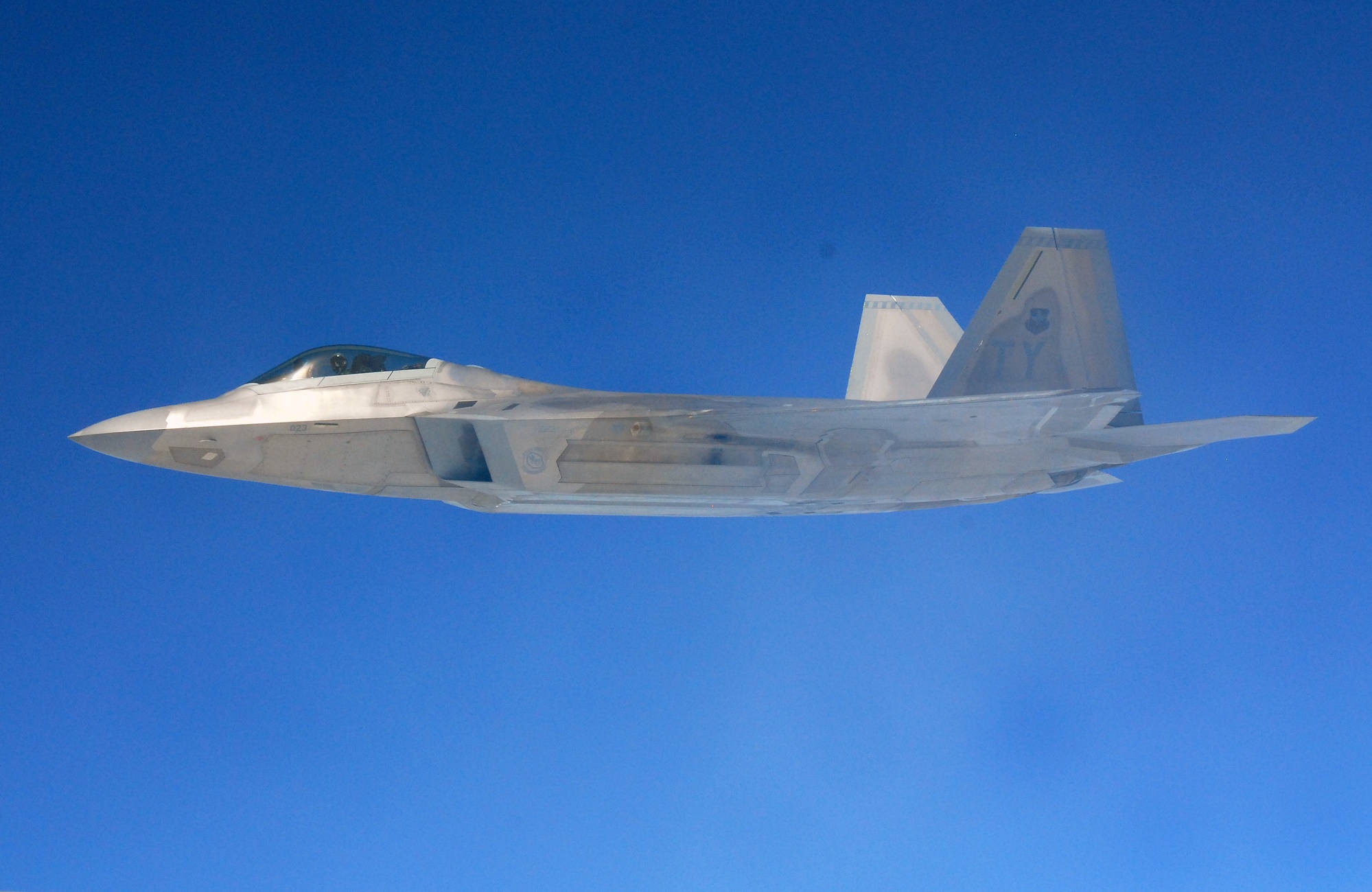
An F-22 Raptor demonstrates the angular, faceted design that defines its all-aspect stealth signature (U.S. Air Force photo)
Design Philosophy: Air Superiority vs. Versatile Strike Platform
The F-22 and J-20 were built to solve different problems, and that difference shapes everything about them.
F-22 Raptor: Built to Own the Sky
The F-22 emerged from the Advanced Tactical Fighter (ATF) program, which launched in 1981 with a singular objective: guarantee American air superiority against the best Soviet fighters and air defense networks for the next several decades. The result was an aircraft where every design decision, from the canted twin tails to the saw-toothed panel edges, serves the air dominance mission.
Lockheed Martin's "first look, first shot, first kill" philosophy demanded that the Raptor detect opponents before being detected, engage before being engaged, and win before the fight becomes a contest. That philosophy drove three core capabilities:
All-aspect stealth: The F-22 was shaped for minimal radar cross section from every direction, not just head-on. Internal weapons bays, aligned edges, and radar-absorbent materials work together to make the aircraft extremely difficult to detect regardless of the angle.
Supercruise: Twin Pratt & Whitney F119-PW-100 engines allow sustained supersonic flight above Mach 1.5 without afterburner. That means the Raptor can cover ground fast while burning less fuel and producing less infrared signature than an afterburning opponent.
Sensor fusion: The AN/APG-77 AESA radar, ALR-94 electronic warfare suite, and other sensors feed into an integrated avionics architecture that presents the pilot with a single, fused tactical picture instead of raw data from individual systems.
The tradeoff for this specialization is cost and inflexibility. According to Government Accountability Office reporting, each F-22 ran roughly $150 million in flyaway cost (over $330 million when you include program development), and the production line closed after just 187 operational aircraft. The Obey Amendment of 1998 banned all F-22 exports, meaning the Raptor fleet belongs solely to the U.S. Air Force and can never be replaced once attrited.
J-20 Mighty Dragon: Reach, Speed, and Anti-Access
The J-20 appears to have been designed with a broader mission set in mind. At roughly 20.5 meters (67 feet) long, its airframe is substantially bigger than the 19-meter (62-foot) Raptor, suggesting a platform optimized for greater fuel capacity and internal weapons volume. That points toward long-range interception and strike as primary roles, with air superiority as a parallel capability rather than the sole focus.
The canard-delta wing configuration is distinctive. The small forward canard surfaces, mounted ahead of the main delta wing, provide additional control authority and lift, particularly at high angles of attack. This layout tends to favor high-speed performance and range over the low-speed maneuverability emphasized by conventional tailed designs.
Several features of the J-20's design suggest its intended employment within China's broader anti-access/area-denial (A2/AD) strategy:
Long range: The J-20's large internal fuel capacity could allow it to operate over the vast distances of the Western Pacific without tanker support, striking targets like aerial refueling tankers, AWACS aircraft, or carrier groups that underpin American force projection.
Large weapons bays: The J-20's main weapons bay and side-mounted bays can accommodate a mix of air-to-air missiles and, potentially, air-to-surface weapons. The bay dimensions suggest compatibility with the PL-15 long-range air-to-air missile.
Stealth-forward design: Like the F-22, the J-20 uses internal weapons carriage and aligned planform edges to reduce radar signature. Analysis of the airframe suggests strong frontal-aspect stealth, which matters most when flying toward defended targets.
The J-20's canard-delta configuration and large airframe distinguish it visually from Western stealth fighters (conceptual illustration)
Stealth: What We Know and What We Don't
Stealth is the defining feature of fifth-generation fighters, and it's also the area where honest comparison gets hardest. Radar cross section (RCS) figures are among the most closely guarded secrets in military aviation. That said, there are things we can assess based on publicly observable design features.
F-22 Raptor: The Stealth Benchmark
The F-22 was designed from the ground up for all-aspect low observability. Per widely cited estimates from aviation analysts like Carlo Kopp at Air Power Australia, its RCS is approximately 0.0001 to 0.0002 square meters from the frontal aspect, roughly the radar signature of a marble. Key stealth features include:
Carefully aligned leading and trailing edges that direct reflected radar energy into narrow, predictable lobes away from the transmitter
Canted vertical stabilizers that avoid the right-angle reflections of conventional tails
Serrated (saw-toothed) panel edges and access doors that break up surface discontinuities
Internal weapons carriage that eliminates the massive RCS contribution of external stores
Radar-absorbent material (RAM) coatings over the airframe
S-ducted engine inlets that hide compressor fan faces from radar
The result is an aircraft with low signature from every direction: front, side, above, and rear. This matters tactically because it gives the F-22 freedom to maneuver during an engagement without suddenly becoming visible when it turns.
J-20: Strong Up Front, Questions Elsewhere
The J-20 incorporates serious stealth design work. Its chined forebody, diamond-shaped forward fuselage cross-section, and aligned leading edges follow established low-observable principles. The diverterless supersonic inlet (DSI) design is an effective radar-reduction feature also used on the F-35.
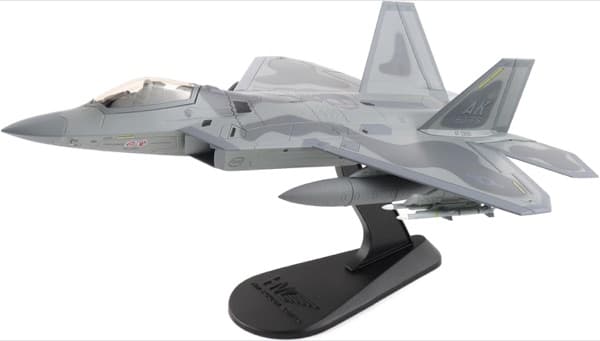
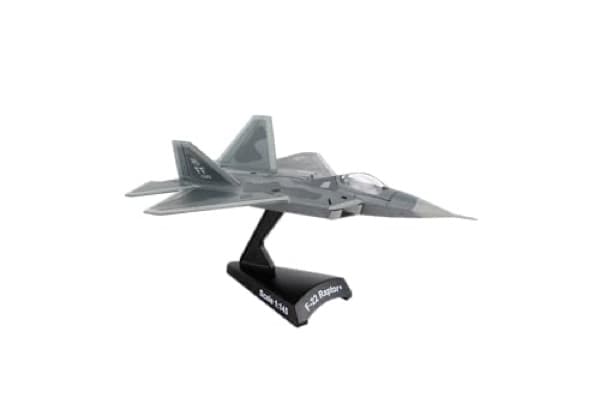
An anniversary-edition F-22A at 1:72 scale with special tail flash markings, opening weapons bays, removable ordnance, and optional landing gear configurations. Limited production run.
From the frontal aspect, the J-20 likely achieves a respectably low RCS. But several observable features raise questions about all-aspect stealth:
Canard surfaces: The forward canards create additional radar-reflecting surfaces and edge diffractions. While their swept alignment mitigates this somewhat, they add signature complexity that the F-22 avoids entirely.
Engine nozzles: Early J-20 production aircraft used round, unserrated engine nozzles (associated with the AL-31F and WS-10C engines) that are less stealthy than the F-22's two-dimensional, serrated nozzles. Newer variants may address this.
Rear-aspect signature: The combination of conventional round nozzles and the aft fuselage shaping suggest the rear hemisphere may have a notably higher RCS than the front.
None of this means the J-20 lacks effective stealth. It means the stealth is likely optimized for the aircraft's primary mission profile: flying toward targets at high speed. In that role, frontal-aspect signature reduction is what matters most. All-aspect stealth becomes more critical in a prolonged air-to-air dogfight where opponents can view you from any angle, which may not be the J-20's intended engagement scenario.
Engines and Performance: The Powerplant Question
Engines are arguably the area where the gap between the two aircraft is most concrete and most significant.
F-22: Proven Power
The F-22's twin Pratt & Whitney F119-PW-100 engines are the gold standard for fifth-generation fighter propulsion. According to Pratt & Whitney's published specifications, each produces approximately 35,000 pounds of thrust with afterburner, and their defining capability is supercruise: sustained supersonic flight above Mach 1.5 without afterburner. Maximum speed with afterburner is around Mach 2.25.
The F119 also features two-dimensional thrust-vectoring nozzles, which give the Raptor exceptional pitch-axis maneuverability. These nozzles are rectangular with serrated edges, contributing to the aircraft's rear-aspect stealth signature reduction. The engines have accumulated millions of flight hours across the fleet and are a mature, reliable system.
J-20: A Work in Progress
The J-20's engine situation has been one of the program's most closely watched aspects. Early production aircraft used Russian-made Saturn AL-31F turbofans, reliable engines originally designed for the Su-27 Flanker family but far from ideal for a stealth fighter. They lack the thrust, fuel efficiency, and low-observable nozzle design needed to unlock the J-20's full potential.
China has been developing indigenous alternatives. The WS-10C (a variant of the Taihang engine family) has reportedly been fitted to later J-20 production batches, providing improved thrust and reducing dependence on Russian imports. But the real prize is the WS-15, a next-generation turbofan designed specifically for the J-20.
The WS-15 has been in development for years and is intended to provide thrust in the 40,000-pound class with afterburner, along with supercruise capability. Chinese state media, including CCTV and the Global Times, has reported successful testing milestones, and some sources suggest the engine may have entered limited production or at least been fitted to test aircraft. However, achieving serial production reliability for a high-performance military turbofan is one of the hardest problems in aerospace engineering, and independent confirmation of WS-15 operational status remains limited.
Without a mature high-thrust engine, the J-20 almost certainly cannot supercruise. It must use fuel-hungry afterburner to reach supersonic speeds, which cuts range and increases infrared signature. This single factor may be the most consequential performance difference between the two fighters today.
Modern air combat is won by the pilot who sees the battlefield most clearly. Sensors, data processing, and information fusion often matter more than raw airframe performance.
F-22: AN/APG-77 and Mature Fusion
The F-22's AN/APG-77 active electronically scanned array (AESA) radar was a generation-defining system when it entered service and has been continuously upgraded. It can simultaneously track multiple targets at long range, operate in low-probability-of-intercept (LPI) modes that make its emissions difficult for opponents to detect, and double as a narrowband electronic attack system.
What sets the F-22 apart is sensor fusion. The AN/APG-77 feeds data into the same integrated picture as the ALR-94 electronic warfare suite (which passively detects and geolocates enemy radar emissions), the aircraft's communication and identification systems, and missile launch detection. The pilot doesn't manage individual sensors. Instead, the system presents a synthesized tactical situation. As noted by the Congressional Research Service in its assessment of tactical aircraft programs, twenty years of software updates have refined this fusion to a high degree of maturity.
J-20: Type 1475 AESA and EOTS
The J-20 is equipped with a Type 1475 (KLJ-5) AESA radar, reportedly with a large aperture enabled by the aircraft's broad nose section. Specific capabilities are not publicly confirmed, but Chinese AESA technology has advanced rapidly over the past decade, and the radar is generally assessed to be a capable, modern system.
The J-20 also features an electro-optical targeting system (EOTS) integrated beneath the nose, similar in concept to the F-35's AN/AAQ-40. Additionally, the aircraft appears to carry an electro-optical distributed aperture system (EODAS), a network of infrared sensors around the airframe that provides spherical situational awareness and missile launch detection.
On paper, the J-20's sensor suite is comprehensive. The challenge lies in integration maturity. Sensor fusion, the ability to make all those inputs talk to each other and produce a coherent, reliable tactical picture in real time, is an extraordinarily difficult software and systems engineering problem. The DoD's annual China Military Power Report has consistently noted China's progress in avionics, but the United States had a decade-long head start and the benefit of operational experience. The current level of fusion maturity in the J-20 is genuinely unknown to outside analysts.
Both fighters carry advanced AESA radars and electro-optical systems, but sensor fusion maturity may differ significantly (conceptual illustration)
Note: Many J-20 specifications are estimates based on open-source analysis. Chinese official figures are limited, and analyst estimates vary. F-22 figures are drawn from U.S. Air Force and manufacturer data, though some remain classified.
Weapons and Combat Role
Both aircraft carry their weapons internally to preserve stealth, with external hardpoints available for non-stealth missions. But what they carry, and how they're expected to use it, reflects their different roles.
F-22 Weapons Load
The F-22 carries six AIM-120 AMRAAM beyond-visual-range missiles in its main weapons bay and two AIM-9X Sidewinder heat-seekers in side bays. For ground attack, it can swap AMRAAMs for two 1,000-pound JDAMs. The M61A2 Vulcan cannon provides 480 rounds for close-range engagements.
The weapons load is optimized for the air-to-air mission. Six AMRAAMs is a solid loadout for a single engagement, and the AIM-120D variant provides impressive range and midcourse guidance updates via datalink. The Raptor's kill chain exploits its stealth and speed directly: detect at range, fire, then reposition while the missile guides itself.
J-20 Weapons Load
The J-20's larger weapons bays can reportedly carry six PL-15 medium-to-long-range air-to-air missiles in the main bay, with PL-10 short-range infrared missiles in side bays. The PL-15 is a significant weapon. According to a widely cited assessment from the U.S. Air Force's then-head of Air Combat Command, Gen. Herbert "Hawk" Carlisle, the PL-15's range and AESA radar seeker prompted the Air Force to accelerate development of a longer-range counter, as the missile was assessed to have a range exceeding 200 kilometers.
The J-20's bays may also accommodate air-to-surface weapons, including anti-ship missiles, which would support the anti-access mission profile. This versatility could make the J-20 more operationally flexible than the F-22, which is fundamentally an air superiority platform with secondary ground attack capability.
How They'd Fight Differently
In a Western Pacific scenario, the F-22 would likely operate as an air superiority enforcer, clearing the sky of opposing fighters and protecting strike packages. It would use its stealth and supercruise to establish favorable geometry, engage at beyond-visual-range, and withdraw before opponents can respond effectively.
The J-20 might be employed differently: as a long-range interceptor hunting high-value targets like tankers, AWACS, and surveillance aircraft that American air operations depend on. Per the RAND Corporation's analysis of Western Pacific conflict scenarios, its range advantage would allow it to operate in areas where the shorter-legged F-22 might struggle to reach without tanker support. And killing the tankers is precisely how you'd ground the Raptor.
Production Numbers and Strategic Scale
Individual aircraft capability matters, but so does quantity. Here the strategic picture gets interesting.
The United States built 195 F-22s total, of which 187 were production fighters and the remainder test aircraft. The production line closed in 2011, and there is no realistic prospect of reopening it. Attrition from crashes (several have been lost over the years) and structural aging means the operational fleet is gradually shrinking. Every Raptor is irreplaceable.
China, by contrast, has been producing J-20s at an accelerating rate. Open-source analysts tracking satellite imagery and serial numbers, including researchers at the Center for Strategic and International Studies, suggest that over 200 J-20s may have been built through 2025, with production potentially approaching 40-50 aircraft per year. If these estimates are accurate, the PLAAF's J-20 fleet already numerically matches and may soon exceed the entire F-22 fleet.
Numbers alone don't determine outcomes, and the F-22's qualitative advantages may offset numerical parity. But in a sustained conflict, attrition math is unforgiving. The side that can replace losses while maintaining operational tempo holds a structural advantage. China's active production line versus America's closed one is a strategic reality that no amount of per-aircraft superiority can fully overcome.
What We Honestly Don't Know
Any comparison between these aircraft requires acknowledging substantial gaps in publicly available information, particularly regarding the J-20. Here's what remains unclear:
J-20 actual RCS: Analyst estimates of the J-20's radar cross section vary by orders of magnitude. Without measured data, which is classified, all figures are educated guesses based on visible airframe features.
WS-15 engine status: Whether the WS-15 is operational, in limited production, or still in testing fundamentally changes the J-20's performance envelope. Chinese state media claims and Western intelligence assessments don't always agree.
J-20 sensor fusion maturity: Carrying advanced sensors and integrating them into a functioning fusion system are very different accomplishments. China's actual progress on this front is genuinely uncertain.
Chinese pilot training quality: The PLAAF has increased training hours and adopted more realistic exercise formats, but how their proficiency compares to USAF pilots flying the Raptor is unknown.
F-22 upgrade status: The F-22 has received multiple upgrades since 2005, including the Increment 3.2B modernization. The exact current capabilities of the latest block may exceed what's publicly described.
Electronic warfare suites: Both aircraft carry EW systems, but specific capabilities and effectiveness against each other's radar and missiles are among the most tightly held secrets in military aviation.
Anyone claiming to definitively know which aircraft would win in a head-to-head engagement is overstating their knowledge. The variables that matter most (actual RCS, sensor performance in contested electromagnetic environments, missile seeker effectiveness against stealth targets, and pilot skill) are precisely the variables that are classified.
The Bigger Picture
Fighters don't operate in isolation. Both the F-22 and J-20 would be employed as parts of integrated combat systems, and the supporting infrastructure matters as much as the platforms themselves.
The F-22 operates within a mature ecosystem of AWACS aircraft (E-3 Sentry and incoming E-7 Wedgetail), aerial refueling tankers (KC-135 and KC-46), networked command and control, and battle-tested joint force tactics. American pilots train constantly against realistic adversaries in exercises like Red Flag. Former Air Force fighter pilots have consistently described this institutional knowledge and support infrastructure as a genuine force multiplier that doesn't show up on spec sheets.
The J-20 operates within a rapidly maturing Chinese system that includes KJ-500 AWACS aircraft, growing tanker capacity, advanced surface-to-air missile batteries like the HQ-9 and S-400, and an expanding network of surveillance capabilities. As the Pentagon's annual China Military Power Report has documented, China has been investing heavily in the overall system, not just the fighter.
The J-20 doesn't need to beat the F-22 in a one-on-one dogfight to be strategically effective. If it can threaten the tankers, AWACS, and surveillance platforms that the F-22 depends on, it accomplishes its strategic purpose. Conversely, the F-22 doesn't need to outrange the J-20. It needs to maintain air superiority over the battlespace so that the rest of the American joint force can operate.
Both aircraft are tools within larger strategies. The real question isn't "which fighter is better?" but "which system of systems is more effective?" That answer depends on geography, timing, logistics, and dozens of other factors that extend well beyond airframe specifications.
Frequently Asked Questions
Could an F-22 shoot down a J-20?
In the right circumstances, almost certainly yes, and the reverse is also true. Engagement outcomes depend on who detects whom first, the electronic warfare environment, available support from other platforms, missile performance, and pilot skill. The F-22's stealth and sensor fusion advantages make it likely to detect first in many scenarios, but no advantage is absolute.
Is the J-20 a copy of the F-22 or F-35?
The J-20 is a distinct design with its own aerodynamic configuration (canard-delta), dimensions, and mission profile. While there have been allegations of Chinese cyber espionage targeting American stealth programs, notably the 2014 indictment of PLA officers for economic espionage, the J-20's design reflects different engineering choices and operational requirements. Calling it a "copy" oversimplifies what is clearly an independent, if potentially informed, development effort.
Why can't the U.S. just build more F-22s?
The F-22 production line closed in 2011, and the tooling, supplier base, and institutional knowledge required for production have dispersed. Restarting production would cost billions and take years; a 2017 RAND Corporation study estimated costs north of $50 billion. The U.S. has instead focused on the F-35 for current production and the NGAD/F-47 program for next-generation air superiority.
Does the J-20 have supercruise capability?
With its current engines (WS-10C or AL-31FM variants), the J-20 almost certainly cannot sustain supersonic flight without afterburner. The WS-15 engine is designed to enable supercruise, but its operational status remains uncertain. Until the WS-15 is confirmed in widespread service, this remains a significant gap compared to the F-22.
How many J-20s has China built?
Open-source estimates based on satellite imagery and serial number tracking suggest China had produced over 200 J-20s through 2025, with production rates potentially reaching 40-50 aircraft per year. Exact numbers are not officially disclosed by China, and estimates carry a margin of uncertainty.
Which fighter has better stealth?
The F-22 is widely assessed to have superior all-aspect stealth, meaning it maintains a low radar signature from all directions. The J-20 likely has effective frontal-aspect stealth but a higher signature from the sides and rear. However, exact RCS figures for both aircraft are classified, and definitive comparison is not possible from public sources alone.