Daniel Mercer writes about military history with a focus on the 20th century, including World War II, the Cold War, and Vietnam. His work looks at how decisions made decades ago still influence doctrine, planning, and assumptions today.
It lasted three days. It was over before it started.
On April 17, 1961, approximately 1,500 CIA-trained Cuban exiles waded ashore at the Bay of Pigs on Cuba's southern coast. They carried American weapons, rode in American boats, and flew under the cover of American-supplied bombers painted to look like defectors from Fidel Castro's own air force. The plan was to establish a beachhead, trigger a popular uprising, and topple a revolutionary government that had been in power for barely two years.
Within 72 hours, 114 of them were dead and 1,189 were in Cuban custody. The popular uprising never materialized. The air cover collapsed. And the Kennedy administration, barely three months old, had produced the most spectacular intelligence failure of the Cold War.
Sixty-five years later, the Bay of Pigs remains the textbook case of what happens when covert operations substitute wishful thinking for operational planning. Not because the men who fought were incompetent (Brigade 2506 fought hard and, in places, fought well), but because the operation they were sent to execute was built on assumptions that were wrong at every level.
The Bay of Pigs invasion did not begin as a Kennedy operation. It began under Eisenhower. In March 1960, President Dwight Eisenhower authorized the CIA to organize, train, and equip Cuban exile groups for a paramilitary campaign against Castro's government. The original concept was modest: small guerrilla teams would infiltrate Cuba, establish themselves in the mountains, and wage an insurgency that might eventually destabilize the regime.
By the time John F. Kennedy inherited the plan in January 1961, it had metastasized into something far more ambitious. The CIA, under the direction of Deputy Director of Plans Richard Bissell, had transformed the guerrilla concept into a full amphibious invasion. Brigade 2506, named after the serial number of a recruit who died during training, would land on Cuban soil, establish a defensible perimeter, and hold it long enough for a provisional government to be declared and recognized by the United States. International recognition, the thinking went, would give Washington the political cover to intervene openly if necessary.
The plan depended on three critical assumptions. First, that pre-invasion air strikes would destroy Castro's small air force on the ground. Second, that the landing would trigger widespread defections and a popular revolt. Third, that the operation could maintain plausible deniability, meaning the United States could claim it had nothing to do with an invasion being launched from Central American bases using American aircraft and American money.
All three assumptions were wrong.
Brigade 2506: The Exile Army
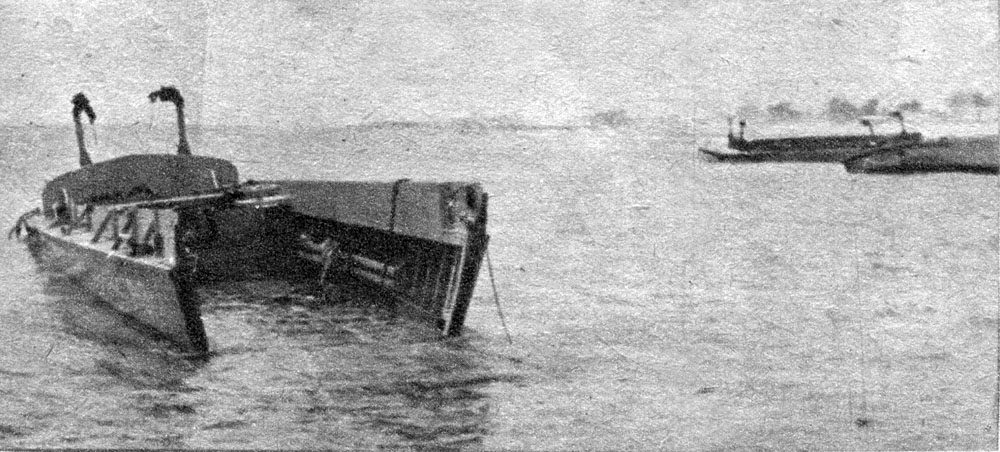
Brigade 2506 landing craft approaching the Cuban coast. The force of approximately 1,500 men was trained by the CIA at camps in Guatemala.
The men of Brigade 2506 were not mercenaries. They were Cuban exiles (doctors, students, farmers, former soldiers) who had fled Castro's revolution and were desperate to take their country back. They trained at CIA camps in Guatemala, primarily at a base called Retalhuleu (codenamed JMTrax), where American Green Beret advisors taught them infantry tactics, weapons handling, and small-unit operations.
The brigade ultimately numbered around 1,500 men organized into six battalions. They had mortars, recoilless rifles, bazookas, and light tanks, specifically M41 Walker Bulldogs that the CIA had procured through intermediaries. It was a force that could have been effective in the right circumstances. But the right circumstances required air supremacy, and air supremacy required destroying Castro's air force before the landing.
The air component of the operation was the most critical, and the most vulnerable to political interference. The CIA had assembled a small air force of Douglas B-26 Invader bombers, World War II-era medium bombers that had been pulled from surplus and repainted in Cuban Air Force markings. The B-26 was a capable ground-attack aircraft, in 1945. By 1961, it was obsolete. It was slow, it was vulnerable, and it had no business operating in an environment where any opposition existed.
That opposition took the form of three Lockheed T-33 jet trainers and a handful of Hawker Sea Furies that Castro's air force kept operational. The T-33 was not designed as a combat aircraft. It was a training jet. But a training jet with machine guns is still a jet, and a jet is faster than a propeller-driven bomber by a margin that is not survivable. The entire operation hinged on eliminating those jets before the landing began.
The Air Strikes That Never Finished
On April 15, 1961, two days before the invasion, eight B-26 Invaders launched from Nicaragua to strike three Cuban airfields. The bombers were painted with Cuban Air Force insignia, and the cover story was that they were flown by defecting Cuban pilots. One B-26 was even shot up on the ground beforehand and flown to Miami, where its pilot, a CIA operative, claimed he had defected after attacking his own base.
The ruse fooled almost no one. At the United Nations, Cuban ambassador Raúl Roa immediately identified the aircraft as American-supplied. U.S. Ambassador Adlai Stevenson, who had not been told about the operation, defended the cover story in front of the General Assembly, and was humiliated when the truth emerged. The political fallout was immediate and severe.
The first air strike was partially successful. Several of Castro's aircraft were destroyed on the ground, including some of his B-26 bombers. But the critical targets, the T-33 jets and the Sea Furies, survived. A second strike was planned for April 16 to finish the job. It would have been the difference between success and catastrophe.
Kennedy cancelled it.
The president, alarmed by the international outcry over the first strike and desperate to maintain some shred of plausible deniability, ordered the second round of air strikes called off. His national security team, led by McGeorge Bundy, conveyed the decision to the CIA late on April 16. Bissell protested. The military liaison, Marine Colonel Jack Hawkins, explicitly warned that without the second strike the invasion would fail. Kennedy held firm.
That decision, made in the White House on a Sunday evening, sealed the fate of 1,500 men.
Landing in the Dark
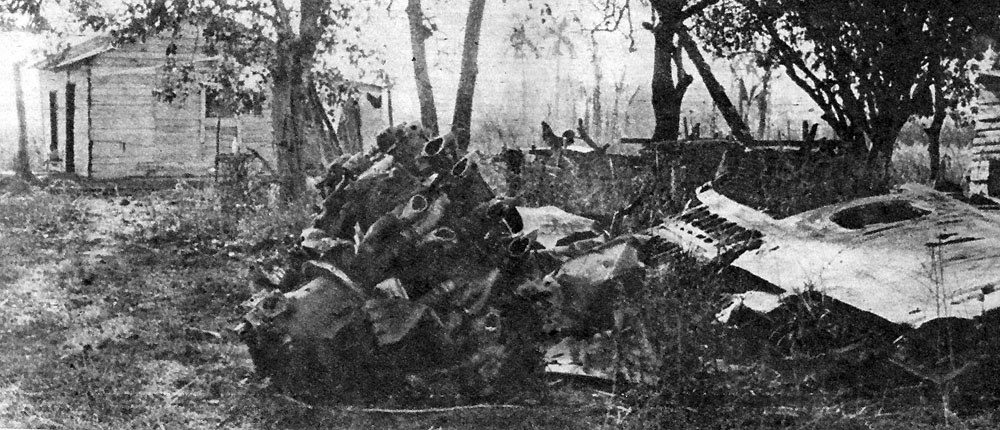
The wreckage of a Brigade 2506 B-26 shot down over Cuba. The World War II-era bombers proved fatally vulnerable to Castro's T-33 jet trainers.
The landing began shortly after midnight on April 17, 1961. Brigade 2506 approached the Bay of Pigs, Bahía de Cochinos, in a collection of transport ships and landing craft. The bay had been chosen as an alternative to the original landing site at Trinidad, which Kennedy had rejected as too conspicuous. The Bay of Pigs was more remote, but it came with its own problems.
The first problem was coral. CIA planners had identified what they believed to be seaweed in aerial photographs of the bay. It was not seaweed. It was coral reef: sharp, boat-shredding coral that tore the bottoms out of landing craft and forced men to wade hundreds of yards through chest-deep water under fire. Equipment was lost. Radios were soaked. The careful timetable began disintegrating before the first man reached dry ground.
The second problem was that Castro knew they were coming. Cuban intelligence had been tracking the exile movement for months. Castro had informants inside the brigade's training camps. When the B-26 strikes hit on April 15, Castro immediately ordered a full military mobilization and dispersed his remaining aircraft to secondary airstrips. By the time Brigade 2506 hit the beach, the Cuban army was already moving toward the landing zone.
Despite these obstacles, the brigade's initial assault was not a complete failure. Paratroopers seized key road junctions inland. The beachhead battalions fought off Cuban militia probes through the night and into the morning. For a few hours on April 17, it appeared that the landing force might hold.
Then Castro's jets arrived.
The T-33 Problem
The T-33 jets that Kennedy's cancelled air strike had left intact now demonstrated exactly why they mattered. On the morning of April 17, a T-33 and a Sea Fury attacked the brigade's supply ships. The freighter Houston was hit and forced to beach itself. The Rio Escondido, carrying ammunition, fuel, and communications equipment, was struck by a rocket and exploded. Ten days' worth of supplies and most of the brigade's ammunition went to the bottom of the bay.
The true story of the Battle off Samar, where a handful of American destroyers and escort carriers took on the entire Japanese Center Force at the Battle of Leyte Gulf. One of the most lopsided naval engagements in history, told with the intensity it deserves.
Without those supplies, the brigade was fighting on borrowed time. The remaining transport ships, terrified of the air attacks, pulled back beyond the horizon. Brigade 2506 was now stranded on the beach with the ammunition in their pockets and whatever had made it ashore in the first chaotic hours.
The B-26 Invaders that were supposed to provide air support were being slaughtered. Cuban T-33 jets, flying faster, climbing higher, and maneuvering more easily than the lumbering World War II bombers, shot them out of the sky over the beachhead. The B-26 pilots, a mix of Cuban exiles and American CIA contract pilots, flew with extraordinary courage. They made run after run against Cuban ground forces, absorbing ground fire and jet attacks. But courage cannot close a 200-mph speed differential.
Four American CIA pilots, Thomas "Pete" Ray, Leo Baker, Riley Shamburger, and Wade Gray, were killed flying combat missions over Cuba. Their deaths were classified for decades. The American government denied their existence. Their families were told nothing. Ray's body was kept in a Cuban morgue freezer for 18 years before it was returned to the United States.
Collapse
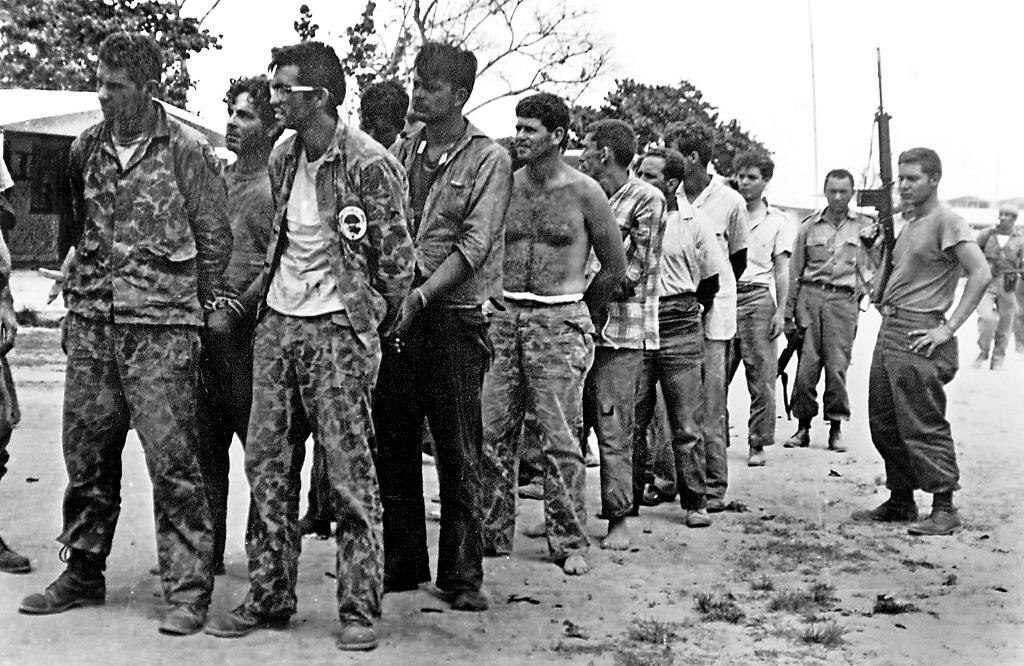
Captured members of Brigade 2506 under guard after the invasion's collapse. Of the approximately 1,500 men who landed, 1,189 were taken prisoner.
By April 18, the situation was hopeless. Cuban army units, led by Castro personally in some sectors, were closing in from three directions. The brigade had almost no ammunition left. Calls for resupply and reinforcement went unanswered. The popular uprising that the CIA had predicted with such confidence never happened. Cuban citizens did not rise against Castro. If anything, the invasion rallied support for the revolution.
The last organized resistance collapsed on April 19. Small groups of brigade members tried to escape into the swamps of the Zapata Peninsula, but the terrain was brutal: dense mangrove, crocodile-infested waterways, and no food. Most were rounded up within days. A few evaded capture for weeks before being caught.
The final tally was devastating. Of approximately 1,500 men who landed, 114 were killed in action and 1,189 were captured. Nine were killed aboard the supply ships. The remaining few managed to escape by sea or were never accounted for. On the Cuban side, approximately 176 soldiers and militia were killed, a reminder that the fighting, while lopsided, had been real.
The Prisoner Exchange
The captured members of Brigade 2506 spent the next twenty months in Cuban prisons. Castro initially demanded 500 tractors for their return, a proposal designed to humiliate the United States. The Kennedy administration, keenly aware that 1,189 men were in prison because of a plan that had been approved at the highest levels of the American government, negotiated quietly through intermediaries.
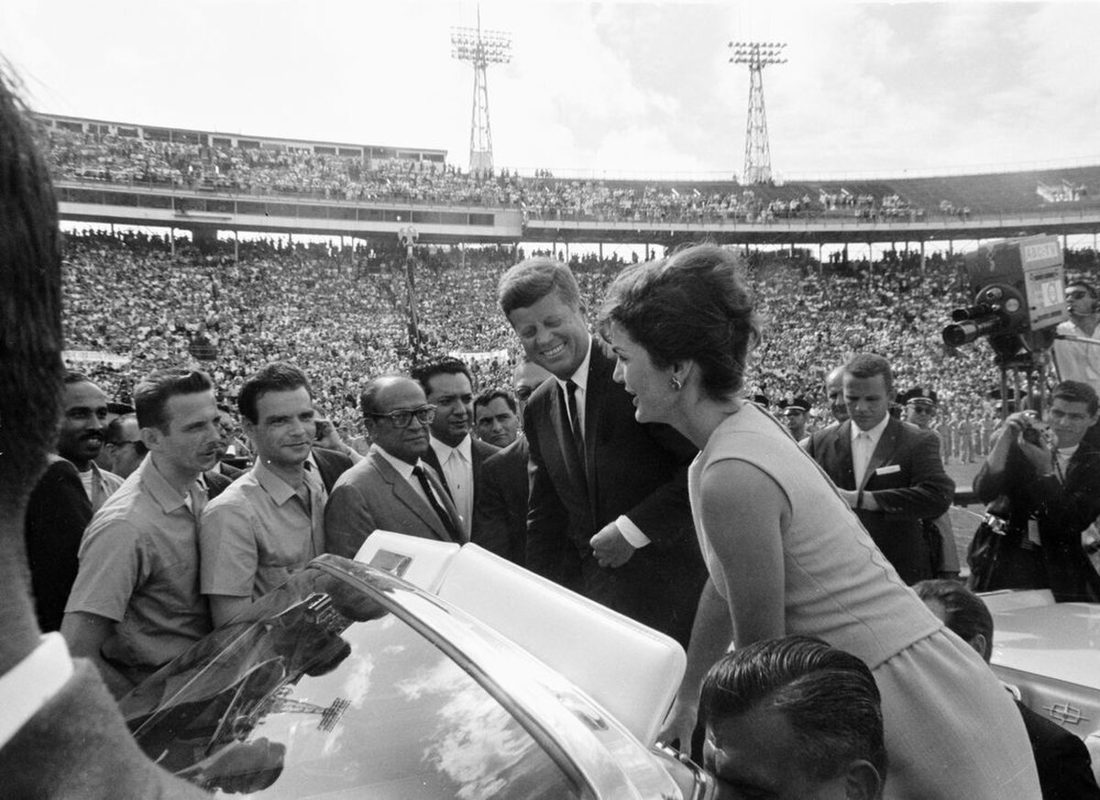
The final deal, completed in December 1962, exchanged the prisoners for $53 million in food and medicine, a ransom paid in all but name. The released prisoners were flown to Miami, where they were met by enormous crowds. On December 29, 1962, President Kennedy met with Brigade 2506 veterans at the Orange Bowl in Miami. The brigade's flag was presented to him. "I can assure you," Kennedy told them, "that this flag will be returned to this brigade in a free Havana."
President Kennedy greets Brigade 2506 veterans at the Orange Bowl in Miami, December 29, 1962, following the prisoner exchange. It was a moment of reconciliation, and a tacit admission of responsibility.
It never was. The flag remains in the Kennedy Library in Boston.
Why It Failed
The post-mortem on the Bay of Pigs, conducted by General Maxwell Taylor at Kennedy's request, identified failures at every level. The military planning was amateurish: the CIA had never conducted an amphibious invasion and did not consult adequately with the military professionals who had. The intelligence was wrong: the Agency's assessment of anti-Castro sentiment inside Cuba was based on wishful thinking, not evidence. The operational security was nonexistent: the invasion was one of the worst-kept secrets in the history of covert operations.
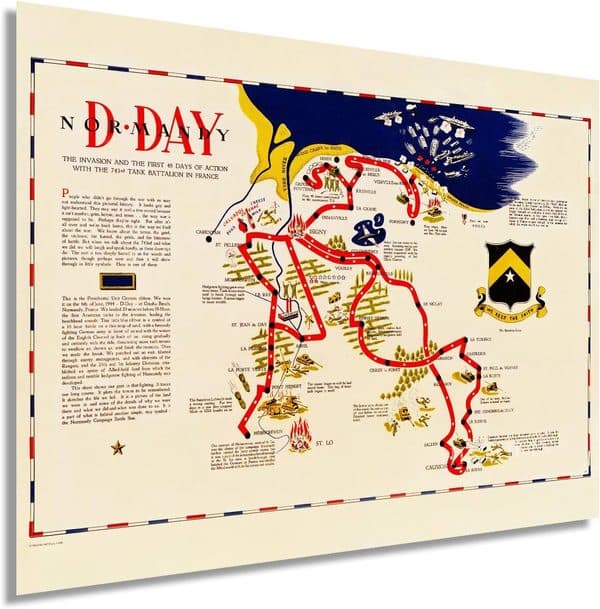
An archival reproduction of the actual D-Day operational map from the Library of Congress collection, printed on heavyweight matte stock at 18x24 inches.
But the proximate cause of failure was the cancelled second air strike. Without air supremacy, the brigade's supply ships were sitting targets. Without supplies, the beachhead was unsustainable. Without a sustainable beachhead, there was no staging area for a provisional government. The entire chain of logic that justified the operation depended on controlling the sky over the Bay of Pigs, and that control was surrendered by presidential order on the evening before the landing.
Kennedy accepted responsibility publicly. Privately, he was furious: at the CIA for presenting the plan as viable, at the Joint Chiefs for not objecting more forcefully, and at himself for approving an operation he had doubted from the beginning. He fired Allen Dulles as CIA director and replaced Bissell. He told his advisors, famously, that "victory has a hundred fathers and defeat is an orphan."
The Consequences That Mattered
The Bay of Pigs did not end with the prisoner exchange. Its consequences rippled through the Cold War for decades.
The most immediate consequence was the Cuban Missile Crisis. Historians have argued persuasively that the Bay of Pigs was a direct cause of Nikita Khrushchev's decision to place nuclear missiles in Cuba in October 1962. The Soviet premier concluded from Kennedy's handling of the invasion (the halfway commitment, the cancelled air strikes, the unwillingness to intervene openly) that the young American president was weak and could be pressured. The missiles were Khrushchev's gamble that Kennedy would not push back. He was wrong about that, but the gamble brought the world closer to nuclear war than it has ever been.
The Bay of Pigs also cemented Castro's position domestically. Before the invasion, his government faced genuine internal opposition. After it, he had a rallying cry (evidence that the United States was actively trying to overthrow him) that silenced domestic critics and justified the consolidation of a one-party state. The invasion that was supposed to topple Castro made him stronger.
For the American intelligence community, the Bay of Pigs was a watershed. It led directly to the restructuring of the CIA's relationship with the White House and the creation of new oversight mechanisms. It established a principle that has been tested repeatedly since: covert operations that require military-scale resources and carry strategic-level consequences should not be planned and executed by intelligence agencies operating outside the normal chain of command.
Sixty-five years later, the lesson remains: a plan built on assumptions that no one is willing to test is not a plan. It is a hope. And at the Bay of Pigs, hope was not enough.