Skip to content
April 17:Bay of Pigs Invasion Begins65yr ago

How a Carrier Strike Group Defends Itself in Layers — From 1,000 Miles Out to Point-Blank Range

Nathan Cole · · 13 min read
Save
Share:
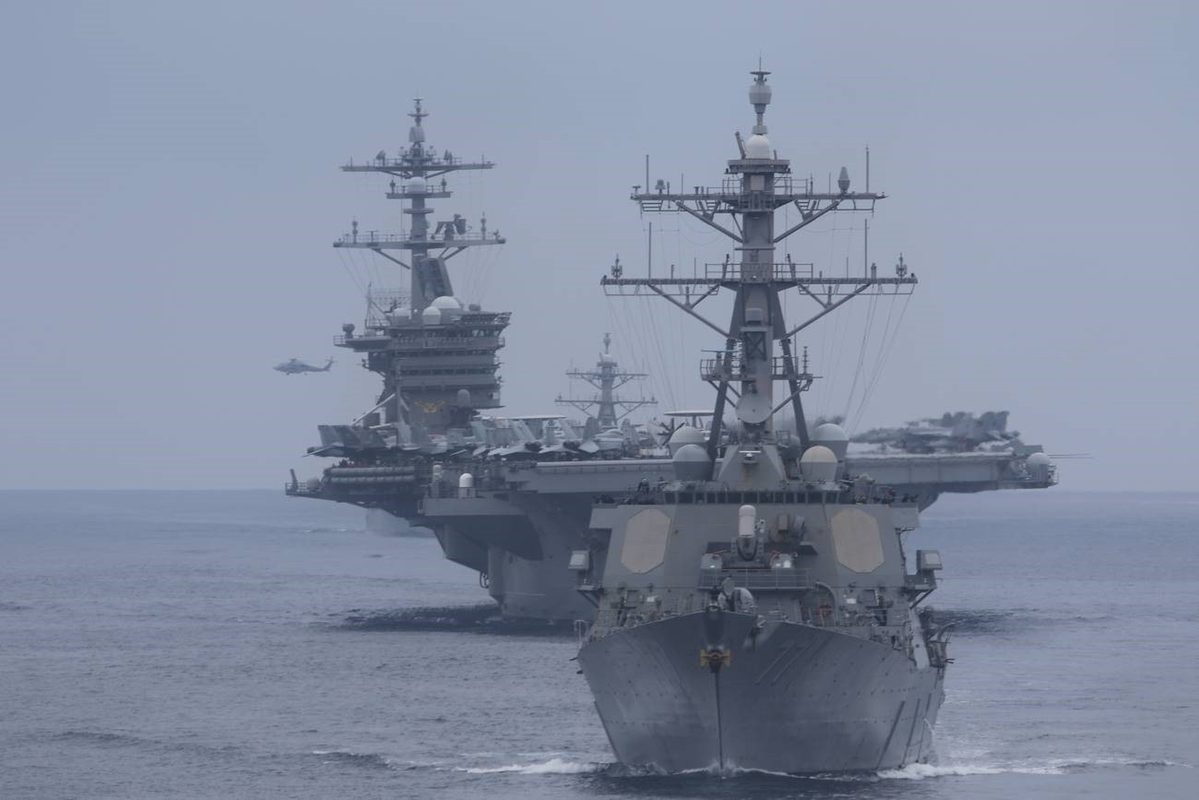
Multiple U.S. Navy warships sailing in formation as part of a carrier strike group exercise in the Pacific Ocean
Nathan Cole
Nathan Cole

Naval Warfare & Maritime Systems Analyst

Nathan Cole covers naval warfare, maritime strategy, and the ships and submarines that project power across the world's oceans. His work focuses on fleet architecture, carrier operations, and how navies adapt to threats from missiles, drones, and undersea warfare.

A carrier strike group is the most defended mobile asset on Earth. It has to be — a Nimitz-class aircraft carrier represents a $13 billion investment, carries 5,000 sailors, and operates 75 aircraft that project power across thousands of square miles of ocean. Losing one would be the most catastrophic military event since Pearl Harbor. So the Navy wraps each carrier in overlapping layers of defense that begin over 1,000 miles from the ship and extend all the way down to the last-ditch weapons systems that engage threats at point-blank range. An incoming missile has to survive every single layer to reach the carrier. Here's how each one works.

The Strike Group: What's in the Formation

A typical carrier strike group (CSG) consists of one aircraft carrier, one Ticonderoga-class guided-missile cruiser (though these are being phased out and replaced by additional destroyers), four to six Arleigh Burke-class guided-missile destroyers, one or two Los Angeles-class or Virginia-class attack submarines, and one or two supply ships. The exact composition varies by deployment and mission, but this is the standard configuration. Each ship in the formation has a specific defensive role, and the group's layered defense depends on all of them working together through the Aegis Combat System — the integrated radar and weapons network that ties the entire group's sensors and weapons into a single coordinated picture.

The ships don't sail bunched together like a convoy. A carrier strike group's warships spread across thousands of square miles of ocean, with individual ships positioned to maximize sensor coverage and weapons engagement zones. The submarines operate ahead of and around the surface group, often at distances of 50 to 100 miles, and their exact positions are known only to the strike group commander. This dispersal means that an adversary must find and target multiple ships spread across a vast area, not a single cluster.
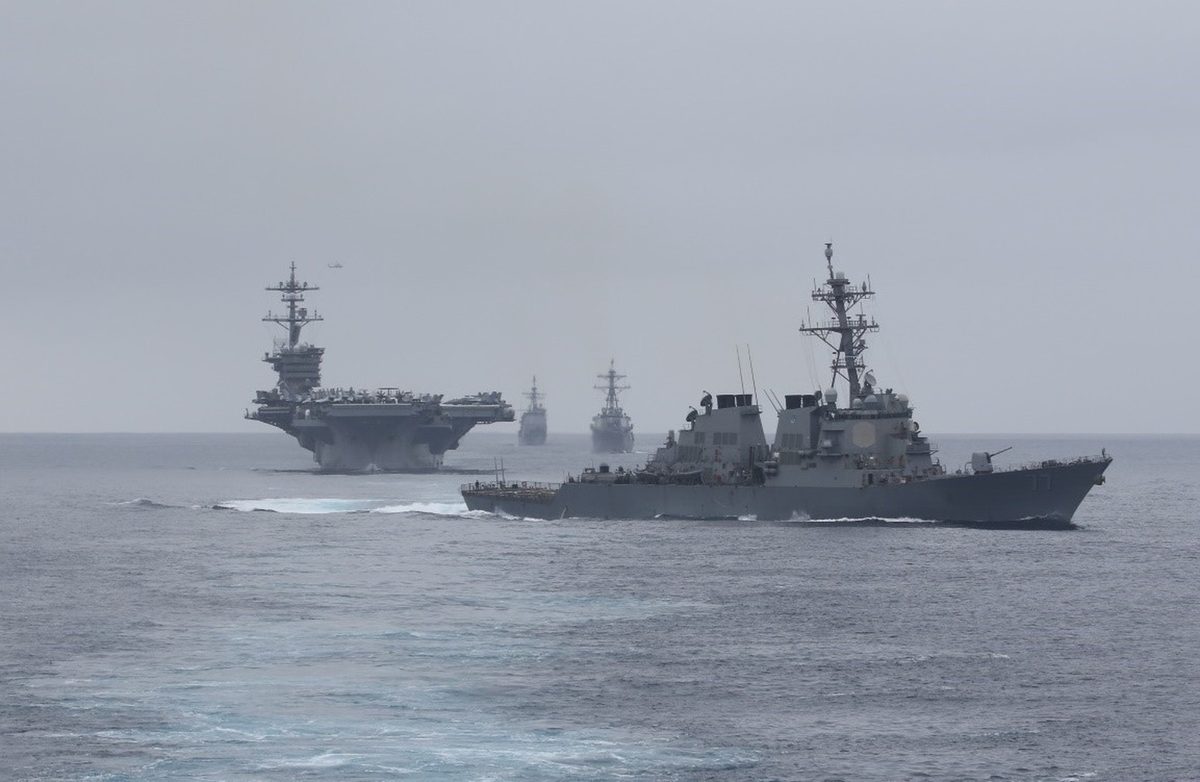
Ships of Carrier Strike Group 1 steaming in formation in the Pacific Ocean with aircraft overhead
Ships from Carrier Strike Group 1 sail in formation during a photo exercise. In actual operations, these ships would be spread across thousands of square miles of ocean. (U.S. Navy photo)

Layer 1: Long-Range Detection and Combat Air Patrol (1,000+ Miles)

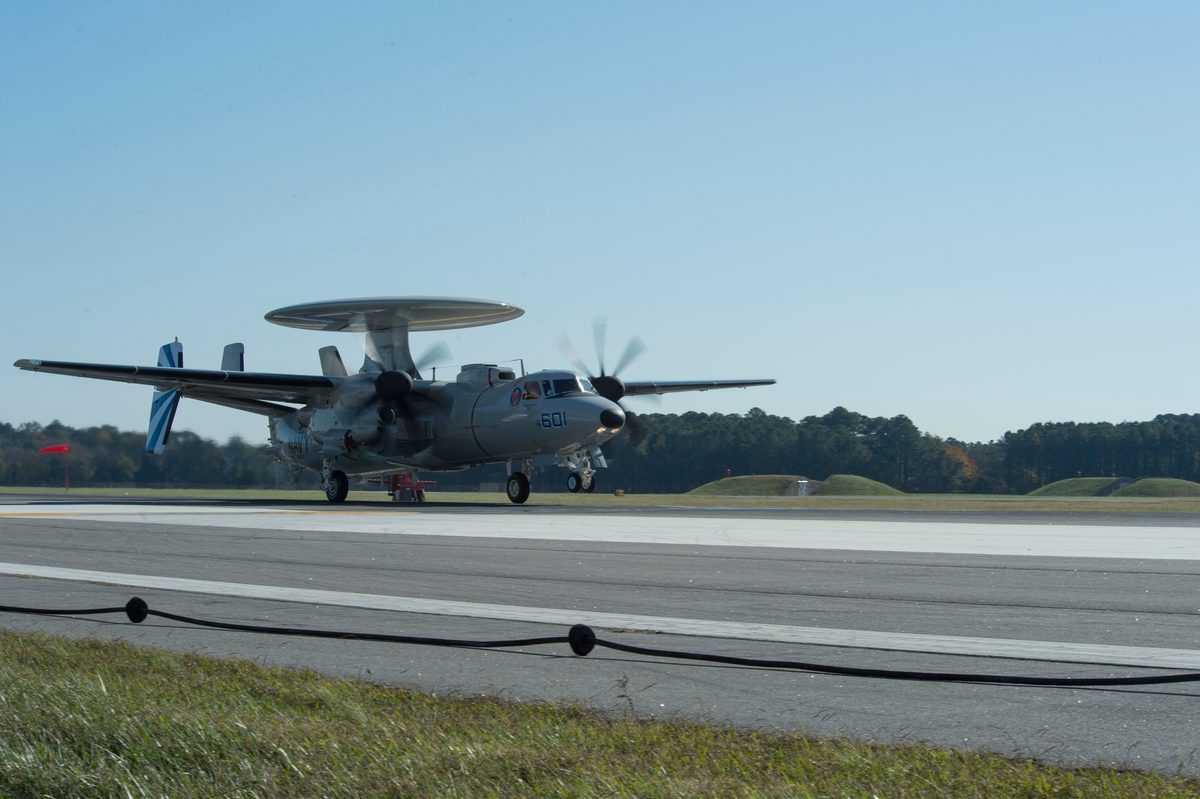
The outermost defensive layer begins over 1,000 miles from the carrier, where E-2D Advanced Hawkeye airborne early warning aircraft orbit at 25,000 feet, scanning the horizon with their AN/APY-9 radar. The E-2D's radar can detect aircraft, cruise missiles, and even some ballistic missile threats at ranges exceeding 350 nautical miles. Two Hawkeyes typically orbit at opposite sides of the formation, providing 360-degree radar coverage that extends the strike group's detection range far beyond what the ship-based radars can see.

The Hawkeyes don't just detect threats — they direct the fighters to intercept them. F/A-18E/F Super Hornets fly combat air patrol (CAP) stations 200 to 400 miles from the carrier, armed with AIM-120D AMRAAM missiles that can engage targets at ranges exceeding 100 miles. In a high-threat environment, the carrier can sustain multiple CAP stations around the clock, cycling fresh fighters from the flight deck every few hours. This means that an incoming aircraft or cruise missile must first survive interception by fighters that have been vectored onto it by the Hawkeye's radar — fighters that are actively looking for it and can shoot it from beyond visual range.

E-2D Advanced Hawkeye aircraft launching from an aircraft carrier flight deck for airborne early warning patrol
An E-2D Advanced Hawkeye launches for an airborne early warning patrol. The Hawkeye's radar extends the strike group's detection range to over 350 nautical miles. (U.S. Navy photo)

The attack submarines provide a parallel layer of long-range defense. Virginia-class submarines patrol ahead of the strike group, listening for the acoustic signatures of enemy submarines that might be positioning for a torpedo attack. The submarine threat is arguably the most dangerous one a carrier faces — a modern diesel-electric submarine running on batteries is extremely quiet and can fire wake-homing torpedoes from ranges of 20 to 30 miles. The strike group's submarines hunt these threats before they can get close enough to attack.

Layer 2: Area Air Defense — SM-6 (200-300 Miles)

If a threat survives the fighters and penetrates to within 200 to 300 miles of the formation, it enters the engagement zone of the Standard Missile 6 (SM-6), the Navy's longest-range surface-to-air missile. The SM-6 combines the airframe of the SM-2 with an active radar seeker derived from the AIM-120 AMRAAM air-to-air missile, giving it the ability to engage targets at extreme range without requiring continuous radar illumination from the launching ship. This is critical because it means multiple SM-6 missiles can be in flight simultaneously against different targets — each one guiding itself independently after receiving initial targeting data from the Aegis system.

The SM-6 can engage aircraft, cruise missiles, and even ballistic missiles in their terminal phase. It also has a secondary anti-ship capability, using its kinetic energy at impact to damage surface targets. The missile's range and versatility make it the first ship-launched weapon that a threat will encounter, and a single Arleigh Burke-class destroyer carries up to 96 vertical launch system cells that can be loaded with a mix of SM-6, SM-2, ESSM, and Tomahawk missiles.

Layer 3: Medium-Range Defense — SM-2 and ESSM (10-100 Miles)

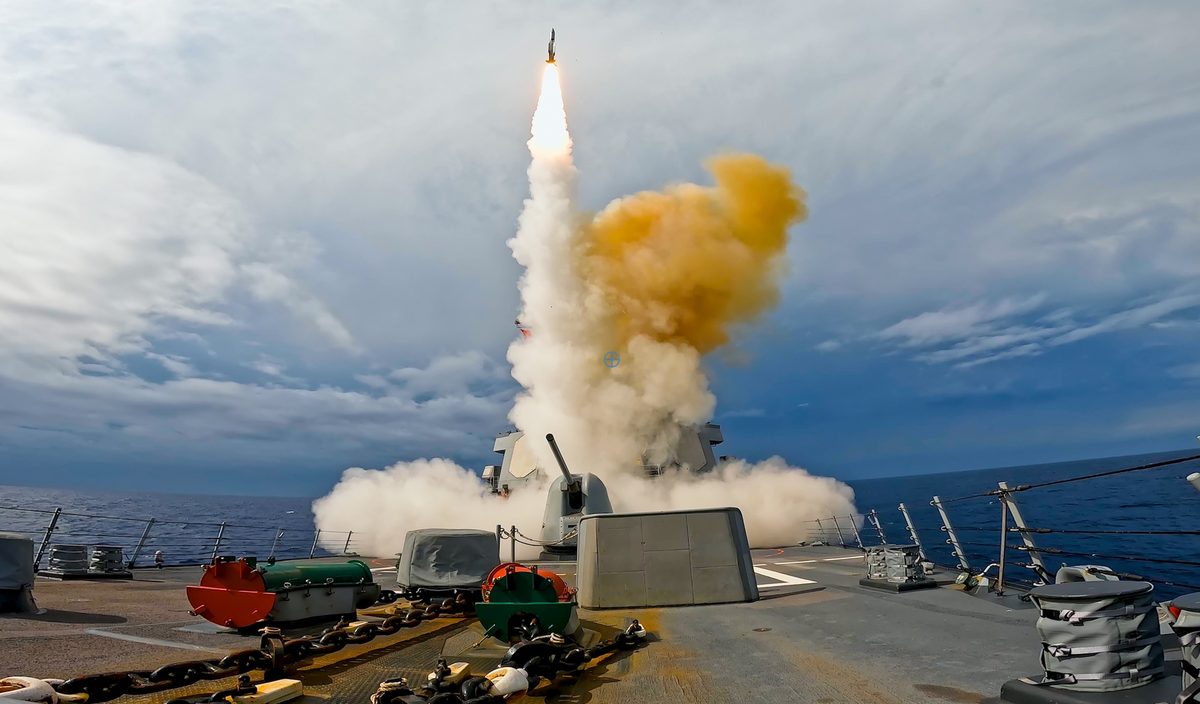
Threats that survive the SM-6 engagement zone enter the coverage of the Standard Missile 2 (SM-2) and the Evolved SeaSparrow Missile (ESSM). The SM-2 is the Navy's workhorse area-defense missile, in service since the 1980s and continuously upgraded. It uses semi-active radar homing — the Aegis system's SPG-62 fire control radars illuminate the target, and the missile homes on the reflected energy. Each Arleigh Burke destroyer has three SPG-62 illuminators, allowing it to engage up to three targets simultaneously in the terminal phase.

Standard Missile 2 launching from an Arleigh Burke-class destroyer's vertical launch system during a live-fire exercise
An SM-2 Standard Missile launches from the vertical launch system of an Arleigh Burke-class destroyer during a live-fire exercise in the Philippine Sea. (U.S. Navy photo)

The ESSM fills the gap between the SM-2's engagement zone and the close-in weapons systems. Four ESSMs can be packed into a single VLS cell — a technique called "quad-packing" — which means a destroyer can carry a large number of these medium-range interceptors without sacrificing cells for other weapons. The ESSM Block 2 variant adds an active radar seeker, freeing it from dependence on the ship's illumination radars and allowing multiple simultaneous engagements. Against sea-skimming anti-ship missiles — the most common threat in modern naval warfare — the ESSM is particularly effective because of its fast reaction time and ability to engage targets at low altitude where the SM-2 and SM-6 may have difficulty tracking.

Layer 4: Close-In Defense — RAM and Phalanx CIWS (1-5 Miles)

If a missile survives three layers of interceptors and reaches the inner ring of the defense, it encounters the final active weapons systems: the Rolling Airframe Missile (RAM) and the Phalanx Close-In Weapon System (CIWS). These are the last-ditch defenses, designed to engage threats that have gotten past everything else.

The RAM is a small, heat-seeking missile fired from a 21-round launcher. It was designed specifically to kill anti-ship cruise missiles at short range — the kind of threat that a Phalanx CIWS would struggle to engage because of its speed and low radar cross-section. The RAM's infrared seeker homes on the heat of the incoming missile's engine or warhead, and its small size allows rapid target engagement. A RAM launcher can fire multiple missiles in quick succession against incoming threats from different directions.

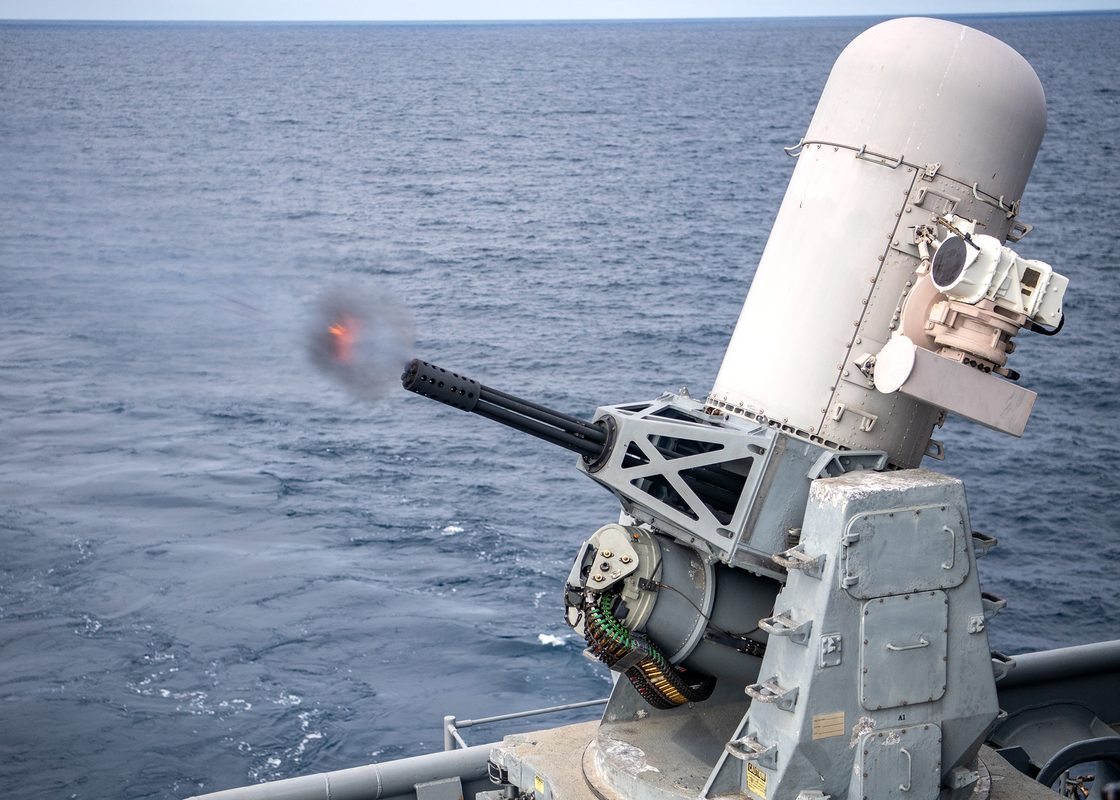
Phalanx CIWS close-in weapon system firing during a live-fire exercise aboard a U.S. Navy warship
A Phalanx CIWS opens fire during a live-fire exercise. The system's 20mm Gatling gun fires 4,500 rounds per minute in fully automatic mode, creating a wall of tungsten between the ship and an incoming missile. (U.S. Navy photo)

The Phalanx CIWS is the last weapon in the chain — a radar-guided 20mm Gatling gun that fires 4,500 rounds per minute of tungsten penetrator rounds. The system is fully autonomous: its own radar detects, tracks, and engages incoming missiles without requiring human input. The Phalanx creates a dense stream of projectiles in the path of an incoming missile, relying on volume of fire to either destroy the missile or damage it enough to cause it to miss. The Phalanx Block 1B variant adds a forward-looking infrared sensor and the ability to engage surface targets and slow-moving air threats like small drones. Every ship in the strike group carries at least one Phalanx mount, and the carriers typically carry two or three.

Layer 5: Electronic Warfare and Decoys

Running parallel to every physical defensive layer is an electronic warfare layer that attempts to prevent threats from finding the strike group in the first place — or to confuse them if they do. The AN/SLQ-32 electronic warfare system, installed on every major warship, can detect, classify, and jam incoming radar-guided missiles. It can also identify the radar emissions of enemy aircraft, ships, and shore-based targeting systems at long range, providing early warning that the strike group is being tracked.

The Nulka active decoy is an expendable rocket-propelled device that hovers in the air near the ship and broadcasts a radar signal that mimics the radar return of a warship. To an incoming radar-guided missile, the Nulka looks more like a ship than the actual ship does. Multiple Nulkas can be launched simultaneously to create false targets that draw missiles away from the real ships. Against infrared-guided threats, the ships can deploy flares and chaff — clouds of metallic strips that create false radar returns.

The AN/SLQ-25 Nixie is a towed torpedo decoy — a device pulled behind the ship on a cable that generates acoustic noise mimicking the ship's propeller and hull signature. Torpedoes that home on acoustic signatures are drawn toward the Nixie instead of the ship. The Nixie is particularly important because torpedo defense is one of the few areas where the carrier strike group has limited active defensive options — there is no ship-launched anti-torpedo weapon in the current U.S. Navy inventory, though the Surface Ship Torpedo Defense system is being fielded.

What Gets Through?

The honest answer is: nothing is guaranteed to get through, and nothing is guaranteed to be stopped. The layered defense is designed to impose such a high attrition rate on incoming threats that no salvo can succeed. If an adversary launches 20 anti-ship cruise missiles at a carrier strike group, the defense might kill 18 to 19 of them across all layers. The question is whether the one or two that survive can find and hit the carrier specifically, rather than one of the escort ships or a decoy.

The threats that concern the Navy most are the ones designed to defeat layered defense: hypersonic anti-ship ballistic missiles like China's DF-21D and DF-26, which approach at speeds exceeding Mach 5 and follow trajectories that existing SM-2 and ESSM interceptors were not originally designed to counter. The SM-6 has demonstrated ballistic missile defense capability in testing, and the Navy is investing heavily in directed-energy weapons (lasers) and the Aegis Baseline 10 upgrade to counter hypersonic threats. But the threat is evolving as fast as the defense.

Saturation attacks — launching more missiles than the defense has interceptors to engage — remain the most straightforward way to overwhelm a carrier strike group. A strike group with six escort ships carries roughly 500 to 600 VLS cells total, but not all of those are loaded with anti-air missiles (many carry Tomahawk cruise missiles or anti-submarine rockets). If an adversary can launch 200 or more anti-ship missiles simultaneously from multiple directions, the math of interception becomes extremely challenging. This is the scenario the Navy's investment in directed-energy weapons is designed to address — a laser that never runs out of ammunition could theoretically engage an unlimited number of incoming missiles.

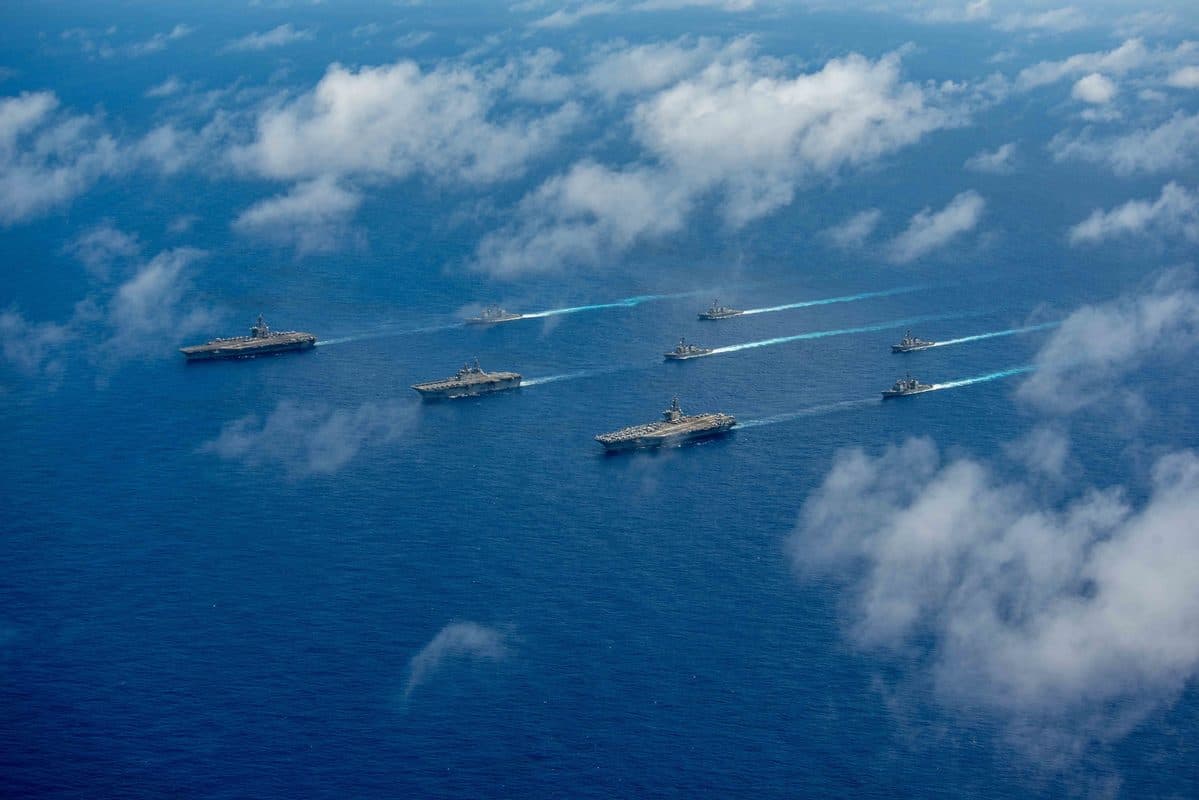
Aerial view of carrier strike group ships steaming in formation across open ocean
A carrier strike group in formation during a photo exercise. Each ship in the formation has a specific defensive role, and the Aegis Combat System ties all their sensors and weapons into a single coordinated picture. (U.S. Navy photo)

The System, Not the Ship

The most important thing to understand about carrier strike group defense is that no single ship, weapon, or sensor provides the capability. The defense works because every element — the Hawkeyes, the fighters, the submarines, the Aegis-equipped escorts, the electronic warfare systems, and the close-in weapons — is integrated into a single coordinated network. The Cooperative Engagement Capability (CEC) allows any ship in the formation to fire a weapon guided by another ship's sensor data. An SM-6 launched from a destroyer on the eastern edge of the formation can be guided by radar data from a cruiser on the western edge, or from an E-2D Hawkeye orbiting overhead. This network-centric approach means the defense is greater than the sum of its parts.

Seven layers. Hundreds of interceptors. Multiple overlapping sensor systems. Electronic warfare and decoys. Attack submarines hunting ahead of the formation. Fighters on combat air patrol hundreds of miles out. And at the center of it all, a carrier that can generate 150 combat sorties per day if the threat demands it. The carrier strike group's layered defense is not perfect — no defense is. But it is the most formidable mobile defensive system ever deployed on the ocean, and any adversary that wants to sink a carrier has to defeat all of it, simultaneously, to have a chance.

Share this article

Share:

Recommended

Ace of The Skies: Can You Identify These Military Aircraft Throughout The Years?
Test Yourself

Ace of The Skies: Can You Identify These Military Aircraft Throughout The Years?

Can you identify these aircraft?

Take the Quiz

On This Day in Military History

April 16

Battle of Seelow Heights Begins (1945)

Soviet forces under Marshal Georgy Zhukov launched a massive assault on the Seelow Heights, the last major defensive line before Berlin. Over one million Soviet troops attacked 100,000 entrenched German defenders in one of the bloodiest battles of the final weeks of WWII. The Soviets used 143 anti-aircraft searchlights to blind German defenders in a predawn attack.

1746Battle of Culloden

1945USS Laffey Survives 22 Kamikaze Attacks

See all 5 events on April 16

Get Military News & History in Your Inbox

Join thousands of readers receiving our weekly digest of military technology, history, and analysis.

Test Your Knowledge