Michael Trent covers military aircraft, weapons systems, and defense technology with an emphasis on cost, maintenance, and real-world performance. He focuses less on specifications and more on how systems hold up once they are deployed, maintained, and operated at scale.
South Korea went from no fighter program to first production aircraft in seven years. The F-35 took twenty-five. That single comparison tells you almost everything you need to know about what the KF-21 Boramae is, and what it is not.
The KAI KF-21 Boramae, "Young Hawk" in Korean, rolled off the production line in March 2026, marking one of the most ambitious defense-industrial achievements of the 21st century. A nation that had never independently designed a combat aircraft produced a twin-engine, AESA-equipped, supersonic fighter in less time than it takes the Pentagon to complete a major acquisition milestone review. The KF-21 is expected to achieve initial operational capability by September 2026.
The F-35A Lightning II, by contrast, traces its origins to the Joint Advanced Strike Technology (JAST) program of 1993 and the Joint Strike Fighter competition of 1996. First flight occurred in 2006. Initial operational capability was not declared until 2016, twenty years after the competition began and a decade after first flight. Full-rate production was not approved until 2024. The program has cost, in total, well over $400 billion in development and procurement.
These timelines exist for reasons. The F-35 is a fundamentally more ambitious aircraft than the KF-21. But the KF-21 exists because an increasing number of countries have concluded that the F-35's level of ambition, and its price tag, exceed what they actually need.
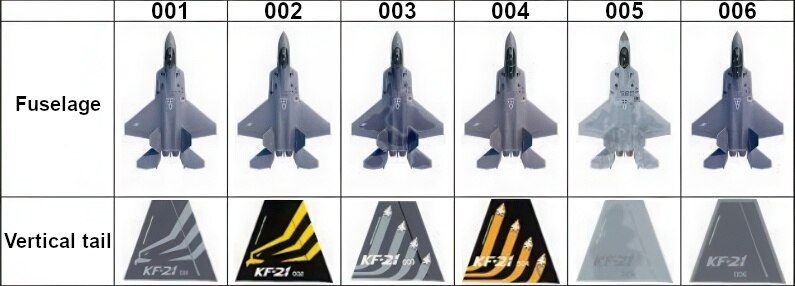
The KF-21 prototype reveals its design philosophy clearly: a clean, modern airframe optimized for performance and manufacturability rather than all-aspect stealth.
The KF-21 is a 4.5-generation fighter. That designation matters, because it defines both the aircraft's capabilities and its limitations. In its Block I configuration, the variant entering production now, the KF-21 carries its weapons externally, on pylons under the wings and fuselage, exactly like an F-16 or Eurofighter Typhoon. It has no internal weapons bay.
This is the single most important distinction between the KF-21 and the F-35. The F-35's stealth depends on carrying its weapons internally, missiles and bombs tucked inside the fuselage where they cannot reflect radar energy. The moment an F-35 opens its weapons bay doors, its radar cross-section spikes. But with the doors closed, the aircraft presents a frontal RCS that is a tiny fraction of a conventional fighter's.
The KF-21 Block I makes no attempt to match this. Its external pylons give it a conventional radar signature, orders of magnitude larger than the F-35's. Korea Aerospace Industries has designed the airframe with reduced-signature features: canted vertical stabilizers, a blended wing-body design, radar-absorbent coatings, and careful attention to edge alignment. These features reduce the radar cross-section compared to older fighters, but they do not achieve stealth. The KF-21 Block I is stealthy the way a crocodile is camouflaged, better than nothing, not as good as invisible.
Block II, scheduled for development starting in the late 2020s, will add internal weapons bays and further signature reduction. The South Korean defense establishment has been explicit that Block II will approach, though not match, 5th-generation capability. Whether Block II ever achieves true stealth remains to be seen, but the airframe was designed from the outset to accommodate internal carriage.
What the KF-21 Does Well
If the KF-21 is not a stealth fighter, what justifies its existence? Several things.
Speed of development. The KF-21 program moved from detailed design to first flight in approximately four years (2017-2022) and from first flight to first production in four more. By comparison, the F-35 spent thirteen years between detailed design start and IOC. South Korea achieved this pace by making deliberate choices about what to include and what to defer. Block I uses proven, available technologies, GE F414 engines, a Hanwha Systems AESA radar derived from Israeli technology, European electronic warfare suites, rather than developing everything from scratch. The result is an aircraft that works now rather than an aircraft that will work perfectly in 2035.
Cost. The KF-21's estimated unit cost is approximately $65 million, roughly 20 percent less than the F-35A's current unit cost of approximately $80 million. More importantly, the operating cost is expected to be significantly lower. The F-35's cost per flight hour remains above $30,000 despite years of sustainment optimization. The KF-21, with twin conventional engines and less exotic materials, should be substantially cheaper to operate. For air forces that need to fly 200+ sorties per month, operating cost matters more than procurement cost.
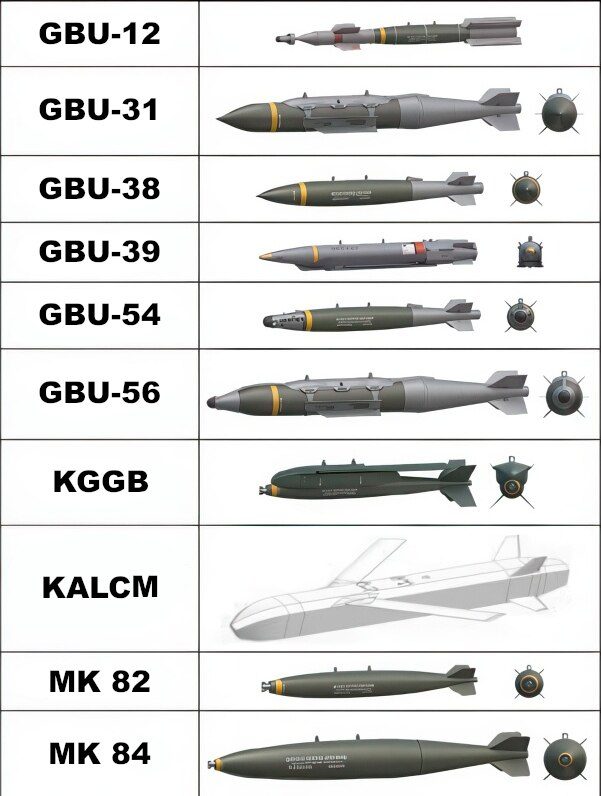
The KF-21's external weapons configuration displays its versatility: the aircraft can carry a wide range of air-to-surface munitions on its hardpoints, though external carriage comes at the cost of radar signature.
Performance envelope. The KF-21 is powered by two General Electric F414-GE-400K engines producing approximately 22,000 pounds of thrust each in afterburner. This gives the aircraft a maximum speed of Mach 1.81 and a combat radius of approximately 550 kilometers with a combat load. These are not exceptional numbers by modern standards, but they are solidly competitive with the Eurofighter Typhoon, the Dassault Rafale, and indeed the F-35A, which, despite its technological sophistication, is not a particularly fast or maneuverable aircraft. The F-35A tops out at Mach 1.6.
Sensor capability. The Hanwha Systems AESA radar is a credible modern sensor, capable of tracking multiple targets at extended range and providing the kind of situational awareness that defines 4.5-generation combat. The aircraft also carries a modern electronic warfare suite, an infrared search and track system, and a datalink compatible with NATO standards. It cannot match the F-35's AN/APG-81 radar or its DAS (Distributed Aperture System), a 360-degree infrared sensor network that gives the F-35 pilot unprecedented awareness, but it provides adequate capability for most realistic threat scenarios.
Head-to-Head Comparison
Specification
KF-21 Boramae (Block I)
F-35A Lightning II
Generation
4.5
5th
First Flight
July 2022
December 2006
Program Duration to IOC
~9 years (2017-2026)
~23 years (1993-2016)
Engines
2x GE F414-GE-400K
1x Pratt & Whitney F135
Max Speed
Mach 1.81
Mach 1.6
Combat Radius
~550 km
~1,093 km
Internal Weapons Bay
No (Block I); Planned (Block II)
Yes
Stealth
Reduced signature (not stealth)
Full stealth (all-aspect LO)
Radar
Hanwha AESA
AN/APG-81 AESA
Sensor Fusion
Limited
Full (DAS, EOTS, MADL)
Unit Cost (est.)
~$65 million
~$80 million
Hardpoints
10 external
4 internal + 6 external
Crew
1 (single-seat); 2 (twin-seat variant)
1
What the F-35 Does That the KF-21 Cannot
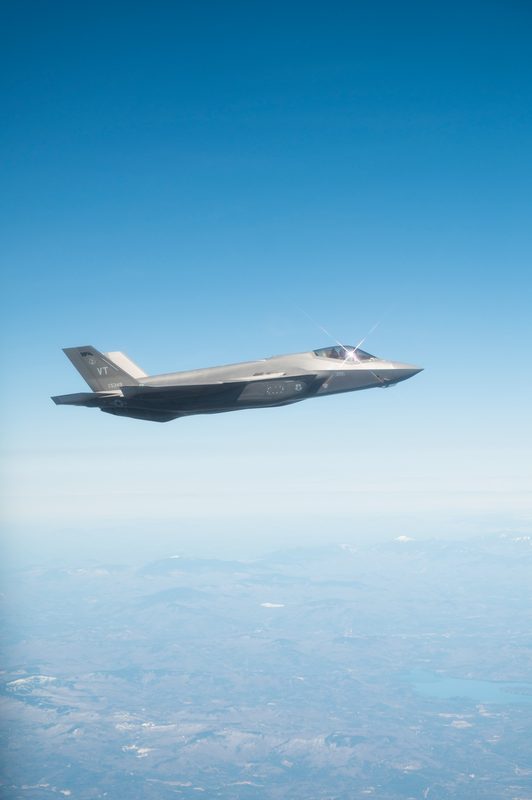
The F-35A's design prioritizes stealth above all other considerations. Its faceted surfaces, internal weapons bays, and radar-absorbent structure make it virtually invisible to conventional radar systems.
The F-35's advantages over the KF-21 are real and they are significant, but they are specific to certain operational scenarios.
Stealth. The F-35's all-aspect low-observable design allows it to operate inside enemy integrated air defense networks where a non-stealthy aircraft would be detected and engaged. This is not a marginal advantage. Against a modern IADS, the kind operated by Russia, China, or Iran, stealth is the difference between surviving the first night and not surviving the first hour. The KF-21 Block I cannot do this. It is not designed to do this.
Sensor fusion. The F-35's most transformative capability is not stealth, it is the way the aircraft integrates data from its radar, infrared sensors, electronic warfare suite, and off-board sources into a single coherent picture on the pilot's helmet-mounted display. The F-35 pilot does not manage sensors. The aircraft manages sensors. The pilot manages the fight. This level of automation reduces cognitive workload and allows a single pilot to maintain situational awareness that would require an entire crew in a previous-generation aircraft. The KF-21 has good sensors, but it does not have this level of integration.
The fighter that swept the Pacific in the war's first year, outclimbing and out-turning every Allied aircraft it faced. 293 reviews at 4.6 stars. About 100 parts for a clean, quick build.
The ecosystem. The F-35 is not just an aircraft. It is a node in a networked combat system. MADL (Multifunction Advanced Data Link) allows F-35s to share targeting data with each other in a stealthy, low-probability-of-intercept format. The aircraft's software, the Autonomic Logistics Information System, provides predictive maintenance and supply chain management. The training system includes full-fidelity simulators that can link pilots across bases and countries. None of this has anything to do with airframe performance. All of it has everything to do with combat effectiveness.
The Export Competition
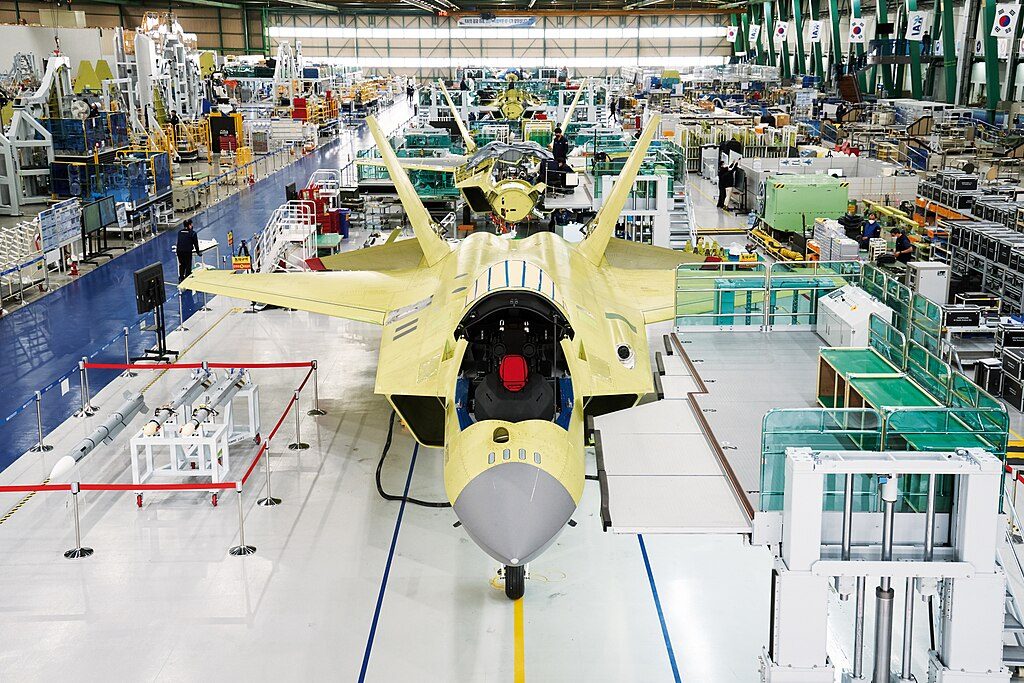
Multiple KF-21 prototypes on the production line at KAI's facility. South Korea plans to build 120 aircraft for its own air force and is aggressively pursuing export customers.
The real competition between the KF-21 and the F-35 is not in the air. It is in the export market, the dozens of countries that need modern fighters but either cannot afford the F-35, cannot obtain it due to political restrictions, or do not need its stealth capability for their specific threat environment.
The F-35's export restrictions are significant. The United States controls who buys the aircraft through the Foreign Military Sales process, and several countries have been denied access for political reasons. Turkey was ejected from the program over its purchase of Russia's S-400 air defense system. The UAE's acquisition remains complicated by technology transfer concerns. Countries like Malaysia, the Philippines, and Colombia are unlikely to receive F-35 approval in the near term.
The KF-21 has no such restrictions, at least not American ones. South Korea controls its own export decisions, subject to domestic law and whatever technology-sharing agreements exist with component suppliers. Indonesia is already a development partner, contributing approximately 20 percent of the program's cost in exchange for technology transfer and a commitment to purchase 50 aircraft. Poland has expressed interest. Several Southeast Asian and Middle Eastern countries have been briefed on the aircraft.
For countries whose primary air defense concern is defending sovereign airspace against non-stealth threats, most countries in the world, in other words, the KF-21 offers approximately 80 percent of the F-35's capability at 80 percent of the cost, with fewer strings attached and faster delivery timelines. Whether 80 percent is good enough depends entirely on who you expect to fight.
The "Good Enough" Argument
The defense-industrial phrase for the KF-21's market position is "good enough." It is a 4.5-generation fighter in an era when 5th-generation aircraft exist. It cannot penetrate advanced air defenses. It cannot hide from modern radars. It does not have the F-35's transformative sensor fusion. But it can fly air superiority missions against any 4th-generation threat. It can deliver precision-guided munitions. It can enforce a no-fly zone. It can patrol maritime boundaries. And it can do all of these things at a price that most medium-power air forces can sustain.
A complete box with kit, Humbrol paints matched to the color scheme, poly cement, and a brush. No separate purchases needed. The Wellington builds into an 11-inch-wingspan twin-engine bomber at 1/72. 1,039 reviews at 4.6 stars.
The history of military procurement suggests that "good enough" often wins. The F-16 was designed as the cheap, simple complement to the F-15, a fighter that sacrificed some capability for affordability and numbers. It became the most successful fighter aircraft in history, with over 4,600 built and operators in 25 countries. The countries that bought F-16s did not buy them because they were the best fighter available. They bought them because they were the best fighter they could afford to fly in the quantities they needed.
The KF-21 is making the same bet. South Korea is gambling that enough countries in the world need a modern, affordable, capable fighter without the baggage of 5th-generation complexity and American export restrictions to sustain a production run of several hundred aircraft. If they are right, the KF-21 will become one of the most significant fighter programs of the 2020s, not because it is the best, but because it is the most relevant to the most buyers.
Seven years from blank sheet to production aircraft. Twenty-five years for the alternative. In the defense business, speed has a quality all its own.