Alex Carter writes about modern warfare, emerging military technology, and how doctrine adapts to new tools. His work focuses on what changes in practice -- command, control, targeting, and risk -- when systems like drones and autonomous platforms become routine.
Stealth aircraft are invisible to radar. They are not invisible to heat.
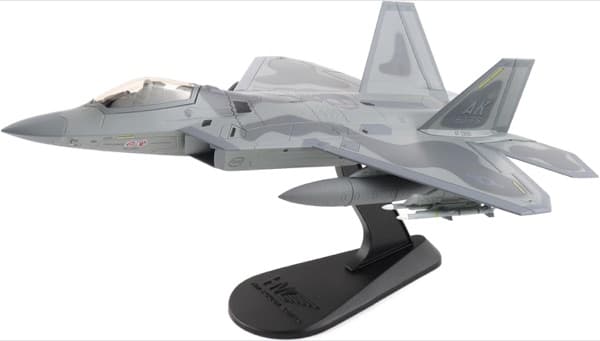
An F-22 Raptor at supercruise, sustaining Mach 1.5 without afterburner, generates skin temperatures exceeding 100 degrees Celsius from aerodynamic friction alone. Its exhaust plume, even with cooled nozzles and bypass air mixing, radiates infrared energy that stands out against the cold background of the upper atmosphere like a flashlight in a dark room. The aircraft's radar cross-section may be smaller than a marble. Its infrared signature is the size of a bonfire.
This is the fundamental vulnerability that Infrared Search and Track systems exploit. IRST is not new, the concept dates to the 1970s, and Soviet fighters have carried infrared sensors since the MiG-29 entered service in 1983. But advances in detector technology, processing power, and sensor fusion have transformed IRST from a supplementary curiosity into the most credible passive counter-stealth technology in operational service today.
Every major fighter aircraft in production or development in 2026 either carries an integrated IRST system or can mount one in an external pod. The technology is mature, it is affordable, and it works. The question is no longer whether IRST can detect stealth aircraft. The question is at what range, under what conditions, and what happens after detection.
An IRST system is, at its core, a passive infrared camera optimized for detecting aircraft-sized heat sources at long range. The sensor itself is typically a cooled focal-plane array, a grid of infrared-sensitive detector elements maintained at cryogenic temperatures (around -200°C) to maximize sensitivity. The cooling is necessary because infrared detectors at room temperature generate so much thermal noise that distant targets become invisible in the background clutter.
The sensor scans the sky in a systematic pattern, either mechanically, by rotating the sensor head, or electronically, by steering the detector's field of view with movable optics. It detects infrared radiation in specific wavelength bands, typically the mid-wave infrared (MWIR, 3-5 micrometers) and long-wave infrared (LWIR, 8-12 micrometers) bands, which correspond to the peak emissions from jet engines and hot airframe surfaces.
When the sensor detects a heat source that matches the expected signature of an aircraft, a specific intensity profile, a movement pattern consistent with powered flight, a spectral signature matching combustion products, it classifies the detection as a track. The system then follows the target across successive scans, building a track file that includes angular position (azimuth and elevation), angular rate of change, and signal intensity.
What IRST does not provide, and this is the technology's most significant limitation, is range. An infrared sensor measures the angle to a target and the intensity of its emissions, but intensity alone cannot reliably determine distance. A small, hot object nearby looks the same as a large, hot object far away. This is called the "angle-only" tracking problem, and it is both the defining characteristic and the defining weakness of passive infrared detection.
The Systems in Service
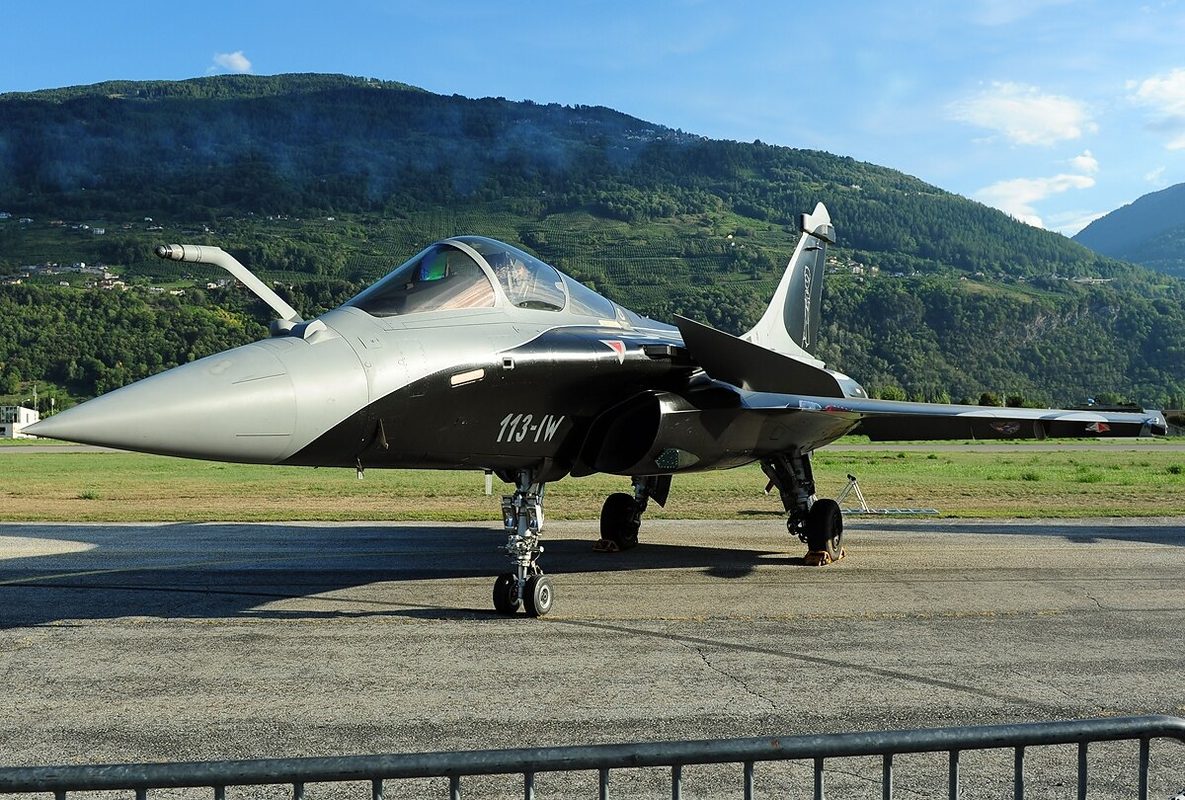
The Dassault Rafale carries its OSF (Optronique Secteur Frontal) IRST system in a housing ahead of the windscreen. The OSF integrates infrared search and track with a television camera for visual identification at range.
The current generation of operational IRST systems represents a dramatic improvement over earlier designs. Five systems dominate the market, each with distinct capabilities and design philosophies.
PIRATE (Eurofighter Typhoon). The Passive Infra-Red Airborne Track Equipment is manufactured by Leonardo and is integrated into every Eurofighter Typhoon. Mounted in a housing ahead of the windscreen on the port side of the nose, PIRATE uses a cooled mercury-cadmium-telluride (MCT) detector array operating in both MWIR and LWIR bands simultaneously. This dual-band capability allows the system to correlate detections across wavelengths, significantly reducing false alarm rates and improving classification accuracy. PIRATE's detection range against a fighter-sized target in afterburner is reported in the 80-150 kilometer range, depending on atmospheric conditions. Against a non-afterburning target, the condition most relevant for detecting stealth aircraft, the range drops significantly but remains operationally useful.
OSF (Dassault Rafale). The Optronique Secteur Frontal is a multi-sensor system that combines IRST with a high-resolution television camera in a single housing. The TV channel allows visual identification of targets at ranges well beyond what the pilot's eyes can achieve, adding a crucial capability: positive identification without using radar. The OSF also provides laser ranging, solving the angle-only problem by actively measuring distance to targets the IRST has already detected. This makes the Rafale's IRST system one of the few that can generate a complete fire-control solution without any radar emission.
OLS-35 (Su-35 Flanker-E). The Russian approach to IRST has always been aggressive. The OLS-35, manufactured by UOMZ, is mounted in a large, spherical housing ahead of the Su-35's windscreen. It combines IRST with a laser rangefinder and a target designator. Russian sources claim detection ranges of up to 90 kilometers against a rear-aspect target and 40 kilometers head-on, figures that should be treated with appropriate skepticism but are not implausible given the system's large aperture and mature detector technology. The OLS-35 also provides laser-guided weapon delivery, giving the Su-35 pilot a precision strike capability that does not require radar.
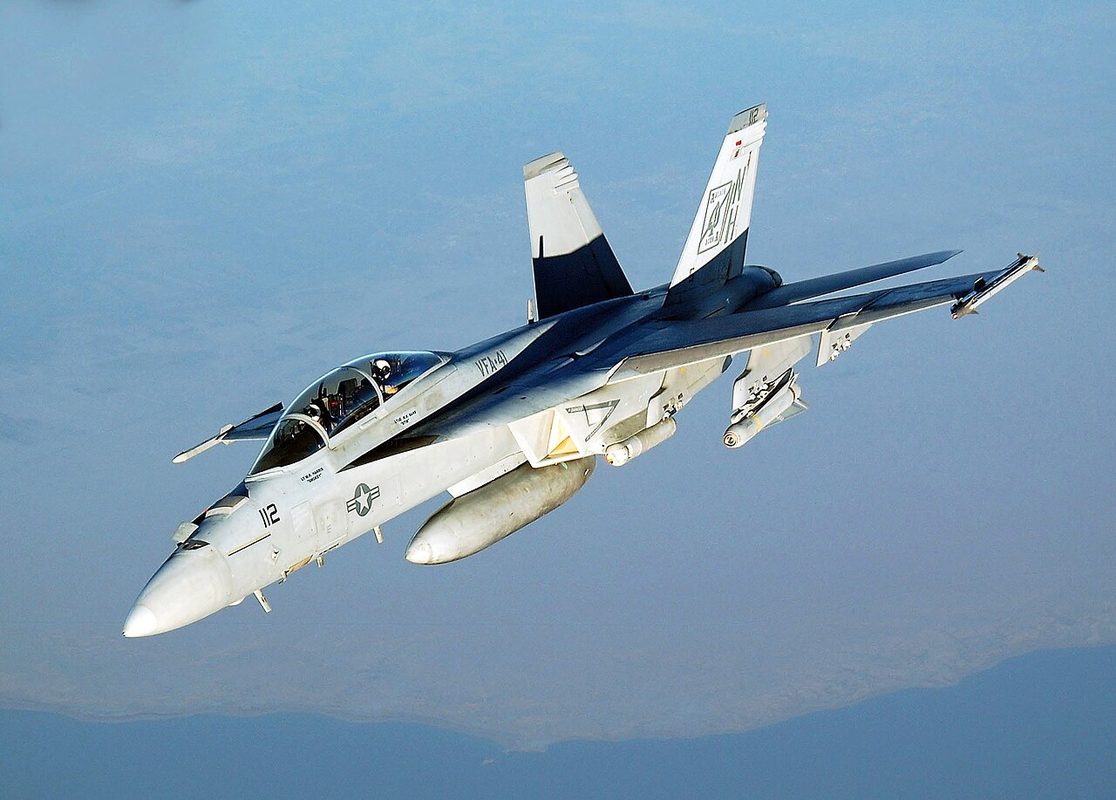
The F/A-18E/F Super Hornet fleet is being equipped with the IRST21 sensor pod, giving the U.S. Navy a passive detection capability against stealth threats for the first time.
IRST21 (F/A-18E/F Super Hornet). The U.S. Navy's IRST21, manufactured by Lockheed Martin, is mounted in a modified centerline fuel tank pod on the Super Hornet. This approach sacrifices a fuel station but allows the system to be added to existing aircraft without structural modification. IRST21 uses a large-aperture MWIR sensor with advanced signal processing to detect and track targets at extended range. Crucially, it is designed to operate in a networked environment, sharing track data with other aircraft via Link 16 and the Navy's Cooperative Engagement Capability. A formation of Super Hornets with IRST21 can triangulate target positions by correlating angle-only tracks from multiple bearings, solving the range problem geometrically rather than with active sensors.
Legion Pod (F-15/F-16). Lockheed Martin's Legion Pod is the U.S. Air Force's equivalent of the Navy's IRST21, a podded IRST system that can be mounted on existing fighters without structural changes. The pod contains the same IRST21 sensor along with an advanced electronic warfare suite. It has been integrated on the F-15C/E and F-16, giving the Air Force a passive detection capability on aircraft that were never designed to carry IRST. The Legion Pod's significance is operational rather than technological: it allows legacy fighters to contribute to counter-stealth detection networks without replacing the aircraft.
The Stealth Problem
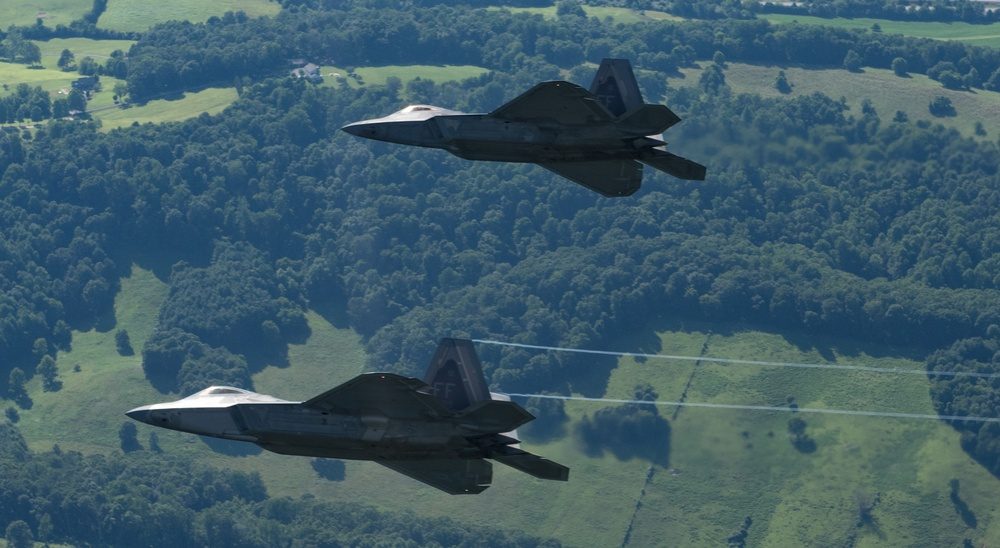
F-22 Raptors in formation flight. Despite their revolutionary radar stealth, these aircraft generate substantial infrared signatures from engine exhaust and aerodynamic heating, exactly the emissions IRST systems are designed to detect.
Stealth aircraft are engineered to minimize their radar cross-section, the amount of electromagnetic energy they reflect back to a radar receiver. The F-22 and F-35 achieve this through a combination of airframe shaping (aligning surfaces and edges to deflect radar energy away from the transmitter), radar-absorbent materials (coatings and structures that convert radar energy into heat), and internal weapons carriage (eliminating the radar returns from external pylons and munitions).
None of these techniques do anything to reduce infrared emissions. Stealth aircraft generate heat from the same sources as any other aircraft: engine combustion, exhaust gases, aerodynamic friction, and solar heating of the airframe. A jet engine burning hydrocarbon fuel at several thousand degrees produces an exhaust plume that is intensely bright in the infrared spectrum. The exhaust nozzle and the surrounding structure radiate heat that can be detected at considerable range by a sufficiently sensitive sensor.
Modern stealth aircraft incorporate some infrared signature reduction measures. The F-22's two-dimensional vectoring nozzles partially shield the turbine face from below. The F-35's nozzle design mixes cooler bypass air with the hot exhaust to reduce plume temperature. Both aircraft use coatings that reduce infrared emissivity on certain surfaces. But these measures reduce the infrared signature by factors of two or three, useful for reducing detection range, but nowhere near the orders-of-magnitude reduction achieved in the radar spectrum.
This asymmetry is fundamental. Radar stealth achieves RCS reductions of 1,000 to 10,000 times compared to conventional aircraft. Infrared signature reduction achieves reductions of 2 to 5 times. An IRST system does not need to be as sensitive as a radar to detect a stealth aircraft, it just needs to be sensitive enough to see a target that is only modestly less visible in infrared than a conventional fighter.
Angle-Only: The Strength and the Limitation
The angle-only nature of IRST tracking is simultaneously its greatest strength and its greatest limitation.
The strength is passivity. An IRST system emits nothing. It does not broadcast its presence. It cannot be detected, jammed, or deceived by electronic warfare systems designed to counter radar. A fighter aircraft with its radar off and its IRST on is electromagnetically silent, invisible to radar warning receivers, immune to anti-radiation missiles, and undetectable by the target it is tracking. In an era when stealth aircraft carry radar warning receivers that alert them to radar illumination, the ability to search for targets without emitting anything is enormously valuable.
One meter wingspan when completed. 577 parts rendering every turret, bomb bay, crew position, and defensive gun station of the B-17G. This is the kit that serious bomber builders plan their year around.
The limitation is that angle-only tracks cannot directly support weapons employment. To fire a missile, the launching aircraft needs to know the target's range, not just its direction. Without range, you cannot compute an intercept geometry, set a missile's terminal guidance parameters, or determine whether the target is within weapons employment zone. An IRST track tells you where to look. It does not tell you where to shoot.
There are several solutions to this problem, and they define the current state of the art in IRST-based combat.
Laser ranging. Systems like the Rafale's OSF and the Su-35's OLS-35 include integrated laser rangefinders that can measure distance to a target once it has been detected by the infrared sensor. This provides a complete fire-control solution from a single platform. The drawback is that the laser itself is detectable, it is an active emission that can be picked up by laser warning receivers, compromising the passive advantage of IRST.
Triangulation. Multiple aircraft with IRST sensors can share their angle-only tracks via datalink and compute target range geometrically. If two fighters separated by 50 kilometers both track the same target, the intersection of their bearing lines provides a position fix. This is the approach favored by the U.S. Navy's IRST21 system and is one of the reasons the Navy places such emphasis on networked operations. The triangulation approach preserves passivity, no aircraft needs to emit anything, but it requires cooperative engagement and sufficient platform separation.
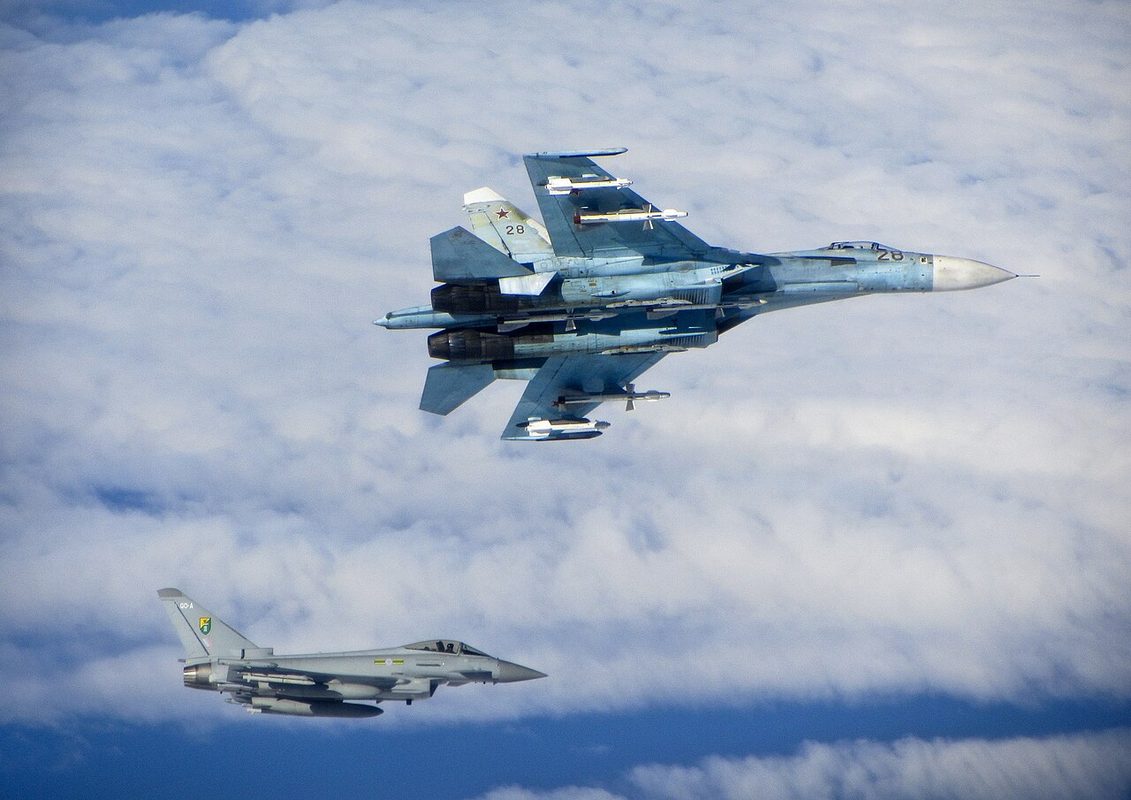
A Russian Su-27 Flanker intercepted by an RAF Typhoon, both aircraft carry IRST systems. The Flanker family pioneered the integration of infrared search and track on combat aircraft, and every variant since the original Su-27 has carried a passive infrared sensor.
Track refinement over time. Extended observation of an angle-only track allows sophisticated algorithms to estimate range based on the target's angular rate of change and signal intensity variation. A target that is approaching will show increasing angular rate and intensity; a target moving laterally will show high angular rate but constant intensity. Advanced IRST processing can derive approximate range estimates from these dynamics, particularly when combined with knowledge of typical aircraft performance envelopes. These estimates are less precise than radar ranging but can be sufficient for medium-range missile employment.
The 2026 Threat Landscape
The proliferation of IRST systems changes the calculus of stealth in several important ways.
First, it complicates the assumption that stealth aircraft can operate with impunity inside defended airspace. A stealth aircraft approaching an adversary equipped with modern IRST may avoid radar detection but be tracked passively at significant range, potentially far enough for the defender to vector fighters or cue surface-to-air missile systems using the IRST bearing data combined with other sensor inputs.
Second, IRST creates a detection layer that electronic warfare cannot suppress. Radar jammers, chaff, and decoys have no effect on infrared sensors. Digital radio frequency memory (DRFM) jammers, the sophisticated systems that create false radar targets, are useless against a sensor that operates in an entirely different part of the electromagnetic spectrum. The only way to defeat IRST is to reduce the aircraft's infrared signature below the sensor's detection threshold, and as discussed, current stealth aircraft achieve only modest IR reductions.
Third, the networking of IRST sensors across multiple platforms creates a distributed detection architecture that is fundamentally different from the radar-centric approach. A traditional integrated air defense system relies on a small number of powerful radars whose positions are known and whose emissions can be targeted. A network of fighter-borne IRST sensors is mobile, passive, and individually expendable. Destroying one element does not compromise the network. Jamming is not possible. The only counter is to stay out of detection range entirely, which, against cryogenically cooled detectors operating against the cold sky background, may require infrared signature levels that no current aircraft achieves.
The Future of Passive Detection
IRST technology is still improving rapidly. Current-generation detectors use indium antimonide (InSb) or mercury-cadmium-telluride (MCT) focal plane arrays with pixel counts in the millions. Next-generation systems are moving to Type-II superlattice detectors that offer comparable sensitivity at higher operating temperatures, potentially eliminating the need for cryogenic cooling and dramatically reducing system cost and maintenance burden.
Quantum-well infrared photodetectors (QWIPs) and barrier detectors are maturing as well, offering multi-spectral capability, the ability to simultaneously image in multiple infrared bands, which further improves target discrimination and reduces false alarm rates. Multi-spectral IRST can distinguish between an aircraft's engine exhaust (dominated by CO2 and water vapor emission lines) and background clutter (solar-heated terrain, cloud edges) with much higher confidence than single-band systems.
Processing power is the other transformation. Modern IRST systems process millions of pixels at video frame rates, applying machine learning algorithms to automatically classify targets, reject false alarms, and correlate tracks across multiple sensor heads. The processing is already sophisticated enough to distinguish between different aircraft types based on their infrared signature profiles, identifying not just "there is an aircraft" but "there is an F-22" or "there is a Su-57" based on the spatial and spectral characteristics of the heat source.
Stealth aircraft are not obsolete. Radar stealth remains enormously valuable in combat, and no IRST system in operational service provides the tracking precision needed to replace radar for long-range missile guidance. But the era in which stealth conferred something close to invisibility is ending. IRST ensures that stealth aircraft can be seen. The remaining question, whether they can be seen well enough, at long enough range, to be killed, is the one that will define air combat for the next generation.
The heat cannot be hidden. The only question is how well it can be measured.