Michael Trent covers military aircraft, weapons systems, and defense technology with an emphasis on cost, maintenance, and real-world performance. He focuses less on specifications and more on how systems hold up once they are deployed, maintained, and operated at scale.
The pilot has three seconds. A missile approach warning system screams to life. The cockpit fills with audio tones. Somewhere behind and below, a surface-to-air missile is climbing toward the aircraft at Mach 3. In three seconds, the engagement will be over. The countermeasures either work, or the aircraft becomes wreckage. There is no middle ground.
Aircraft countermeasures represent one of the most consequential technologies in modern warfare, yet they remain poorly understood outside the cockpit. The public imagines flares as a simple distraction, bright objects that lure a missile away. The reality is far more complex. Modern countermeasure systems must defeat missiles that see in multiple wavelengths, resist jamming, and use imaging seekers that can distinguish a real engine from a decoy. The battle between missiles and countermeasures is an arms race measured in microseconds, and the technology that protects aircrew today bears almost no resemblance to what protected them a decade ago.
Understanding how these systems work, and how they fail, reveals why the aircraft survivability equation keeps getting harder.
The Threat: What Countermeasures Must Defeat
Every countermeasure exists to defeat a specific type of missile guidance. The two primary categories are radar-guided and infrared-guided missiles, and each requires a fundamentally different defensive response.
Radar-guided missiles, sometimes called semi-active or active radar homing missiles, track aircraft by following radar energy. Semi-active types ride a beam from the launching platform's radar. Active types carry their own radar transmitter in the nose. Either way, the missile sees the aircraft as a radar return, a reflection of electromagnetic energy bouncing off metal.
Infrared-guided missiles, commonly called heat-seekers, track the thermal signature of an aircraft. Early versions locked onto the hottest point, typically the engine exhaust. Modern imaging infrared seekers build a thermal picture of the entire aircraft, tracking shape as well as heat. This distinction matters enormously for countermeasure design.
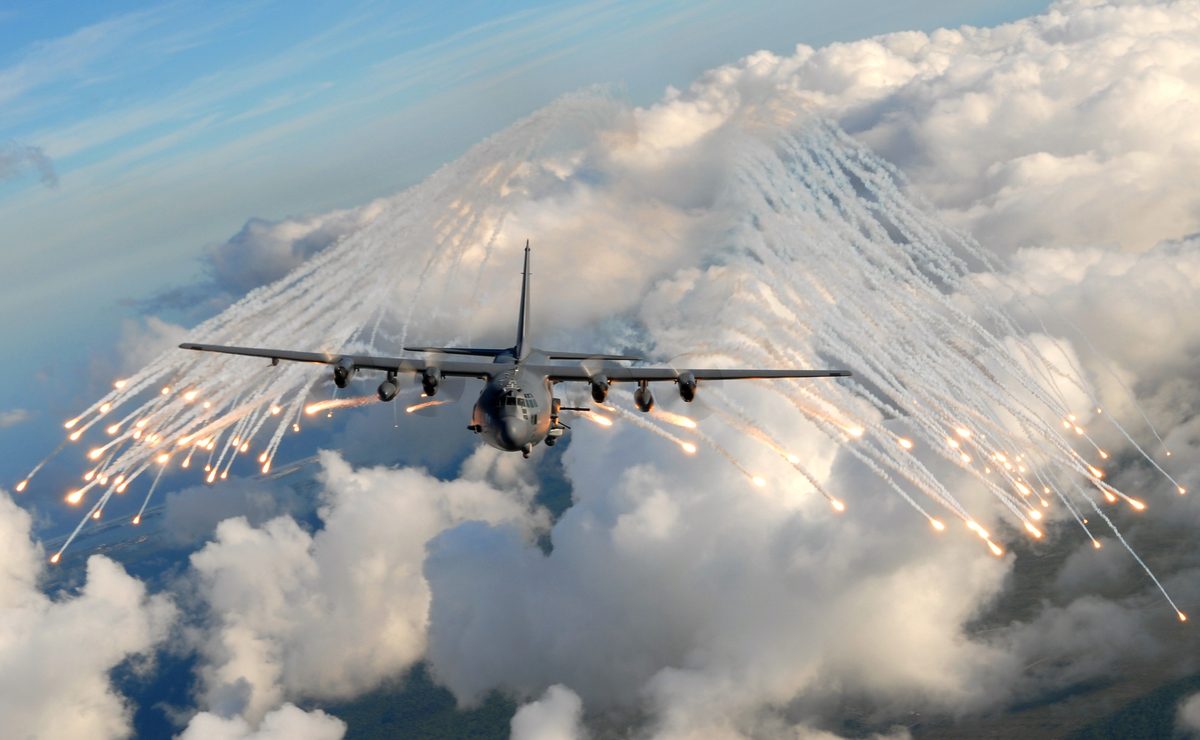
An AC-130H/U gunship jettisons flares as infrared countermeasures during a training mission near Hurlburt Field, Florida. Large aircraft like the AC-130 present significant thermal signatures, making robust countermeasure systems essential for survivability. (Photo: U.S. Air Force / Senior Airman Julianne Showalter)
Chaff: Fooling Radar With Aluminum Confetti
Chaff is the oldest airborne countermeasure still in widespread use. The concept dates to World War II, when RAF bombers dropped strips of aluminum foil, codenamed "Window," to overwhelm German radar. The physics have not changed. Thin metallic strips cut to specific lengths resonate at the frequencies used by enemy radar, creating a cloud of false returns that can mask the aircraft or present a competing target.
Modern chaff cartridges are fired from dispensers mounted on the aircraft, typically the AN/ALE-47 Countermeasures Dispenser System used across dozens of American military platforms. Each cartridge contains thousands of aluminum-coated glass fibers. When dispensed, the fibers bloom into a cloud that produces a radar cross-section comparable to or larger than the aircraft itself. The cloud hangs in the air while the aircraft maneuvers away, and the radar-guided missile, if it takes the bait, steers into the chaff cloud instead of the aircraft.
Chaff works best against older radar seekers that cannot distinguish between a moving aircraft and a stationary chaff cloud. Modern pulse-Doppler radars can filter out stationary objects by measuring Doppler shift, which is why chaff is rarely effective on its own against contemporary threats. It remains useful as part of a layered response, deployed in combination with electronic jamming and evasive maneuvers, but no pilot relies on chaff alone against a modern missile.
Flares: Burning Bright to Blind Heat-Seekers
Infrared flares are the most visually dramatic countermeasure. A standard flare is a pyrotechnic composition, usually magnesium and Teflon bonded with Viton, that burns at temperatures exceeding 2,000 degrees Fahrenheit. When ejected from the aircraft, a flare creates a heat source that rivals or exceeds the thermal signature of the aircraft's engine exhaust. An infrared-guided missile sees the flare as a hotter target and steers toward it, allowing the aircraft to escape.
The AN/ALE-47 dispenser can carry a mix of flares and chaff cartridges and can be programmed for specific threat scenarios. In automatic mode, the system receives threat data from the aircraft's missile approach warning system and dispenses the appropriate countermeasure without pilot input. The entire sequence, from detection to dispensing, can occur in under two seconds.
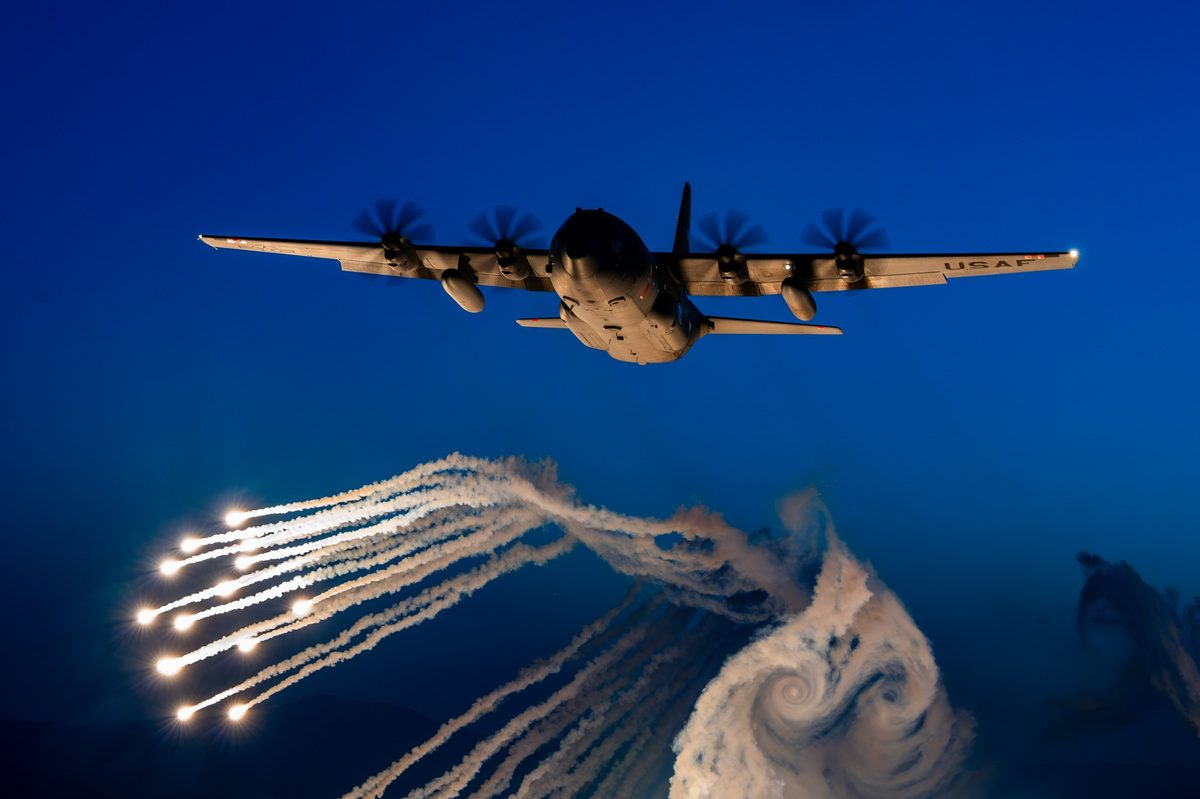
A C-130 Hercules from the 153rd Airlift Wing, Wyoming Air National Guard, deploys infrared countermeasure flares over Camp Guernsey Joint Training Center during a training mission, May 2024. The intense burning of magnesium-based flares creates thermal signatures that compete with the aircraft's engines. (Photo: U.S. Air National Guard / Senior Airman Zachary Herold)
But traditional flares face a growing problem. Early infrared seekers used a spinning reticle that tracked the single brightest point in their field of view. A flare hotter than the engine would reliably seduce these seekers. Modern imaging infrared seekers, however, do not simply track the brightest spot. They build a two-dimensional thermal image of the target, recognizing its shape, size, and thermal distribution. When an IIR seeker sees a flare separate from the aircraft, it can identify the flare as a point source and continue tracking the spatially larger aircraft signature. This is why imaging IR seekers have made traditional flares increasingly unreliable against advanced threats.
The countermeasure community responded with multi-spectral decoys. These are advanced flares that replicate not just the temperature but the spectral characteristics of an aircraft's exhaust across multiple infrared bands. Some incorporate kinematic features, burning in patterns that mimic an aircraft's movement. Others use chemiluminescent materials that produce a more diffuse, aircraft-like thermal signature rather than a single bright point. The goal is to present the imaging seeker with something that looks like an aircraft, not a burning lump of magnesium.
DIRCM: The Laser That Blinds Missiles
Directed Infrared Countermeasures represent the most significant leap in aircraft self-protection since the invention of chaff. Instead of deploying expendable decoys, DIRCM systems use a focused laser beam to overwhelm and defeat a missile's infrared seeker directly.
The principle is straightforward in concept but extraordinarily difficult in execution. When a missile approach warning system detects a launch, the DIRCM turret slews toward the incoming threat and fires a modulated laser beam at the missile's seeker head. The laser energy saturates the seeker's detector elements, effectively blinding it. More sophisticated DIRCM systems use coded modulations that feed false guidance signals into the seeker, causing the missile to steer away from the aircraft.
The U.S. military's primary DIRCM system for large aircraft is the Large Aircraft Infrared Countermeasures system, or LAIRCM. Developed by Northrop Grumman, LAIRCM integrates a missile warning sensor with a pointer-tracker turret that directs a laser beam onto the incoming missile. The system operates automatically. The missile warning sensor detects the ultraviolet signature of a missile's rocket motor, classifies the threat, and hands off targeting data to the DIRCM turret. The entire engagement takes place without crew intervention.
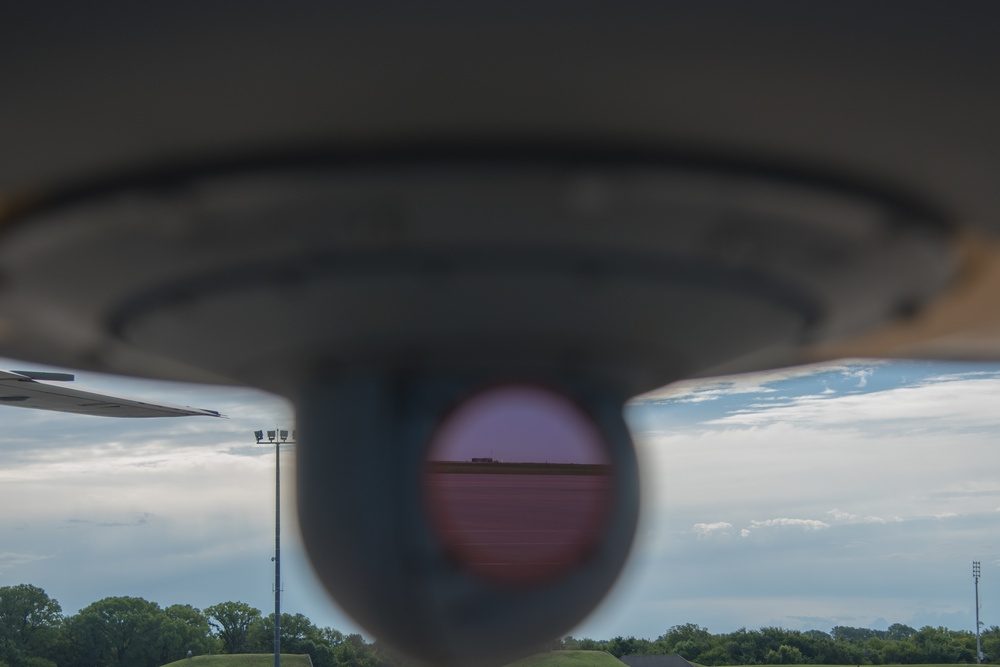
The Large Aircraft Infrared Countermeasures (LAIRCM) system undergoes testing on the KC-46A Pegasus aerial refueling aircraft. The system uses a laser turret to automatically detect and defeat infrared-guided missiles without crew intervention. (Photo: U.S. Air Force)
LAIRCM is installed on C-17 Globemaster III transports, C-130 Hercules variants, and is being integrated onto the KC-46A Pegasus tanker. For fighter-sized aircraft, smaller DIRCM systems are in development and deployment, including the AN/AAQ-24(V) Nemesis system used on helicopters and tiltrotor aircraft.
The advantage of DIRCM over expendable countermeasures is profound. A flare magazine holds a finite number of rounds. Once depleted, the aircraft is defenseless. DIRCM provides unlimited engagements as long as the laser has power. It works against the imaging infrared seekers that defeat traditional flares. And it eliminates the problem of flare burnout time, meaning the duration a flare must burn to cover the aircraft's escape. With DIRCM, the engagement ends the instant the laser locks onto the seeker.
Towed Decoys: A Sacrificial Target on a Wire
Towed decoys take a conceptually different approach to aircraft defense. Instead of creating a brief distraction, a towed decoy presents a persistent, credible false target that trails behind the aircraft on a fiber-optic cable.
The AN/ALE-50 towed decoy, developed by Raytheon and first deployed in 1996, was the pioneer. The expendable decoy unreels from a pod mounted on the aircraft's wing pylon and trails several hundred feet behind. It emits radio-frequency energy that creates a radar cross-section larger and more attractive than the aircraft itself. A radar-guided missile homes on the decoy instead of the aircraft. When the missile hits the decoy, the aircraft survives.
The early-war light tank that saw action before the US even entered the conflict. British forces used M3 Stuarts at Operation Crusader in November 1941, nicknaming them "Honey" for their reliability. 166 reviews at 4.7 stars.
The successor, the AN/ALE-55 Fiber-Optic Towed Decoy built by BAE Systems, is significantly more capable. The fiber-optic tether allows the aircraft's electronic warfare system to feed tailored jamming signals through the decoy. This means the decoy does not just emit generic noise. It receives the incoming missile's radar signal, processes it through the aircraft's onboard electronic warfare suite, and retransmits a specifically crafted deception signal from a point in space behind the aircraft. The missile's seeker interprets the decoy's signal as the real target because the jamming is coherent and precisely tuned.
Towed decoys proved their value in combat. During operations over Kosovo, Iraq, and Afghanistan, AN/ALE-50 decoys were credited with protecting U.S. Navy and Air Force aircraft from radar-guided surface-to-air missiles. The F/A-18 Super Hornet, F-16 Fighting Falcon, and B-1B Lancer all employed towed decoys operationally. The F-35 Lightning II integrates a towed decoy capability within its stealthy airframe, with the decoy unreeling from a conformal launcher that does not compromise the aircraft's radar cross-section.
Electronic Jamming: Corrupting the Signal
Electronic countermeasures, or ECM, attack the missile's guidance system through the electromagnetic spectrum rather than with physical decoys. Jamming can be broadly divided into two categories: noise jamming and deception jamming.
Noise jamming floods the missile's radar receiver with electromagnetic energy across a range of frequencies, drowning out the real radar return from the aircraft. The missile's seeker cannot distinguish the aircraft's reflection from the noise and loses track. Noise jamming is crude but effective against simpler seekers, particularly when the aircraft is at extended range.
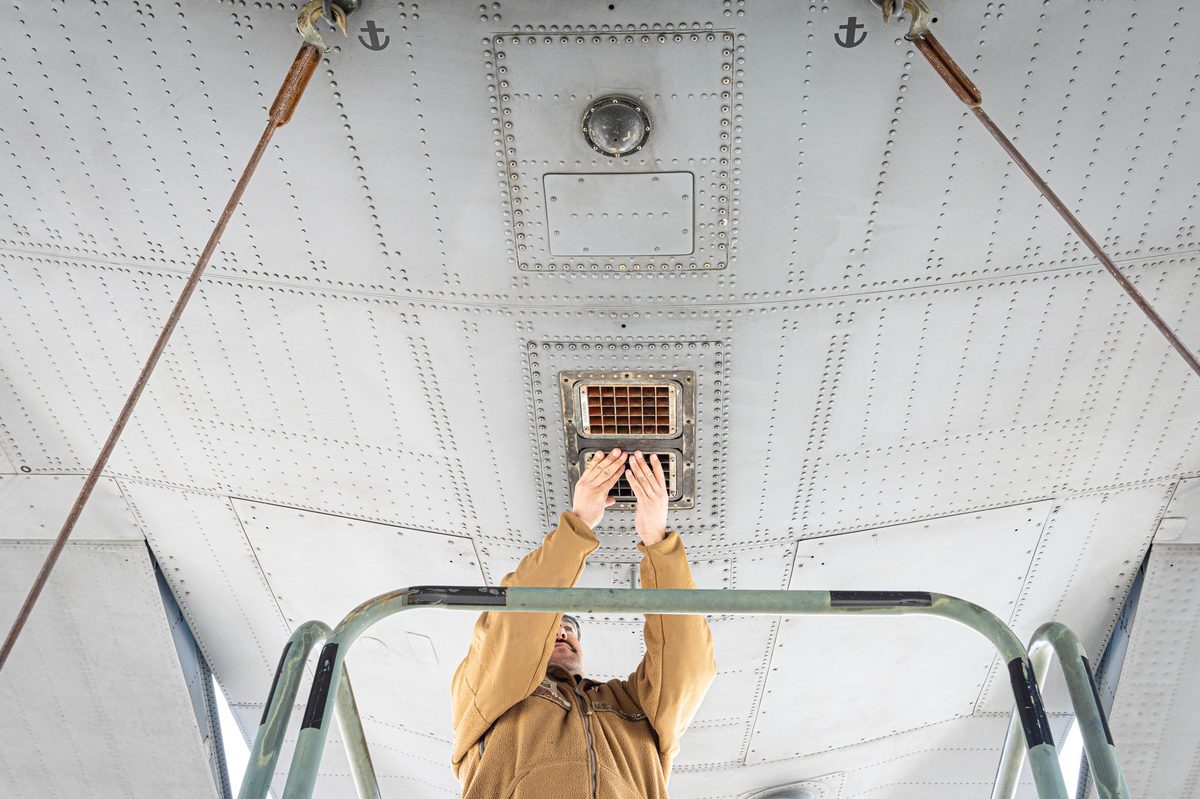
Airmen install training cartridges into the AN/ALE-47 Chaff and Flare Dispenser System aboard a C-130H Hercules during a maintenance training course at Rosecrans Air National Guard Base, Missouri. Each dispenser module can hold dozens of chaff and flare cartridges for rapid deployment. (Photo: U.S. Air National Guard / Master Sgt. Patrick Evenson)
Deception jamming is more sophisticated. Instead of flooding the spectrum with noise, the aircraft's electronic warfare system receives the missile's radar signal, modifies it, and retransmits it to create false targets or pull the missile's tracking gate away from the aircraft. Range-gate pull-off, for example, tricks the missile into thinking the aircraft is farther away than it actually is, causing the missile to fly past. Velocity-gate pull-off manipulates the Doppler return to make the missile believe the aircraft is moving at a different speed or direction.
Modern integrated electronic warfare suites, like the AN/ALQ-239 Digital Electronic Warfare System on the F-35 and the AN/ALQ-250 Eagle Passive/Active Warning Survivability System (EPAWSS) on the F-15E, combine radar warning, electronic attack, and countermeasure management into a single system. These suites can simultaneously detect, classify, and jam multiple threats across a wide frequency range while cueing expendable countermeasures for threats that electronic jamming alone cannot defeat.
The Warning: How Pilots Know a Missile Is Coming
None of these countermeasures matter if the pilot does not know a missile is inbound. Missile Approach Warning Systems are the critical first link in the survivability chain. Modern MAWS use ultraviolet or infrared sensors mounted around the aircraft to detect the bright rocket motor plume of an incoming missile. The AN/AAR-57 Common Missile Warning System, fielded across numerous U.S. military platforms, uses ultraviolet sensors to detect missile launches and provide bearing information to the crew and to automated countermeasure systems.
The F-35's Distributed Aperture System takes this concept further, using six infrared cameras distributed around the airframe to provide spherical coverage. The DAS detects missile launches, tracks incoming missiles, and can cue both pilot awareness and countermeasure response simultaneously. In an aircraft with fully integrated defensive systems, the entire sequence from missile detection to countermeasure deployment can be automated, reducing human reaction time to zero.
This automation is not optional. Against a missile traveling at Mach 3, the time from detection to impact at close range can be less than five seconds. Human reaction time, even for trained combat pilots, is approximately one to two seconds. By the time a pilot processes the warning, evaluates the threat, and manually dispenses countermeasures, the engagement window may already be closed. Automated systems compress this timeline to milliseconds.
The Arms Race: Why Countermeasures Never Stay Ahead for Long
Every countermeasure innovation drives a corresponding missile improvement. When flares defeated early infrared seekers, missile designers built two-color seekers that could discriminate between a flare's spectral signature and an engine exhaust. When chaff confused pulse radars, missile designers adopted pulse-Doppler processing with look-down/shoot-down capability. When noise jamming degraded radar seekers, missiles gained home-on-jam modes that could track the jamming source itself.
The current generation of threats poses the greatest challenge yet. Advanced imaging infrared seekers, like those on the Chinese PL-15 or Russian R-77M, can build a thermal map of the target area and reject countermeasures that do not match the expected target profile. Active radar seekers with electronic counter-countermeasures can frequency-hop to avoid jamming and use monopulse processing that is inherently resistant to deception. Some modern missiles combine radar and infrared seekers in a dual-mode configuration, forcing the defending aircraft to counter both simultaneously.
The response has been equally aggressive. Multi-spectral decoys, DIRCM lasers, cognitive electronic warfare systems that learn and adapt in real time, and the integration of all these capabilities into unified defensive suites represent the current state of the art. The F-35's approach, combining extreme low observability with advanced electronic warfare and automated countermeasures, represents the philosophy that the best countermeasure is not being seen in the first place.
But stealth is not invisibility. Even the most advanced aircraft can be detected under certain conditions, and when that happens, the three-second clock starts again. The pilot, or more accurately the aircraft's automated systems, must deploy the right countermeasure against the right threat in the right sequence. Get it wrong, and no amount of technology matters. Get it right, and the pilot never even feels the missile fly past.