David Kowalski writes about missile systems, air defense networks, and the technology behind precision strike warfare. His work examines how offensive and defensive missile capabilities shape the balance of power between nations.
Russia sells reach. America sells precision. The S-400 Triumf and MIM-104 Patriot are the two most consequential air defense systems on the planet, deployed by dozens of countries between them, and they defend against the same spectrum of threats, including ballistic missiles, cruise missiles, aircraft, and drones, using completely opposite philosophies. Understanding why these approaches differ, and what each sacrifices for its advantage, reveals something fundamental about how Russia and America think about air defense.
This is not a question of which system is "better." That framing misses the point. The S-400 and Patriot were designed to solve different problems within different military doctrines, and each does what it was designed to do. The more useful question is: what does each system actually provide, what does it cost, and what are its blind spots?
The S-400 Triumf: Layered Area Defense
The S-400, designated SA-21 Growler by NATO, entered Russian service in 2007 as a successor to the S-300PMU2. Developed by Almaz-Antey, it represents Russia's philosophy of air defense in its purest form: create a massive engagement envelope that threatens anything flying within hundreds of kilometers, layer multiple missile types to handle threats at different ranges and altitudes, and force the enemy to deal with the air defense problem before doing anything else.
The system's defining characteristic is its four-missile architecture. Each S-400 battery can fire four different interceptor types, each optimized for a different threat category:
40N6E: Maximum range of 400 km, designed to engage AWACS aircraft, tankers, and other high-value targets at extreme distance. This missile forces support aircraft to operate so far from the front lines that their effectiveness is degraded.
48N6: Range of 250 km, the primary long-range interceptor for aircraft and some ballistic missile targets. Proven lineage from the S-300 family.
9M96E2: Range of 120 km, a medium-range missile with active radar homing for engaging maneuvering targets like cruise missiles and tactical fighters.
9M96E: Range of 40 km, a shorter-range missile for point defense against low-flying threats, drones, and precision-guided munitions.
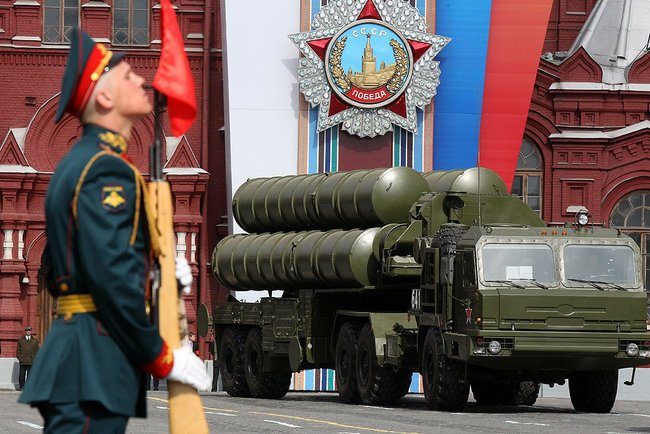
An S-400 Triumf TEL (transporter-erector-launcher) during a Victory Day parade rehearsal in Moscow. Each TEL carries four missile canisters and can be reloaded in the field. Wikimedia Commons / CC BY 3.0.
The S-400's radar suite is equally ambitious. The 91N6E "Big Bird" acquisition radar can detect targets at up to 600 km and track 300 objects simultaneously. The 92N6E "Gravestone" engagement radar provides fire-control quality tracking for guided intercepts. Together, these radars create an air surveillance picture that covers an area the size of a small European country.
A standard S-400 battalion consists of up to eight TEL (transporter-erector-launcher) vehicles, each carrying four missile canisters, plus the radar vehicles, a command post, and support equipment. A single battalion can theoretically engage 80 targets simultaneously, a capacity designed to overwhelm any plausible air attack package.
The Patriot: Point Defense With Kill Precision
The MIM-104 Patriot approaches air defense from the opposite direction. Where the S-400 tries to deny access to an entire region, the Patriot defends specific assets such as airbases, command posts, and population centers, with extreme precision at shorter ranges.
The current frontline variant, the PAC-3 MSE (Missile Segment Enhancement), represents the culmination of decades of American investment in hit-to-kill technology. Unlike the S-400's interceptors, which use proximity-fused blast-fragmentation warheads to destroy targets with a cloud of shrapnel, the PAC-3 MSE has no warhead at all. It destroys incoming threats through direct kinetic impact, hitting a bullet with a bullet, at closing speeds that can exceed Mach 10.
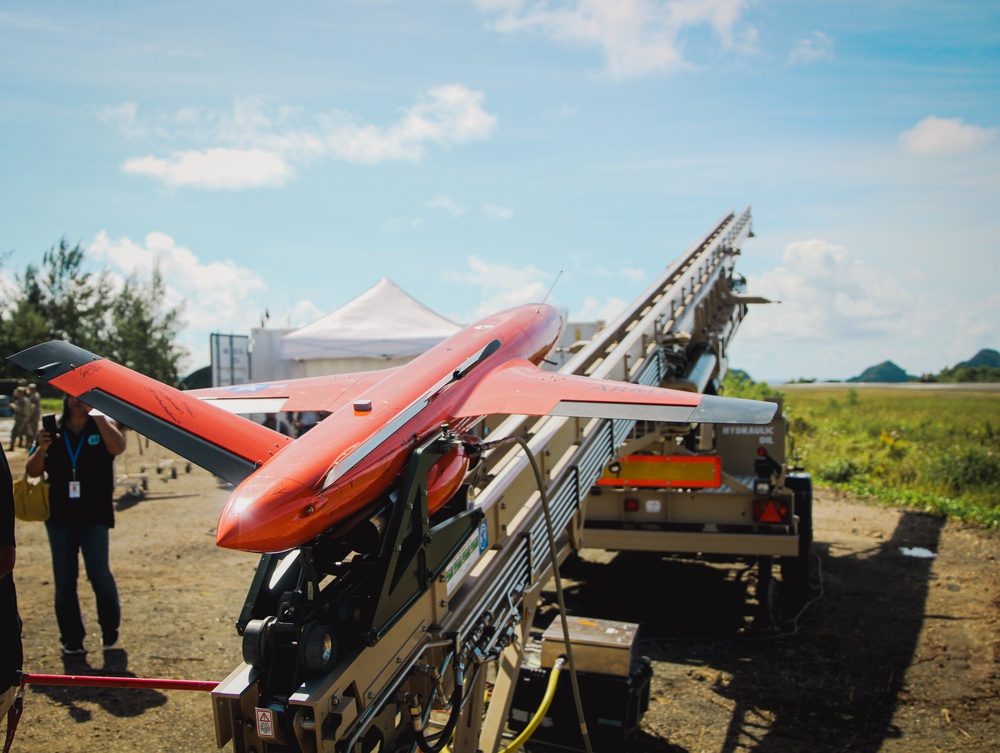
Two PAC-2 Patriot interceptor missiles launch during Valiant Shield 22 at Palau. In this test, both missiles successfully destroyed a cruise missile surrogate target at approximately 35 km range. U.S. Army photo.
This approach sacrifices range for lethality. The PAC-3 MSE's engagement envelope extends to roughly 35 km range and up to 40 km altitude, a fraction of the S-400's claimed coverage. But within that envelope, the PAC-3 MSE achieves something the S-400 cannot guarantee: near-certain destruction of the target. A blast-fragmentation warhead can damage a ballistic missile without destroying it, potentially allowing the warhead to continue on its trajectory. A kinetic kill vehicle that hits the target at Mach 5+ ensures complete destruction.
The Patriot's AN/MPQ-65A radar, an advanced electronically scanned array, provides 360-degree surveillance and can simultaneously track and engage multiple targets. While its detection range (roughly 170 km) is significantly less than the S-400's Big Bird radar, the Patriot's fire control accuracy within its engagement envelope is considered the best in the world.
These two systems reflect fundamentally different theories about how air defense should work.
Russia's approach: deterrence through denial. The S-400's 400 km engagement range means that any aircraft operating within that radius must assume it could be engaged. Even if the probability of a kill at maximum range is relatively low, the threat forces enemy air operations to stay far from the defended area. This is area denial in its purest form. You do not need to shoot down every aircraft if you can prevent them from operating effectively within your defended zone.
America's approach: precision defense of critical assets. The Patriot assumes that some threats will penetrate the outer defenses. Its job is to ensure that the threats that matter most, such as ballistic missiles aimed at airbases and cruise missiles targeting command centers, are destroyed with high confidence. The system does not try to deny an entire region. It tries to make specific targets invulnerable.
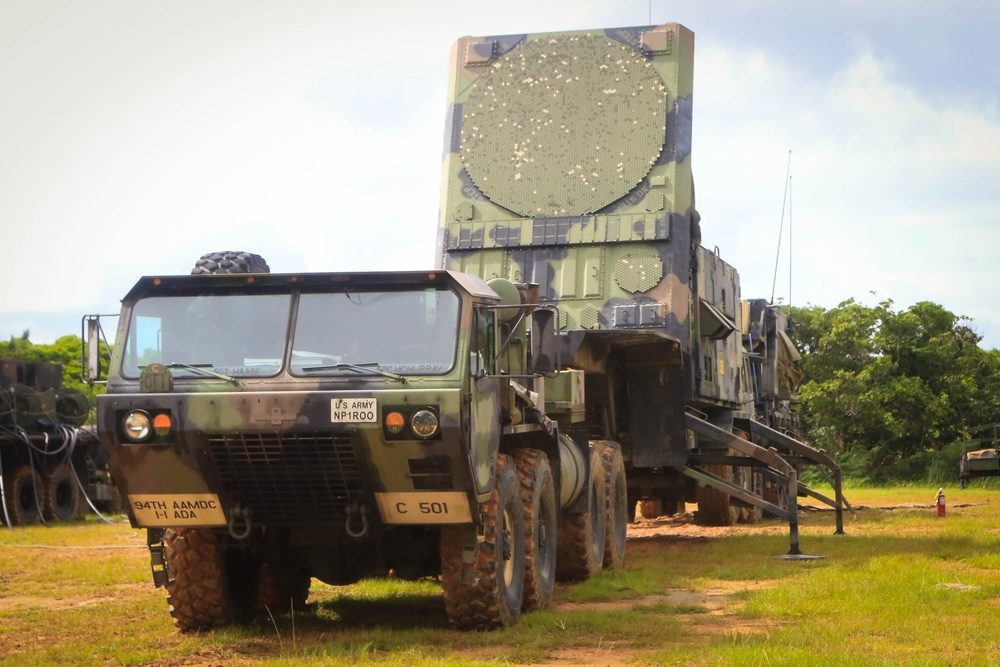
A Patriot AN/MPQ-65 radar set scans the skies during gunnery training at Kadena Air Base, Japan. The phased array radar provides simultaneous search, track, and engagement functions. U.S. Army photo.
This philosophical difference extends to how each country integrates air defense into its broader military strategy. Russian doctrine treats air defense as a standalone capability. The S-400 creates an anti-access bubble that shapes the entire battlespace. American doctrine treats air defense as one layer in a multi-domain defense architecture, where Patriot works alongside electronic warfare, offensive counter-air operations, and stealth aircraft to achieve air superiority.
Specification
S-400 Triumf
Patriot PAC-3 MSE
Maximum Range
400 km (40N6E missile)
~35 km
Maximum Altitude
30 km (185 km with 40N6E)
~40 km
Kill Mechanism
Blast-fragmentation warhead
Kinetic hit-to-kill (no warhead)
Missile Types
4 types (40N6E, 48N6, 9M96E2, 9M96E)
2 types (PAC-2 GEM-T, PAC-3 MSE)
Radar Detection Range
~600 km (91N6E)
~170 km (AN/MPQ-65A)
Simultaneous Targets
Up to 80 (per battalion)
Up to 9 (per battery)
Setup Time
~5-10 minutes (shoot-and-scoot)
~30 minutes
Operators
Russia, China, India, Turkey, others
USA, Germany, Japan, Saudi Arabia, 17+ nations
Combat Record
No confirmed peer combat engagements
Proven in 3+ wars (Iraq, Yemen, Ukraine)
Approximate Unit Cost
~$500M per battalion
~$1B per battery (with missiles)
Combat Records: One Proven, One Theoretical
The Patriot has been tested in combat repeatedly. During the 1991 Gulf War, early PAC-1 variants attempted to intercept Iraqi Scud missiles with mixed results. Subsequent analysis showed a much lower intercept rate than initially claimed. But the system has evolved dramatically since then. PAC-3 variants deployed in the 2003 Iraq invasion successfully intercepted multiple ballistic missiles. Saudi Arabia has used Patriot batteries against Houthi ballistic missiles fired from Yemen, with generally positive results.
Most significantly, Ukraine's use of donated Patriot batteries since 2023 has demonstrated the system's effectiveness against a full spectrum of Russian threats, including the Kh-47M2 Kinzhal, a hypersonic air-launched ballistic missile that Russia had previously claimed was invulnerable to Western air defenses. Ukraine's Patriot batteries have intercepted Kinzhal missiles on multiple confirmed occasions, shattering that narrative.
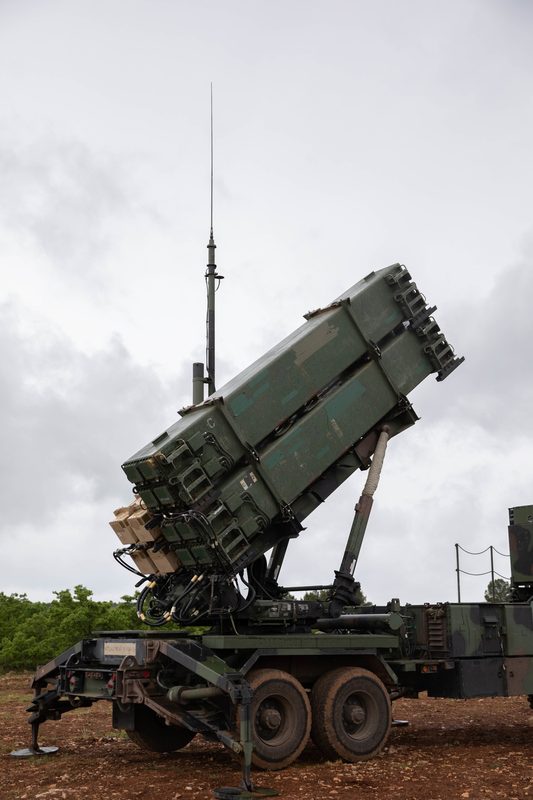
A Patriot missile system deployed during DEFENDER-Europe 21 in Zadar, Croatia. Forward deployment of Patriot batteries across NATO's eastern flank has accelerated since 2022. U.S. Army photo.
The S-400's combat record is far less clear. Russian S-400 batteries deployed to Syria's Khmeimim Air Base have been in proximity to combat operations since 2015, but their actual use against hostile targets remains disputed. Russian S-400 systems deployed in Ukraine have failed to prevent Ukrainian strikes on targets deep inside Russian territory, including strikes against the S-400 batteries themselves. Multiple units have been destroyed by Ukrainian long-range attacks.
This does not necessarily mean the S-400 is ineffective. The systems in Ukraine may have been operated poorly, positioned badly, or overwhelmed by the volume and sophistication of Ukrainian attacks using Western-supplied weapons. But the absence of a demonstrable combat record against a peer adversary remains the S-400's most significant credibility gap, particularly as Russia markets the system aggressively to export customers.
The Turkey Controversy
Turkey's 2017 decision to purchase the S-400 from Russia, with a NATO member buying its primary competitor's air defense system, triggered the most consequential defense procurement dispute in recent alliance history. The United States expelled Turkey from the F-35 program, arguing that operating the S-400 alongside F-35s would allow Russia to gather intelligence on the stealth fighter's radar signature and electronic emissions.
The dispute illuminated a reality that extends beyond the technical specifications of either system: choosing between the S-400 and the Patriot is as much a geopolitical decision as a military one. Countries that buy the S-400 gain access to an air defense system with impressive range specifications at a competitive price, but they also accept the strategic consequences of deepening a military relationship with Russia, including potential sanctions, technology transfer restrictions, and exclusion from Western defense programs.
What Each System Cannot Do
The S-400's maximum range claims, particularly the 40N6E's 400 km envelope, assume ideal conditions: high-altitude targets with large radar cross sections, no electronic jamming, and a clear line of sight. Against low-flying cruise missiles using terrain masking, the effective engagement range shrinks dramatically. Against stealth aircraft, the S-400's S-band radar can detect but may not be able to generate a fire-control quality track at meaningful range. The system's blast-fragmentation warheads may damage but not destroy hardened targets like ballistic missile warheads.
The Patriot's limitations are more straightforward. Its relatively short range means that a country defending its entire border requires many batteries. At roughly $1 billion per battery (including missiles), this is prohibitively expensive for most nations. The system's 30-minute setup time makes it vulnerable to suppression during shoot-and-scoot operations. And each PAC-3 MSE interceptor costs approximately $5.6 million. Against drone threats that cost a few thousand dollars, the economics are catastrophically unfavorable.
Both systems are evolving in ways that suggest partial convergence. Russia's S-500 Prometey adds a true anti-ballistic missile capability with hit-to-kill interceptors, borrowing from the American approach. The United States' Lower Tier Air and Missile Defense Sensor (LTAMDS) will dramatically extend the Patriot's radar coverage, and integration with longer-range interceptors could push the engagement envelope beyond current limits.
But the fundamental philosophies are unlikely to converge completely. Russia will continue to prioritize area denial systems that create massive keep-out zones. The United States will continue to invest in precision interceptors that guarantee destruction of specific threats. Both approaches have merit. Both have weaknesses. And the most sophisticated air defense architectures, like those being built in the Middle East and Asia, increasingly combine elements of both philosophies, pairing long-range area denial with short-range precision kill.
The S-400 and Patriot are not competing products in the way that consumer electronics compete. They are expressions of two different strategic traditions, each shaped by decades of operational experience and strategic culture. Russia builds air defense to deny access. America builds air defense to protect assets. Neither approach is wrong. But understanding the difference is essential for anyone evaluating what these systems can, and cannot, actually do.